

The Los Angeles, California Progressive Voter Guide for the June 2026 Primary Election by LA Forward
NOTE ABOUT THE GUIDE AND HOW WE ARRIVED AT OUR RECOMMENDATIONS
The first thing LA Forward did after we were founded in 2016 was create a voter guide. Since then, we’ve published an extensive voter guide every major election. Our local candidate endorsements are the result of a multi-step process. For all other candidates and measures, the recommendations below were written by a team of volunteers and staff. Our team consulted publicly available media coverage, candidate and organizational websites, and conducted interviews with people in our networks and on the ground to make our decisions and complete our write-ups. Candidates and ballot measure committees were not given the opportunity to donate for preferential treatment and were not shown these recommendations before they were published.
TABLE OF CONTENTS
COUNTY OF LOS ANGELES
LA COUNTY MEASURE ER
LA COUNTY SHERIFF
LA COUNTY SUPERIOR COURT JUDGES (COMING SOON)
LA COUNTY SUPERVISOR DISTRICT 1
LA COUNTY SUPERVISOR DISTRICT 3
CITY OF LOS ANGELES
LA CITY MAYOR
LA CITY ATTORNEY
LA CITY CONTROLLER
LA CITY COUNCIL DISTRICT 1
LA CITY COUNCIL DISTRICT 3
LA CITY COUNCIL DISTRICT 5
LA CITY COUNCIL DISTRICT 7
LA CITY COUNCIL DISTRICT 9
LA CITY COUNCIL DISTRICT 11
LA CITY COUNCIL DISTRICT 13
LA CITY COUNCIL DISTRICT 15
LA City Prop CB
LA City Prop TC
LA City Prop TT
ADDITIONAL CITIES
BELL
BELL GARDENS
BEVERLY HILLS
CARSON
COMMERCE
COMPTON SCHOOL DISTRICT
COVINA
GARDENA
GLENDALE
INGLEWOOD
LAKEWOOD
LA CAÑADA FLINTRIDGE
LA PUENTE
LAWNDALE
LOMITA
LONG BEACH (COMING SOON)
MONTEREY PARK
PALOS VERDES
PASADENA
POMONA
SAN MARINO
SIERRA MADRE
TORRANCE
STATE OF CALIFORNIA
GOVERNOR
LIEUTENANT GOVERNOR
CONTROLLER
TREASURER
INSURANCE COMMISSIONER
ATTORNEY GENERAL
SECRETARY OF STATE
BOARD OF EQUALIZATION
CALIFORNIA STATE LEGISLATURE
CA STATE SENATE
CA STATE ASSEMBLY

COUNTY OF LOS ANGELES
LA COUNTY MEASURE ER - RESTORE HEALTH CARE FOR LA: YES
This measure would enact a 0.5% (half‑cent) countywide sales tax for five years, raising the countywide rate from 9.75% to 10.25%, generating an estimated $1 billion annually. Because this tax is added on top of each city’s existing rate, the final combined sales‑tax rate varies by city. The revenue is intended to offset severe federal healthcare cuts and prevent major losses to LA County’s safety‑net system, including the potential closure of four public hospitals, dozens of community clinics, and widespread layoffs of healthcare workers. Funds would go into the County’s general fund, with independent audits required.
The main argument against the Measure is that LA County already has one of the highest sales tax rates among major metro regions and this measure would push it higher. Despite these concerns, the measure offers a temporary and targeted source of revenue to prevent deep and immediate harm to the county’s healthcare system and maintain essential access to healthcare for vulnerable communities.
LA County Supervisors Holly Mitchell and Hilda Solis authored the measure and it’s supported by Supervisors Lindsey Horvath and Janice Hahn, plus the Community Clinic Association of LA County; Health Justice Action Fund; St. John’s Community Health; Planned Parenthood Advocacy Project; LA County Medical Association; Service Employees International Union Local 721.
Opponents include Supervisor Kathryn Barger – the lone “no” vote on placing the measure on the ballot, the Howard Jarvis Taxpayers Association and the California Contract Cities Association. We recommend a yes vote on this temporarily revenue measure.
LA COUNTY SHERIFF: ERIC STRONG
Eric Strong was the most progressive of the candidates running in 2022 against reactionary Sheriff Alex Villanueva. Robert Luna prevailed and is Sheriff today. All three men are in the race again this election, with Luna as the incumbent. Strong hasn't assembled the same coalition this year as last time around but he’s still worth voting for to keep Villanueva out of the November general election and to send a signal that far-reaching changes are still needed in our County’s policing and jail systems.
LA COUNTY SUPERVISOR DISTRICT 1: MARIA ELENA DURAZO
Maria Elena Durazo is the clear choice for Los Angeles County Supervisor in District 1. Few candidates in local politics bring her combination of movement credibility, governing experience, and lifelong commitment to working people. We recommend voting for Maria Elena Durazo for County Supervisor, District 1.
District 1 is one of the most important seats in local government, stretching from Silver Lake and Downtown through Boyle Heights, East Los Angeles, the San Gabriel Valley, and out to Pomona, and the supervisor who represents it helps oversee a county government with a budget of nearly $50 billion. That means this office shapes health care, homelessness services, labor standards, public health, social services, jails, and the broader safety net for nearly two million residents. At a moment of budget stress driven by wildfire costs, federal cuts, and legal settlements, the county needs someone who understands both how government works and why so many residents depend on it.
Durazo has spent her entire career preparing for exactly this role. Before entering the State Senate, she led the Los Angeles County Federation of Labor and the Los Angeles chapter of UNITE HERE, helping build one of the most powerful labor movements in the country and winning real gains for low-wage workers. In Sacramento, she has continued that work by championing measures to raise wages for health care workers, expand Medi-Cal access, and improve pay for workers with disabilities. She is also endorsed by the Los Angeles County Democratic Party, the LA County Federation of Labor, and supporters including Hilda Solis, which says a great deal about the coalition she has built and the trust she has earned.
Durazo’s politics fit this district. She speaks plainly about economic justice, about using county contracts to support employers that create living-wage jobs, and about making government deliver for ordinary people instead of well-connected insiders. In a county where too much power is concentrated in a tiny circle of officials and institutions, that matters. District 1 does not need a technocrat or an empty reformer; it needs a seasoned organizer who understands that county government can be a force for dignity, economic security, and racial justice. Durazo is that candidate.
LA COUNTY SUPERVISOR DISTRICT 3: LINDSEY HORVATH
Supervisor Lindsey Horvath won election in 2022 by defeating political heavyweight Bob Hertzberg and quickly went about making her mark on the County Board of Supervisors. She’s generally progressive and her boldness is often appreciated, especially on protections for tenants and immigrants. Her tendency to get into social media spats with Mayor Bass is less impressive and seems unnecessary. The fact that she was prepared to back Rick Caruso for Mayor against Bass is concerning too. Her effort to overhaul County governance with Measure G in 2024 had a lot of good ideas, but it was so rushed that even reform-minded community groups didn’t have a chance to give meaningful input before it was advanced to the ballot. She also drove the County’s decision to pull its funds from LAHSA, the joint LACity/LA County homelessness agency.
We appreciate her support for renters, workers, immigrants and the environment and her sense of urgency too and would hope that in her second term, she learns from some of the missteps (see Measure J’s accidental overturning) of her first term.
Horvath faces no real opposition and we recommend her for another term.
CITY OF LOS ANGELES
LA CITY MAYOR: NO ENDORSEMENT
By national standards, there are three progressives among the leading candidates for Mayor – incumbent Karen Bass, Councilwoman Nithya Raman, and housing coalition organizer Rev. Rae Huang.
This race is about which strand of progressivism resonates with you and who you think is best equipped to manage a massive city government. LA Forward has members who support all three candidates, although our endorsement process (which didn’t produce an official choice) and internal surveys have shown the large majority support either Raman or Huang.
We encourage to you listen to Mike Bonin’s interviews with all the candidates and make up your own mind. (Mayor Karen Bass, Councilmember Nithya Raman, Reverend Rae Huang, plus businessman Adam Miller who’s eschewing the progressive label entirely).
Among popular lefty voter guides, DSA LA recommends Raman while KNOCK is supporting Huang.
Whatever you do, don’t vote for rightwing reality star Spencer Pratt and don’t let your friends vote for him either. We can’t take a chance of him making it into the runoff.
As of May 13, public polling show “Bass leading the field in her re-election bid with 30% support, followed by reality television star Spencer Pratt at 22% and Councilwoman Nithya Raman with 19%. Entrepreneur Adam Miller, at 7%, and housing advocate Rae Huang, at 4%, round out the field, while 16% of voters remain undecided.”
LA CITY ATTORNEY: MARISSA ROY
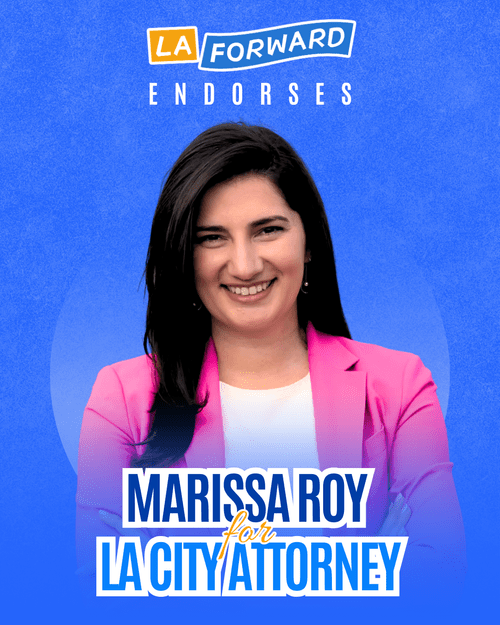
In the race for LA City Attorney, voters have one of the easiest choices on the ballot. Marissa Roy is the best choice for LA City Attorney. After a disastrous four years of incumbent Hydee Feldstein Soto, Roy promises to make the office of City Attorney a true public interest law firm that protects workers, tenants, immigrants, and communities from corporate abuse — not a rubber stamp for the powerful. We strongly endorse Marissa Roy for LA City Attorney.
The City Attorney is LA’s lawyer: they advise the mayor and City Council, prosecute misdemeanors, and decide how aggressively the city takes on wage theft, illegal evictions, consumer fraud, and environmental harms. In practice, that means the City Attorney can either use the law to hold slumlords, union‑busting employers, polluters, and abusive police accountable—or duck those fights and leave communities on their own.
Recent years have shown how much damage a cautious, corporate‑friendly City Attorney can do, from weak enforcement against bad landlords to settlements that protect city departments more than residents. A progressive, movement‑aligned City Attorney can instead shift the office toward impact litigation, civil rights enforcement, and real accountability for abuses that fuel homelessness, displacement, and distrust.
Marissa Roy is a lifelong Angeleno who decided to go into public service when Proposition 8 stripped marriage equality from LGBTQ Californians, including her younger brother. She began her legal career in the LA City Attorney’s Office, bringing major workers’ rights cases to protect people from wage theft and other exploitation. Roy later served as outside counsel for Los Angeles County, where she joined legal actions against the Trump administration to defend sanctuary policies, DACA recipients, students, and immigrants seeking asylum. Today she is a Deputy Attorney General in the California Department of Justice, suing large tech companies over practices that threaten public health and safety and standing up for tenants who are wrongfully evicted and consumers who are defrauded.
Roy is explicit: she is running to transform the City Attorney’s Office into the largest public interest law firm in Los Angeles. Her agenda includes:
Protecting workers and tenants by aggressively enforcing wage and hour laws, cracking down on wage theft, and defending renters from illegal evictions and abusive landlord practices.
Taking on corporate and tech abuse by scaling up impact litigation against corporations engaged in unlawful, unfair, or deceptive conduct that harms Angelenos.
Making civil rights and immigrants’ rights central to the office’s mandate, including pushing back on racial profiling, unconstitutional policing, and ongoing attacks from the Trump administration.
Pursuing smart public safety by prioritizing strategies that actually make communities safer—diversion, prevention, accountability—rather than reflexive criminalization that feeds mass incarceration.
Unlike Feldstein Soto, Roy’s entire career has been about using the law as a tool for economic and social justice, not as a shield for powerful institutions.
Incumbent Feldstein Soto has made clear who she believes her client is—and it’s not the tenants facing illegal evictions, the workers facing wage theft, or the communities living with the fallout of LAPD abuse. Her tenure has been defined by caution, deference to the political establishment, and a willingness to use the office’s power to shield the city from accountability rather than to protect residents.
Feldstein Soto has repeatedly taken the side of the bureaucracy over the public. She has used the office to defend city departments against lawsuits over police misconduct, environmental harms, and other abuses, focusing more on limiting liability than on using the law to change harmful practices. That “protect the institution at all costs” posture helps keep payouts down in the short term, but it leaves systemic problems untouched and residents unprotected.
Feldstein Soto has not used the enormous civil power of the City Attorney’s Office to meet the crises Los Angeles is facing. At a time when tenants are being pushed out of their homes by illegal evictions and harassment, wage theft remains rampant, and corporate landlords and employers treat fines as a cost of doing business, we have not seen a clear, aggressive strategy from her office to make examples of the worst actors. When the city desperately needs high‑impact lawsuits against slumlords, wage thieves, and corporate fraudsters, Feldstein Soto has given us tinkering around the edges.
On public safety, Feldstein Soto is stuck in an old, failed paradigm. Instead of centering strategies that reduce harm—like diverting low‑level offenses out of the criminal system, refusing to criminalize poverty, and holding police accountable—she has oriented the office toward protecting traditional prosecutorial tools and preserving the status quo. That approach does little to make communities safer, but it does feed the machinery of misdemeanors, warrants, and criminal records that keep people trapped in cycles of homelessness and incarceration.
Feldstein Soto also represents a broader political trend in LA: candidates who campaign as pragmatic reformers and then govern as reliable allies of the downtown establishment. When real estate, police unions, and corporate interests need a lawyer who won’t rock the boat, she has been there. When workers, tenants, immigrants, and over‑policed communities need a champion willing to test the limits of the office on their behalf, she has been missing.
Los Angeles cannot afford another four years of a City Attorney who treats the job as risk management for the powerful. The crises of rent gouging, wage theft, environmental injustice, and police abuse demand someone willing to put the public interest ahead of City Hall insider comfort. Hydee Feldstein Soto has shown that she is not that person.
In addition to Feldstein Soto, the race includes John McKinney and Aida Ashouri. McKinney, a deputy district attorney, comes from a traditional “tough on crime” background and has run on a more carceral, prosecutor‑first approach that would deepen the very problems progressives are trying to undo. He’s been backed by the police union and Republican DA Nathan Hochman and a whopping $1.5 million of outside spending from Airbnb. Ashouri has a patchy resume and few endorsements from progressives groups who are almost uniformly behind Roy, except for the Peace and Freedom Party.
Roy stands alone as the candidate who is both rooted in Los Angeles and clearly committed to turning the office loose on wage thieves, slumlords, polluters, and abusive corporations—and to reorienting the City Attorney’s work around workers, tenants, and over‑policed communities instead of City Hall insiders.
LA CITY CONTROLLER: KENNETH MEJIA
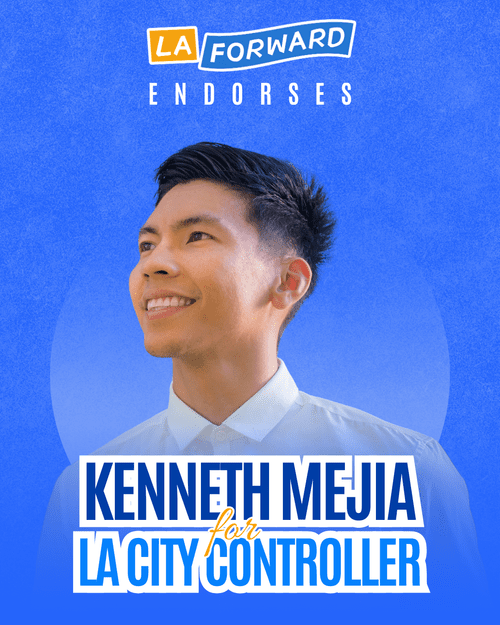
City Controller Kenneth Mejia has redefined what transparent and accountable city government can look like. Since taking office, he has been an invaluable partner in advancing our shared priorities by breaking down complex data into accessible public-facing visuals. His office’s audits and reporting have brought long-standing problems into public view, including (amongst many other issues) problems with the city’s Mental Evaluation Unit and Systemwide Mental Assessment Response Team (SMART) program and the need for LA’s climate plan to get a desperately needed reboot, as reported in his “This is Not Fine” report. Kenneth is not a career politician. He is an accountant, and a brave one. He has shown a rare willingness to tell the truth about how the city functions, even when it ruffles feathers among other elected officials. By making complex information clear and easy for Angelenos to understand, he is giving residents the power to hold their government accountable. Kenneth Mejia is delivering the transparency and honesty Los Angeles deserves.
LA CITY COUNCIL DISTRICT 1: EUNISSES HERNANDEZ
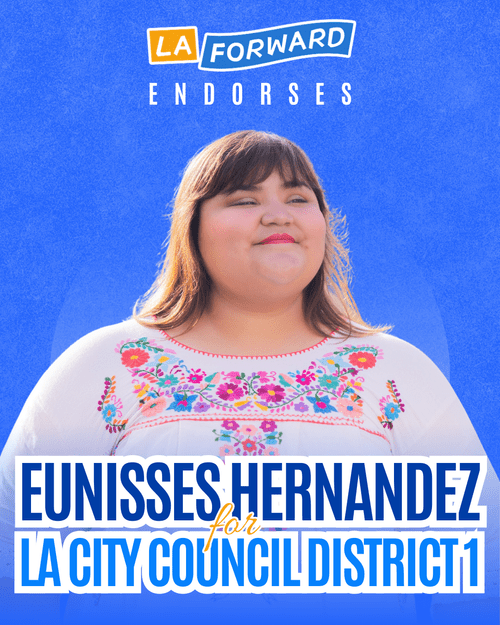
LA Forward is proud to endorse Councilmember Eunisses Hernandez for re-election to a second term. In the face of intense political pressure and right-wing attacks, she has stood firmly with working families, tenants, and immigrants.
She has been our key partner in advancing unarmed crisis response, pushing Los Angeles toward 40% coverage of the Unarmed Models of Crisis Response program and closer to community safety that works for all Angelenos. In her first term, Eunisses brought courageous leadership to city budgeting – voting “no” on her first budget and in 2025 helping craft a significantly improved one as a member of the Budget & Finance Committee. She has been a steadfast defender of Measure ULA, outspoken against Trump’s immigration raids, and consistently pushed for investments that prioritize care over punishment.
Eunisses is exactly the kind of bold, values-driven leader Los Angeles needs to keep in office.
LA CITY COUNCIL DISTRICT 3: BARRI WORTH GIRVAN
Councilmember Bob Blumenfield is termed out and so the southwest corner of the Valley has the first open race in more than a dozen years. The two main candidates are Barri Worth Girvan who has extensive labor and Democratic club support, and Tim Gaspar who has business backing and support from incumbent Councilman Blumenfield. Only Barri participated in our endorsement process.
Barri has had a long career in public service, most recently serving as District Director of County Supervisor Lindsey Horvath. She had strong reputation among people who know her and of all the candidates in the race, she’s the one most likely to advance our agenda across a wide range of policy agenda from climate and environment to immigrant rights and unarmed crisis response.
Although not a movement progressive and not aligned with our entire agenda, we think we could have a strong working relationship with her office, similar to Councilwoman Katy Yaroslavsky. In contrast, Tim would add to the council’s conservative bloc and be accountable to the most rightwing forces in the city like corporate landlords and police unions. If any candidate gets above 50% in the primary, they win outright. That means no runoff election in November. With only three candidates (Tim, Barri, and a third choice who has assembled almost no support), your vote is especially important if you live in this district. So smake sure you vote for Barri.
LA CITY COUNCIL DISTRICT 5: KATY YAROSLAVSKY
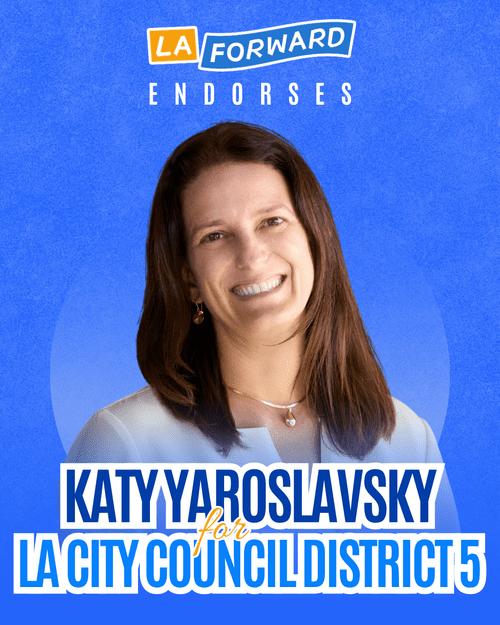
LA Forward has had a constructive relationship with Councilmember Yaroslavsky and her office since she was first elected in 2022, with our endorsement. She's been an important partner to our working groups on climate, transportation, and many others. She's been ally in our work to fund the Climate Adaptation and Action Plan (CAPP) and has shown real courage in pushing for affordable and interim housing in her district, despite very loud NIMBY opposition, and in being one of two votes on Council against the massive spending on an overhaul of convention center that's likely to deprive the city of funds to carry out basic services.
LA CITY COUNCIL DISTRICT 7: NO RECOMMENDATION
Incumbent Monica Rodriguez is running unopposed. She’s been part of the Council’s conservative bloc along with Traci Park and John Lee and has been far too deferential to the police and the police union. With no opponent, she’s a lock to win this election. She’ll hit term limits in 2030 and in the meantime, it’ll be crucial to build up a progressive base and organizing infrastructure in the Northeast Valley and recruit a strong candidate to run in that open election.
LA CITY COUNCIL DISTRICT 9: ESTUARDO MAZARIEGOS
Estuardo Mazariegos is the strongest choice in City Council District 9 for voters who want an unapologetic champion for tenants, immigrants, working families, and neighborhoods that City Hall has neglected for far too long. We recommend voting for Estuardo Mazariegos for Los Angeles City Council District 9.
Council District 9 is one of the youngest, poorest, and most heavily burdened districts in Los Angeles, stretching from the southern edge of Downtown through South Los Angeles communities that face housing insecurity, disinvestment, and environmental harms. With Curren Price termed out, this is the first open-seat race in the district since 2013, and it is a real chance to send someone to City Hall who is rooted in grassroots organizing instead of the insider culture that has repeatedly failed South L.A.
This is also a contest over what representation should look like in a district where residents are too often over-policed, under-served, and only remembered during election season. District 9 does not need another manager of decline or another politician promising ribbon cuttings while basic services fall apart; it needs a fighter.
Estuardo Mazariegos is a father, immigrant, and longtime community organizer who has spent nearly two decades working alongside low-income residents, tenants, undocumented families, and communities of color in Los Angeles. He is the co-director of ACCE Los Angeles, a grassroots organization that has been central to major fights for tenant protections, economic justice, and racial justice across the city.
Mazariegos’s story matters here because it is inseparable from the district he wants to represent. He came to the United States from Guatemala as a child, grew up in working-class neighborhoods in Los Angeles, studied labor and public administration at Cal State Dominguez Hills and Cal State L.A., and has said his family’s union jobs taught him how closely immigrant dignity is tied to worker organizing and collective power.
Unlike candidates who discover “equity” when they file paperwork for office, Mazariegos has made a career out of building power with people whom City Hall tends to ignore. That is exactly the kind of perspective District 9 needs.
Mazariegos is running on a platform centered on affordable homes, tenant protections, immigrant solidarity, and a city government that actually shows up for working people. He has pledged to expand social housing, enforce tenant protections, invest in neglected neighborhoods, and reject the influence of corporate PACs, real-estate developers, and police associations.
He has also drawn a sharp and welcome distinction on public safety. Mazariegos does not support increasing the size of LAPD, and he argues that safety means safe streets, functioning lights, responsive services, and neighborhoods that receive public investment rather than abandonment. That is a far more honest vision than the tired City Hall script that treats policing as the answer to every social failure.
On government reform, Mazariegos has recognized something many Angelenos feel every day: trust in City Hall has collapsed. He says District 9 has the lowest voter turnout in the city, links that disengagement to unanswered 311 calls and broken basic services, and supports ethics reforms, stronger conflict-of-interest rules, stricter outside-income disclosure, and efforts to close the revolving door between lobbyists and public office.
This is a crowded open-seat race, with at least six candidates on the ballot, including Elmer Roldan and Jose Ugarte. Roldan has a strong reputation as an organizer, and significant backing from nonprofit and civic leaders in South LA from his days working for Community Coalition. But Roldan is closely tied with Mayor Karen Bass, and the last thing the City Council needs is another Bass loyalist who won’t aggressively pull her to the left. Ugarte, on the other hand, is a City Hall insider – a staffer for Curren Price and a longtime political consultant who would be another voice for the establishment.
Mazariegos is running as an organizer, and that matters. In a district battered by displacement, speculative development, and long-term neglect, the district needs a leader who has been in the trenches fighting for renters, immigrants, and low-income families before there was a title attached. On that test, Mazariegos is the clearest progressive choice in the race.
His coalition reflects that politics. He is backed by California Working Families Party, Initiate Justice Action, EAA Union, the National Union of Healthcare Workers, the teachers union, the environmental group LA League of Conservation Voters, LGBT groups like Stonewall Democrats, Controller Kenneth Mejia, and Councilwoman Eunisses Hernandez. UTLA has described him as a community and labor organizer committed to South Central who has partnered on affordable housing issues. He is also supported by movement organizations that know firsthand that he has spent years doing the work, not just talking about it.
Mazariegos’s record is not polished for elite comfort, and that is part of why he is compelling. He has been open about being justice-impacted and has argued that this creates a deeper connection with residents whose lives are shaped by the criminal legal system rather than protected by it. In a district where too many people know what it means to be targeted, discarded, or written off, that honesty is a strength, not a liability.
LA CITY COUNCIL DISTRICT 11: FAIZAH MALIK
The Westside deserves a councilmember who will fight for families, workers, and renters. Faizah Malik is the answer for District 11.
For years, the current councilmember has stood with landlords and police – blocking affordable housing, opposing protections for tenants, pushing back against police accountability, and attacking homelessness solutions. Los Angeles can’t afford more obstruction. LA Forward member and civil rights champion Faizah Malik offers a clear and hopeful alternative.
A Southern California native, mom, and housing and community development attorney, Faizah has dedicated her career to protecting tenants and expanding affordable housing. We have worked closely with her on creating affordable housing in our neighborhoods, and have seen firsthand her intelligence, work ethic, and deep commitment to community. Faizah will bring thoughtful, justice-centered leadership to the Westside. She is exactly the advocate her district needs and LA Forward is proud to endorse her.
LA CITY COUNCIL DISTRICT 13: HUGO SOTO-MARTINEZ
Hugo Soto-Martínez deserves reelection to the Los Angeles City Council not just because he is solid on the issues, but because he has become one of the central pillars of the city’s progressive bloc. Since defeating Mitch O’Farrell in 2022, he has shown that a movement candidate can enter City Hall, survive its pressures, and still govern in a way that is recognizably rooted in labor, tenant, immigrant, and social justice politics. That balancing act is never easy for organizers who win office: they have to stay true to the communities that sent them there while working through an institution designed to dilute, delay, and domesticate bold politics. Soto-Martínez is a student of history and of leadership, and he is navigating that tension about as well as anyone could hope.
In office, Soto-Martínez has compiled a real record. He helped win the biggest expansion of renter protections in a generation, backed sanctuary city policies, supported alternatives to policing, and pushed cleaner and safer transportation and environmental justice measures. On police issues especially, he has been willing to take heat where many electeds shrink: he came into office as a vocal critic of police violence, has continued to demand meaningful accountability, and worked on efforts to strengthen LAPD discipline, including proposals that would have expanded the chief’s power to fire officers for serious misconduct. He has also never been intimidated by the police union, which spent against him when he first ran because it understood exactly what kind of voice he would be on the Council.
Just as important, Soto-Martínez has played a broader leadership role beyond his own district. He has been a backbone of the progressive bloc, helping strengthen ties between DSA-aligned progressives and organized labor, raising money to elect and reelect allies, and giving the movement an anchor inside City Hall that is strategic as well as ideological. He was also a strong and necessary voice against Kevin de León after the racist tape scandal, understanding that there are moments when “unity” is just another word for surrender.
LA CITY COUNCIL DISTRICT 15: TIM McOSKER
McOsker was first elected in 2022 after a long career in government service and has been a major upgrade from Joe Buscaino who previously represented this district that stretches from San Pedro and Wilmington all the way up to Watts. Our hopes for him weren’t high. He’d previously served as a lobbyist for the police union. We’ve been pleasantly surprised by what an improvement he was over Buscaino. His office is open to meeting and working with progressives inside and and outside City Hall and he’s even partnered with Councilmember Soto-Martinez on police accountability legislation. He’s shown an ability to change his mind, as evidenced by his support for reforming the troubled City Attorney’s office. His opponent is a lefty in his early twenties with no campaign infrastructure and some troubling press coverage. For all these reasons, we recommend you vote for Tim McOsker.
LA CITY PROP CB - Cannabis Business Tax: YES
This measure proposes to amend the municipal code to apply the City’s existing cannabis business taxes to unlicensed cannabis businesses, ensuring that illegal operators are subject to the same tax obligations as licensed businesses. The measure does not create a new tax; it simply clarifies that the current cannabis tax applies to all cannabis business activity, regardless of licensing status. This measure strengthens enforcement against unlicensed operators who undercut legal businesses, avoid taxes, and contribute to unsafe market conditions. Applying existing cannabis taxes to unlicensed operators helps stabilize a legal market that has struggled to take root in communities most harmed by past criminalization.
Unlicensed shops often cluster in low‑income neighborhoods, operate without safety standards, and undercut licensed businesses trying to comply with the law. Ensuring all operators are subject to the same tax requirements helps protect consumers, reduce harmful market disparities, and reinforce the City’s broader equity goals for cannabis regulation.
Opponents like conservative Councilmembers John Lee and Monica Rodriguez argue that applying taxes to unlicensed businesses could increase enforcement actions without addressing deeper issues in the City’s cannabis licensing system. Despite these concerns, clarifying tax obligations for all operators is a necessary step toward stabilizing the regulated market, supporting equity‑licensed businesses, and improving consumer safety. LA Forward recommends a YES vote.
LA CITY PROP TC - Expand Hotel Tax to Online Travel Companies: YES
This measure aims to amend the City’s tax code to clarify and expand the application of the 14% Transient Occupancy Tax (TOT) - the hotel tax- to include fees, goods, and services provided by online travel companies and booking platforms. The measure ensures that online platforms are taxed the same way as hotels and traditional lodging providers. This is a tax fairness and modernization measure. As more travelers book through online platforms, the City risks losing revenue unless the TOT clearly applies to these transactions. This measure closes loopholes, ensures consistent tax treatment, and protects funding for essential City services. LA Forward recommends a YES vote.
LA CITY PROP TT - Increase Hotel Tax: YES
This measure proposes to increase the local hotel and lodging tax (Transient Occupancy Tax) from 14% to 16% until 2028, after which it would decrease to 15%.
This measure would increase the City’s Transient Occupancy Tax (hotel and lodging tax) from 14% to 16% through 2028, after which the rate would decrease to 15%. The TOT is paid by visitors staying in hotels, motels, and short‑term rentals, not by residents. The increase would generate additional revenue for general City services, including public safety, homelessness response, and infrastructure.
Raising the TOT aligns Los Angeles with other major tourist destinations and ensures that visitors contribute more toward the cost of City services they rely on. Because the tax is paid by travelers rather than residents, it is one of the least burdensome revenue tools available to the City. Opponents argue that increasing the TOT could make Los Angeles less competitive for tourism and conventions, potentially reducing visitor spending and harming local hotels. They contend that higher taxes may discourage visitors from choosing Los Angeles over other destinations. Despite these concerns, Proposition TT strengthens the City’s ability to fund essential services in a way that protects residents, ensures visitors pay their fair share, and supports long‑term fiscal stability. This measure is structured so that the cost falls primarily on tourists and other non‑residents, especially those visiting for major events like the 2026 World Cup, the 2027 Super Bowl, and the 2028 Olympic Games, rather than on city residents.
Opponents include conservative councilmmembers John Lee and Monica Rodriguez along with the Howard Jarvis Taxpayers Association and the Hotel Association of Los Angeles. We recommend a Yes vote to raise much needed revenue for LA City during the Olympics and beyond.
ADDITIONAL CITIES
BELL
Measure BB - Sales Tax to Fund Public Safety and City Services: YES
Measure BB would establish a 1% local sales tax in Bell, raising the rate from 9.75% to 10.75%, generating an estimated $3.5 million annually for the city’s General Fund. These funds may be used for essential services including public safety, crime prevention, youth and after‑school programs, street and sidewalk repair, graffiti removal, park safety, and homelessness response. The measure includes annual independent audits and a resident oversight committee to ensure transparency.
City officials state that Bell faces a structural budget deficit driven by rising costs and declining utility tax revenue. Without new revenue, the city warns it may need to reduce core services. The City Council placed Measure BB on the ballot to maintain service levels and avoid cuts.
Bell currently operates below the state’s 10.25% sales‑tax cap and does not have authorization to exceed it. If Measure BB passes, Bell’s rate would rise to 10.75%, exceeding the cap and requiring state authorization to remain in place. Officials also note that if Los Angeles County enacts its own sales‑tax increase first, Bell could lose the ability to adopt a local tax at all.
Measure BB was introduced by the Bell City Council, not by outside groups, there is no special‑interest involvement found, no PAC activity, and no controversy associated with the measure. It is framed as a city‑driven fiscal stability measure intended to preserve essential services.
BELL GARDENS
Measure BG - Keep Bell Gardens Sales Tax Revenues Local Measure: YES
This measure would increase Bell Gardens’ local sales tax rate from 10.50% to 10.75%, generating approximately $1.2 million annually for general city services. These funds support essential programs such as police and emergency response, street and sidewalk repairs, park maintenance, youth and senior services, and the Community Family Service Center.
Bell Gardens is currently facing a Fiscal Emergency due to new state regulations requiring major operations at the Parkwest Bicycle Casino to cease. Because the casino is one of the City’s largest revenue sources, this ruling could reduce General Fund revenue by up to 30%, threatening the City’s ability to maintain basic services. To address the potential immediate loss in revenue from the casino, the proposed sales tax increase is intended to stabilize funding and prevent cuts to public safety, community programs, and core city operations. A significant share of Bell Gardens’ sales tax revenue comes from non‑residents who shop in the city’s commercial corridors, meaning much of the tax burden is carried by visitors rather than local households.
Bell Gardens already operates above the state’s 10.25% sales‑tax cap because state law authorizes Los Angeles County to exceed the cap. As a result, Measure BG is not restricted by the County’s Measure ER, and both measures can take effect in the city if they pass.
BEVERLY HILLS
For Beverly Hills City Council, LA Forward recommends you vote for Rebecca Pynoos. She’s not a movement progressive but as far as Beverly Hills goes, she’s a relatively liberal Democrat and that’s no small thing. She’s an urban planner by training, a transit rider, and has the backing of the environmental group LA League of Conservation Voters.
CARSON
Measure FW - Sales of Fireworks Initiative: NO
Measure FW would overturn Carson’s existing citywide ban on all fireworks, including “Safe and Sane” fireworks, and allow up to 12 temporary stands to sell Safe & Sane fireworks during limited periods around the Fourth of July. The measure would also permit their use within city limits during those same dates. Dangerous aerial and explosive fireworks would remain illegal under state law.
Carson currently enforces a zero‑tolerance fireworks policy, adopted to address ongoing fire hazards, injuries, property damage, loud noise impacts, and widespread illegal fireworks activity that severely impacts the quality-of-life. The city partners with the LA County Sheriff’s Department and LA County Fire Department on enforcement, and violations carry fines ranging from $2,000 to $5,000. While supporters argue that regulated fireworks could provide a legal alternative to illegal fireworks and generate revenue, the measure raises significant public safety concerns. Public safety officials regularly warn that legalizing any fireworks, even those labeled “Safe and Sane” can ignite fires, cause injuries, increase noise impacts, and worsen air quality, especially in dense neighborhoods and during dry conditions.
Supporters are mostly nonprofit groups hoping to sell fireworks as a fundraising tool including Carson Christian Center Carson High Boosters, Gilbert Lindsey Legion Post 352, and Knights of Columbus.
Opponents include the LA County Fire Department, the CA Dept of Forestry and Fire Protection, Mayor Lula Davis-Holmes and Mayor Pro Tem Cedric L. Hicks Sr.
A “No” vote keeps Carson’s current protections in place and avoids expanding access to fireworks at a time when many residents and safety advocates are calling for stronger enforcement, not weaker regulations.
COMMERCE
Measure PC - Essential Services Protection Sales Tax: YES
Measure PC would enact a ¼‑cent (0.25%) local sales tax, raising Commerce’s rate from 9.75% to 10.0% and generating approximately $4.5 million annually to maintain essential city services. Revenue would support police services, 911 emergency response, youth and senior programs, library operations, parks, street and infrastructure maintenance, and graffiti cleanup, with annual independent audits and public reporting to ensure transparency. The tax would add 25 cents per $100 of taxable purchases and would not apply to groceries, prescription medications, or other non‑taxable essentials.
Commerce faces a significant fiscal threat due to a recent ruling by the California Attorney General to take effect April 1, 2026, that restricts certain gaming operations at the Commerce Casino, which currently provides over $30 million annually, more than 40% of the city’s General Fund. City analysis shows the ruling could reduce Casino revenue by up to $18 million, creating a major structural deficit and jeopardizing essential services. On February 24, 2026, the City Council declared a Fiscal Emergency and unanimously voted to place Measure PC on the June 2026 ballot.
City officials also note that Los Angeles County has placed its own sales‑tax increase on the June ballot. Commerce’s current sales‑tax rate is 9.75%, which leaves 0.50% of remaining local sales‑tax capacity under the state’s 10.25% cap. Measure PC would use 0.25% of that capacity. LA County’s Measure ER would impose a higher sales‑tax increase, using the full 0.50%. If both measures pass, the one that is certified first will take effect and use the remaining tax capacity. If the County’s measure is certified first, Commerce would be unable to implement its 0.25% increase; residents would still pay the higher tax rate, but the revenue would not stay local.
COMPTON SCHOOL DISTRICT
Measure CPT - Fund Repair of Public Schools: YES
Measure CPT would authorize the Compton Unified School District to issue $360 million in school bonds to repair, modernize, and upgrade aging school facilities. To repay the bonds, the District would levy a tax of $60 per $100,000 of assessed property value, generating approximately $22 million annually while the bonds are outstanding.
Funds would be used to fix deteriorating roofs, plumbing, heating, electrical, and other critical building systems; improve school safety; and construct or modernize classrooms, science and technology labs, arts and media centers, and athletic facilities. The measure includes independent citizen oversight, annual audits, and a requirement that no funds be used for administrator salaries, ensuring all money goes directly toward school improvements.
Many Compton Unified schools were built decades ago and require significant repairs to remain safe and functional. Measure CPT provides a stable, locally controlled source of funding to upgrade facilities, support modern learning environments, and ensure students have access to safe, well‑maintained schools.
COVINA
Covina Treasurer: Neil Polzin
Analysis to come.
Covina Council District 3: Sarah Rizvi
Analysis to come.
Covina Council District 5: Bri Serrano
Analysis to come.
City of Covina Measure CC - Sales Tax increase: YES
Measure CC would enact a ¼‑cent (0.25%) local sales tax in Covina, generating approximately $3 million annually to maintain essential city services. The measure is intended to support 911 emergency medical response, fire and police services, encampment cleanup, homelessness response, street and pothole repair, park and facility improvements, and youth and senior recreation programs. The tax would add 25 cents per $100 of taxable purchases and would not apply to groceries, prescription medications, medical supplies, rent, or utilities. If approved, Covina’s sales‑tax rate would increase from 10.50% to about 10.75%, with all revenue staying in Covina rather than being redistributed through countywide formulas.
Covina already operates above the state’s standard 10.25% sales‑tax cap due to a legislative authorization. As a result, Measure CC is not restricted by the County’s Measure ER and can take effect regardless of the County’s certification timeline. If both Measure CC and Measure ER pass, Covina’s rate could rise to 11.25%.
Measure CC would remain in effect until ended by voters and includes annual independent audits and public reporting to ensure transparency. City officials note that rising costs for public safety and infrastructure, combined with flat revenues, threaten service levels; without new revenue, service levels may decline over time.
GARDENA
Gardena Mayor: Wanda Love
During her time on the City Council, Wanda Love has built a reputation as a consistent and engaged advocate for Gardena residents. She has raised neighborhood concerns directly at City Hall, asked difficult questions when needed, and remained accessible to the communities she represents.
This race presents voters with a clear choice about how the Mayor’s office can shape accountability and responsiveness in city government. As Mayor, Tasha Cerda’s leadership has largely reflected continuity with the City Council’s existing governing approach. Love, by contrast, has stood out as a more independent voice on the Council, particularly on issues related to public safety oversight and transparency, where she has supported stronger public discussion of policing priorities and how residents’ concerns are addressed in council settings.
In Gardena’s council-manager system, the Mayor’s influence depends heavily on agenda-setting, coalition-building, and public trust. Love’s record suggests the kind of leadership that can strengthen communication between City Hall and residents as the city faces decisions about neighborhood investment, public safety priorities, and long-term planning.
For these reasons, LA Forward recommends Wanda Love for Mayor.
Gardena City Council: Valerie Loduem and Julie Nystrom
Because the City Council plays a central role in shaping decisions affecting infrastructure investment, public safety priorities, and neighborhood stability, this year’s council races give voters an opportunity to consider how additional perspectives on the Council could complement the leadership approach described above.
Voters will choose among five candidates for two seats:
Rodney Tanaka currently serves on the Gardena City Council and previously spent more than three decades with the Gardena Police Department, retiring as a lieutenant. He has also represented Gardena in regional planning and coordination bodies, including the South Bay Cities Council of Governments and the Southern California Association of Governments, reflecting experience working on infrastructure and intergovernmental issues affecting the broader region. Tanaka’s background in the Gardena Police Department and endorsements from members of the current council majority, including Mayor Tasha Cerda, place him within the city’s existing governing coalition. As an incumbent, his record reflects continuity with Gardena’s current governing approach on issues related to public safety priorities, regional coordination, and long-term planning decisions. Voters evaluating this race can look to that record when considering how it aligns with their priorities regarding accountability, neighborhood investment, and the city’s direction on transparency and public safety oversight.
Valerie Loduem brings experience in nonprofit leadership supporting youth and families in Gardena. Her work reflects sustained engagement with how housing stability, access to services, and neighborhood conditions shape outcomes for young people and their families. As the Council considers upcoming decisions related to infrastructure investment, public safety priorities, and long-term planning, that experience would bring a perspective shaped by direct work with families and community institutions into the Council’s decision-making.
Julie Nystrom has coordinated community food-access programs serving Gardena residents, work that reflects direct engagement with households managing rising costs and day-to-day economic pressures. That experience brings familiarity with how city decisions affect access to essential resources and neighborhood stability, offering a perspective grounded in frontline service delivery as the Council considers issues related to housing, infrastructure investment, and public safety priorities.
Alan Chan is running as a community candidate with a professional background in information technology. His experience reflects familiarity with the systems-level planning and operational reliability that shape how residents interact with city services and infrastructure. Because Chan has not previously served in elected office in Gardena and has not released a detailed policy platform for the role, voters evaluating his candidacy will be looking primarily at his campaign priorities and community engagement rather than a prior governing record.
Jeff Fukasawa is running for City Council with a background as a local business owner. Experience in small-business leadership reflects familiarity with permitting processes, local regulations, and the neighborhood-level economic conditions that shape how commercial areas develop.
In Gardena, where redevelopment decisions and infrastructure investments continue to shape the city’s long-term growth, voters may wish to consider how candidates with business and community ties approach balancing economic development priorities with neighborhood needs and transparency in local decision-making.
LA Forward recommends Valerie Loduem and Julie Nystrom for Gardena City Council.
Both candidates bring experience working directly with Gardena residents and community-serving institutions at a time when the City Council is making decisions that will shape infrastructure investment, public safety priorities, and neighborhood stability across the city. In an at-large council system where each seat influences policy outcomes citywide, their backgrounds reflect perspectives that would strengthen representation for working families and community-based organizations alongside the Council’s existing leadership structure.
City Treasurer: Tahron Jackson
The City Treasurer plays an important role in safeguarding Gardena’s financial stability by overseeing the investment of city funds and promoting transparency in the management of public resources. While the position does not set policy directly, the Treasurer’s oversight helps inform City Council decisions about reserves, infrastructure investment, and long-term fiscal planning.
Both Tahron Jackson and Kale Morita are running as community candidates rather than longtime elected officials. Jackson’s campaign has emphasized independence and transparency in city finances, while Morita has shared few public statements about his approach to the role. Neither campaign has released detailed public information outlining priorities for the office.
Because the Treasurer’s responsibilities center on financial oversight and public reporting rather than legislative decision-making, voters evaluating this race can look to each candidate’s approach to transparency, accountability, and the long-term stewardship of public funds as candidates release more detailed information about their priorities for the office.
City Clerk: Becky Romero
The City Clerk plays an essential role in ensuring transparency and accountability in local government. The office administers municipal elections, maintains official city records, and helps ensure residents have access to public information about City Council decisions and proceedings. Becky Romero is the only candidate running for Gardena City Clerk in this election and is expected to assume the role following the election, given the absence of opposing candidates on the ballot.
Measure GG
Measure GG would establish a ¼ % local sales tax in the City of Gardena, raising the rate from 10.50% to 10.75%, generating approximately $3.9 million annually to support general city services. These funds would help maintain essential programs such as fire, paramedic, police, and 911 emergency response; hire and retain well‑trained police officers; prevent property crime; keep parks and public areas safe and clean; address homelessness; repair streets and potholes; and support afterschool and senior services.
The measure includes independent audits, public reporting, and a requirement that all funds remain locally controlled, ensuring the revenue cannot be taken by the state or county. The tax would continue until ended by voters.
Gardena faces rising costs for emergency response, public safety, and infrastructure maintenance. Measure GG provides a stable, locally controlled funding source to maintain essential services and keep neighborhoods safe and clean. Gardena already operates above the state’s standard 10.25% sales‑tax rate because state law authorizes the County to exceed the cap, so Measure GG is not restricted by the County’s Measure ER and both can take effect if they pass.
Supporters include Gardena Management Employees Association, Gardena Municipal Employees Association, Leonard Kim, Owner, Cherrystones, J. Bettencourt, Russ International
GLENDALE
Glendale City Clerk: Suzie Abajian
Glendale City Treasurer: Rafi Manoukian
Glendale City Council: (3 at-large seats available) Alek Bartrosouf, Dan Brotman, & Elen Asatryan
Glendale Unified School District Board of Education, Area B: Ingrid Gunnell
Glendale Unified School District Board of Education, Area C: Kathleen Cross
Glendale Unified School District Board of Education, Area D: Aileen Dinkjian
Glendale Community College Board of Trustees, Area 2: Edit Khachatryan
Glendale Community College Board of Trustees, Area 3: Manuel Magpapian
Glendale Community College Board of Trustees, Area 4: Yvette Vartanian Davis
INGLEWOOD
Measure I - Repeal Ban Fireworks: NO
Measure I would repeal Inglewood’s longstanding ban on the public use of “Safe and Sane” fireworks and replace it with a new regulatory system that permits their sale and use within city limits. The measure would authorize vendors to sell fireworks during limited periods and establish rules, enforcement mechanisms, and penalties for violations.
While supporters argue that regulated fireworks could provide a legal alternative to illegal fireworks and generate revenue, the measure raises significant public safety concerns. Inglewood already struggles with widespread illegal fireworks activity each year, overwhelming emergency services and creating serious fire hazards. Public safety officials regularly warn that legalizing any fireworks, even those labeled “Safe and Sane” can ignite fires, cause injuries, increase noise impacts, and worsen air quality, especially in dense neighborhoods and during dry conditions. Annual advisories highlight that fireworks of all types contribute to structure fires, brush fires, and medical emergencies across the region.
Residents who spoke during public comment expressed additional concerns based on lived experience. They described fireworks triggering anxiety, trauma, and sleep disruption for seniors, veterans, young children, pets and urban wildlife. Several noted that fireworks debris and smoke accumulate in yards and streets, creating respiratory problems for people with asthma and other health conditions. Others reported embers landing on roofs and near homes, raising fears of accidental fires. Many residents emphasized that illegal fireworks already dominate the city each year and worried that legalizing any fireworks would blur the line between legal and illegal activity, making enforcement more difficult in real time and potentially increasing the overall volume of fireworks in neighborhoods.
A “No” vote keeps Inglewood’s current protections in place and avoids expanding access to fireworks at a time when many residents and safety advocates are calling for stronger enforcement, not weaker regulations.
Supporters include Inglewood Blackhawks, Junior All American, KDS Associates, Omega Gents
Opponents include the LA County Fire Department and the CA Dept of Forestry and Fire Protection
LAKEWOOD
Council District 1: uncontested
Council District 2: Rudy Villareal
Council District 5: Cassandra Chase
LA CAÑADA FLINTRIDGE
City Council
For La Cañada Flintridge City Council, LA Forward recommends you vote for Quemars Ahmed and Kim Bowman. They both have the endorsement of the environmental group LA League of Conservation Voters.
LA PUENTE
Measure LP - Keep La Puente Sales Tax Revenues Local Measure: YES
Measure LP would increase La Puente’s local sales tax from 10.25% to 10.75%, generating approximately $3.6 million annually to maintain essential city services. The measure is intended to protect funding for public safety, street and sidewalk maintenance and repair, park maintenance and enhancements, youth and senior programs, and other general governmental purposes. The tax would add 1 cent per dollar of taxable purchases and would not apply to prescription drugs or most basic grocery items such as milk, meat, vegetables, fruit, bread, baby food, and similar essentials.
La Puente is currently at the state’s 10.25% sales‑tax cap, does not have authorization to exceed it, and would require state authorization to take effect. In contrast, Los Angeles County has special authority from the Legislature to exceed the cap for countywide taxes. If the County’s Measure ER passes, it could raise the tax rate in La Puente above 10.25% even though the city itself cannot do so. In that scenario, residents would still pay the higher rate, but the revenue would not stay in La Puente.
The measure intends to give the City Council flexibility to adjust the rate, allowing it to remain at 0.5%, increase to 0.75% temporarily, or rise to the voter‑approved maximum of 1%, to help manage economic conditions and mitigate impacts on residents. Revenue from both the existing 0.5% tax and the additional 0.5% increase would go exclusively to La Puente, supporting general‑fund services such as public safety, infrastructure, and recreation.
Non‑residents share in paying the tax through retail purchases made in La Puente, including restaurant sales and over‑the‑counter goods. For large purchases such as appliances or furniture, the tax applies only when the item is delivered to a La Puente address; for vehicles, it applies only when the vehicle is registered to a La Puente address.
Measure LP was placed on the ballot by a vote of the La Puente City Council.
LAWNDALE
Elementary School District Measure LL - Fund Repair and Modernization of PublicSchool Facilities: YES
This measure would authorize the Lawndale Elementary School District to issue $42 million in school bonds to continue modernizing aging classrooms and school facilities. District materials state that the measure would not increase current tax rates, because it extends and restructures existing bonds rather than adding new tax layers. The measure is projected to generate approximately $2.8 million annually while the bonds are outstanding, at an estimated tax rate of $30 per $100,000 of assessed property value.
Funds would be used to upgrade outdated classrooms; improve school security and student safety; and replace aging plumbing, electrical systems, and other critical infrastructure. All money would stay local to the district and could not be taken by the State of California. The measure includes citizens’ oversight, annual independent audits, and restrictions preventing funds from being used for administrator salaries.
Many Lawndale schools were built decades ago and require ongoing repairs to remain safe, functional, and up to modern educational standards. The measure maintains current tax rates while providing stable funding to address essential facility needs that cannot be covered by the district’s operating budget. If approved, the measure would allow the district to continue upgrading facilities and addressing infrastructure needs without raising the existing tax rate.
LOMITA
Measure LW - Local Sales Tax: YES
Measure LW would enact a ¼‑cent (0.25%) local sales tax in Lomita, increasing local sales tax from 10.50% to 10.75%, generating approximately $650,000 annually to maintain essential city services. The measure is intended to support Sheriff and emergency response, theft, burglary, and property‑crime prevention, gang‑prevention efforts, street and pothole repair, stormwater and sewer‑pipe upgrades, park and public‑area maintenance, and homelessness programs. The tax would add .25 cents per $100 of taxable purchases, and all revenue would remain in Lomita.
Lomita faces significant infrastructure challenges, including water and sewer pipes up to 90 years old that engineers have identified as at risk of failure. The City Council declared a fiscal emergency, noting that the cost of replacing aging infrastructure could drain city reserves and jeopardize public safety and basic services. Measure LW provides a dedicated local revenue source to address these needs and maintain long‑term financial stability.
Lomita’s current sales‑tax rate is 10.50%, which is already above the state’s 10.25% cap due to countywide taxes authorized by the Legislature. If the Measure passes, it requires separate state authorization to take effect. City officials note that if Los Angeles County’s own sales‑tax Measure passes and is certified first, residents would still pay the higher rate, but Lomita would likely lose the chance to secure its own local revenue source. Measure LW preserves that option.
Measure LW was unanimously placed on the ballot by the Lomita City Council on March 3, 2026. If approved, the tax would remain in effect until ended by voters and would require annual independent audits and public spending disclosures.
MONTEREY PARK
Measure NDC - Prohibit Data Centers: YES
Measure NDC would amend Monterey Park’s General Plan to prohibit data centers citywide, including in all commercial, industrial, and mixed‑use zones. The measure was placed on the ballot after the City Council adopted a temporary moratorium on data‑center development and directed staff to pursue long‑term land‑use restrictions. If approved, the prohibition would remain in place unless overturned by voters.
City officials cite concerns about energy demand, noise, water use, and land‑use compatibility with surrounding neighborhoods. The measure is part of a broader, multi‑layered strategy: in addition to this ballot measure, the City Council is also considering a Municipal Code amendment (scheduled for April 2026) that would separately ban data centers through zoning regulations. Together, these actions would create overlapping restrictions intended to make the prohibition legally durable.
No formal ballot argument against Measure NDC was submitted. However, during public hearings, the primary opponents were the developer (HMC Capital/StratCap), construction‑trade unions, business‑interest representatives, and project-aligned lobbyists who supported the proposed data‑center project.
Supporters: Elizabeth Yang, Mayor; Henry Lo, Pro Tem; Councilmembers Vinh Ngo, Jose Sanchez, Thomas Wong
PALOS VERDES
Measure PF - Parcel Tax for Police Dept and Fire Protection Services: YES
Measure PF would renew and increase Palos Verdes Estates’ existing parcel tax for 10 years to maintain the city’s independent Police Department and fund fire protection and emergency medical services provided by the LA County Fire Protection District. The measure sets the tax at $990 per parcel plus $0.67 per square foot of building improvements, generating approximately $16.2 million annually, with annual adjustments The measure was placed on the ballot through a resident‑led initiative petition, not by the City Council. The proponents organized as PVE Residents for a Safe, Secure Future.
Measure PF replaces the expiring Measure E (approved in 2018), which was always intended as a temporary funding bridge. Without PF, the city faces a multi‑million‑dollar structural deficit, depleted reserves, and continued deferral of critical infrastructure maintenance. Nearly 60% of the city’s budget goes to police and fire services, and PVE lacks major commercial revenue sources such as hotels, auto dealerships, or retail centers.
PASADENA
Pasadena City Council District 3: No recommendation
Councilmember Justin Jones has pulled nomination papers to seek reelection in District 3, while Alexandra Annala and Erica Margarita Munoz have also pulled papers to challenge him. No recommendation
Pasadena City Council District 5: Jess Rivas
Pasadena City Council District 7: Jason Lyon
POMONA
Measure Z - Kids First Funding Amendment: NO
This measure would amend Pomona’s Kids First Initiative (Measure Y) to change how the City funds its Children and Youth Fund. Instead of drawing money from the City’s general fund, Measure Z would dedicate 10% of Pomona’s Bradley‑Burns Local Sales and Use Tax revenue to the Children and Youth Fund. This does not raise taxes; it shifts the funding source to a more stable and guaranteed revenue stream.
Dedicating a consistent portion of sales tax revenue helps protect youth‑serving programs from annual budget cuts and political fluctuations. These programs support families and neighborhoods that have historically faced underinvestment. By securing a reliable funding source, the measure strengthens long‑term planning for after‑school programs, youth development, violence prevention, and services that support community safety that would otherwise be vulnerable to shifting budget priorities.
Opponents argue that dedicating a fixed percentage of sales tax revenue limits the City’s flexibility, reducing its ability to respond to emergencies or changing fiscal needs. Some critics also contend that the City Council is attempting to revise a voter-approved initiative before it has even been fully implemented, rather than exploring alternative approaches to balancing the city budget. They argue that this change could constrain the general fund and make it harder for the City to adapt during economic downturns.
We recommend you vote no.
Supporters: Pomona City Council majority (placed the measure on the ballot), including Tim Sandoval; Jeanette Ellis Royston; Steve Lustro; Lorraine Canales; Nora Garcia
Opponents: Pomona Kids First Advocacy Group, Gente Organizada
SAN MARINO
Measure S - Sales Tax Measure for City Services: YES
Measure S would establish a 1% local transactions and use tax in the City of San Marino, increasing the rate from 9.75% to 10.75% and generating approximately $1.65 million annually. The revenue would stay in San Marino and support street and sidewalk repair, public safety, youth and senior programs, park and library maintenance, and other general‑fund needs.
Supporters state that San Marino faces rising costs to maintain aging infrastructure and essential services, and that a locally controlled revenue source is necessary to preserve the city’s high service standards. They emphasize that the measure provides stable funding for core services and ensures that tax dollars generated in San Marino stay in the community.
Opponents may raise concerns about increasing the local sales‑tax rate, noting that residents already face high costs of living. If the County’s Measure ER passes, it would still apply in San Marino because countywide taxes are exempt from the state’s 10.25% cap, and the combined rate could rise to 11.25% depending on ZIP code. They may argue that the City should prioritize budget efficiencies or alternative funding strategies before adopting a new tax. Some critics also question whether a permanent tax is necessary, given San Marino’s historically strong fiscal position.
If adopted, the tax would continue until ended by voters, giving the community long‑term control over whether to maintain or discontinue the revenue source.
SIERRA MADRE
Measure GL - No Tax Increase Gann Measure: YES
Measure GL would authorize a four‑year voter-approved adjustment of Sierra Madre’s state‑mandated Gann Appropriations Limit, allowing the city to continue spending the revenues it already collects. The measure does not raise taxes or create any new taxes.
The Gann Limit, created in 1979, caps how much tax revenue a city may appropriate each year. Due to strong local economic activity, post‑pandemic revenue recovery, and increased public‑safety costs, Sierra Madre is projected to exceed its limit in the coming years. If the city surpasses the cap without voter approval, it may be required to refund excess revenues or cut services.
Measure GL would temporarily increase the city’s appropriations authority by approximately 16% over four years, enabling Sierra Madre to maintain funding for essential services such as 911 emergency response, firefighter/paramedic staffing, wildfire prevention, brush clearing, storm‑drain upgrades, and street/sidewalk repairs.
The City Council voted unanimously to place the measure on the June 2, 2026 ballot.
TORRANCE
Torrance Mayor: Sharon Kalani
LA Forward recommends that you vote for Sharon Kalani as Torrance Mayor.
A sitting councilmember representing District 4 with experience in neighborhood issues, constituent services, and city operations. Kalani previously worked over 25 years in banking, last holding a role as a Senior Vice President, and has held long-term roles with Green Hills Memorial Park and the Torrance South Bay YMCA. She is running for mayor to continue her work on city priorities at the citywide level.
She is endorsed by former Torrance Mayors Frank Scotto and Pat Furey; Councilmembers Bridgett Lewis, Asam Sheikh, Jeremy Gerson, Mike Griffiths; Supervisor Janice Hahn; LA Councilmember Tim McOsker; California School Employees Association Chapter 845; Western States Regional Council of Carpenters; the environmental group Los Angeles League of Conservation Voters; and numerous commissioners and local leaders.
Kalani is challenging the most conservative incumbent, George Chen, who is running for re-election. First elected in 2022, he and previously served on the City Council. Before holding public office, he spent 33 years in engineering and program management roles at Raytheon/Hughes Aircraft working on Electronic Warfare and Airborne Fire Control Systems in both system engineering and program management. He is now retired and running for a second term as Mayor. He is endorsed by several former Torrance mayors, former city councilmembers, and numerous community leaders from the South Bay communities. Both are Republicans, but Kalani is the least bad option.
Torrance Treasurer:
The most important thing in this race is to vote for someone other than Aurelio Mattucci, the arch-conservative District 5 councilmember. Mattucci is part of the city’s MAGA axis. Hes’s been ardently pro-police and takes an enforcement‑first approach to homelessness, supporting stricter enforcement of anti‑camping rules, clearing encampments, and using police as a primary response for public‑space regulations instead of using strategies that offer housing and services first. Mattucci is endorsed by several local and regional figures, including former Cudahy City Councilmember Jack Guerrero, who has drawn public criticism for opposing California’s sanctuary state law (SB 54), supporting increased local cooperation with federal immigration enforcement, and aligning with groups advocating stricter immigration policies.
The most prominent option is Mike Griffiths, a former Torrance City Councilmember who served a total of ten years on the city council. He was first appointed in 2014 to fill a vacancy, then elected in 2016, and later elected to represent District 6 in 2020. Before joining the city council, he served on the Torrance Planning Commission and spent eight years on the Environmental Quality and Energy Conservation Commission. His council assignments included work on committees related to community development, finance, public safety, and city technology. Professionally, Griffiths founded and operated a computer systems and networking business in Torrance for 15 years before selling it in 2000. Griffiths is endorsed by a range of current and former elected officials from Torrance and neighboring South Bay cities.
Another option is Charles Deemer is a tax practitioner and small‑business financial advisor based in Gardena. His professional background includes tax preparation, financial services, and advising individuals and small businesses on compliance and fiscal planning. Deemer was named a plaintiff in a 2012 ballot‑access lawsuit brought by minor political parties and supported by the ACLU of Southern California. The case challenged California Secretary of State's early deadline for minor political parties to qualify for the presidential ballot. His role was limited to serving as an individual plaintiff to help establish standing; he did not participate in legal strategy or settlement negotiations. He previously ran in the 2024 special election for the Torrance Unified School District Board.
Clerk: Write-up coming soon
Torrance Council District 1: Not incumbent Jon Kaji.
Jon Kaji, the incumbent, has made contributions to Donald Trump and Trump-aligned committees. Kaji’s only challenger is David Kartsonis, who’s not a progressive by any stretch of the imagination. Kartsonis serves as Chair of the Torrance Planning Commission, where he participates in land‑use review, development proposals, and community planning recommendations to the City Council. Despite his endorsement from the local Republican party, he seems aligned with some of the less right-wing members of council. Kartsonis is the least bad candidate.
Torrance Council District 3: Asam Sheikh
For this council seat, LA Forward recommends a vote for the Democratic incumbent, Asam Sheikh, against a more conservative challenger. Sheikh is endorsed by our partners at Indivisible South Bay and by the environmental group, LA League of Conservation Voters. Sheikh has 25 years of professional experience with American Honda Motor, Co, Inc. His work on the council has included public safety, community engagement, and city operations. Sheikh emphasizes strengthening public safety, improving infrastructure, and addressing neighborhood‑level concerns. He highlights a hands‑on approach to city operations, including monthly ride‑alongs, site visits to address local issues, and coordination with city staff on infrastructure repairs, beautification projects, and quality‑of‑life concerns. He serves on several city committees related to budgeting, public safety, and government operations, reflecting his involvement in city services and operational oversight. Asam Sheik is endorsed by AFSCME Local 1117, Torrance Democratic Club; Senator Ben Allen; Congressman Ted Lieu; Current and former councilmembers, and state and federal officials including Assemblymember Al Muratsuchi , Senator Ben Allen, and Congressman Ted Lieu, and numerous commissioners and community leaders.(endorsed by Indivisible South Bay, LALCV). His opponent is Michael Mauno, a former councilmember, supported by local conservative leaders like Torrance Mayor George Chen, Councilmembers Jon Kaji and Aurelio Mattucci.
Torrance Council District 5: Betty Lieu
For this council seat, LA Forward recommends a vote for Democrat Betty Lieu, who is endorsed by our partners at Indivisible South Bay LA. Lieu is an attorney and an elected member of the Torrance Unified School District Board of Education, representing Trustee Area D. She is currently serving her second term, which expires in December 2026. She is the first Chinese‑American woman and first Korean‑American person, by seniority, elected in the City of Torrance. Her professional background includes work as a Deputy Attorney General and felony prosecutor for the California Department of Justice, as well as experience in civil litigation and judicial clerkships. She has also served on multiple city commissions, including the California Commissioner on the Advisory Commission on Special Education, and has been active in education‑focused community organizations. The other main candidate is Michelle Brooks. Public campaign‑finance records show that she has made contributions to Donald Trump and his political network.
State of California
GOVERNOR: TOM STEYER
Strange as it may seem, Tom Steyer is the clear viable progressive choice in the gubernatorial race. We can’t risk two Republicans making the November runoff election so it’s important to vote for one of the top-polling Democrats. Steyer is up there along with Xavier Becerra and Katie Porter. Steyer is the one with backing from the broadest range of progressive groups from environmentalists to criminal justice reformers to teachers, hotel workers, nurses, and service workers unions (i.e. CTA, UNITE HERE, CNA, SEIU) to statewide progressive groups like Courage California and activists like Bill McKibben. Tom isn’t a latecomer to progressive politics. He’s been walking the walk for more than a decade and half. His advocacy began with the founding of NextGen America, a progressive non-profit organization centered on organizing young people around progressive issues like climate change, healthcare and equality. He has backed ballot measures to protect California’s signature greenhouse gas reduction law, another to close a tax loophole that allowed corporations to pay taxes out of state, mandating that they pay in California, and a $2 per pack tobacco tax to fund in-state health care programs. Steyer has also spent large sums of money to back climate focused candidates for public office at the federal and state level across the country. We’re especially excited about his idea to call a special election to close a corporate tax loophole that is costing local governments and school districts more than $20 billion a year. (For you wonks out there, we’re referring to the “split roll,” a version of which was on the 2020 ballot as “Schools & Communities First”)
Becerra is likable and has the most conventionally impressive resume, including stints as a Congressman, CA Attorney General, and Secretary of Health and Human Services under Joe Biden. His election would be symbolically powerful — elevating a Mexican-American politician in this time of rampant xenophobia and bigotry. While reports that he received a max-out contribution from Chevron are concerning, the real problem is that he’s shown no inkling that he would shake up the broken status quo in our state’s capitol. He’s already walked back his support of Medicare for All in order to secure the backing of the powerful doctors lobbying group (California Medical Association) and seems unlikely to challenge of the special interest groups and lobbying firms that dominate the halls of power in Sacramento.
Why not Porter? Aside from her dragging poll numbers, she has an abysmal track record as a manger. When she served in Congress, her office had one of the highest turnover rates of any office in the entire House of Representatives. The abusive behavior toward staff which was captured on tape and released a few months ago is only the tip of the iceberg. Putting aside moral qualms — being a governor requires real management skills and Porter is sorely lacking in that regard. Steyer has managed to stake our more progressive positions than her on most issues.
Join all these groups and leaders — UNITE HERE, Secure AI Project, Climate Action California, Food & Water Action, Our Revolution, SmartJustice, The Jane Fonda Climate PAC, Courage California, California Teachers Association, AFSCME 3299, IATSE, United Domestic Workers, California School Employees Association, plus progressive elected officials like Hugo Soto-Martinez, Tina McKinnor, Nick Schultz, Betty Yee, Lola Smallwood Cuevas, Ash Kalra, Caroline Menjivar, Corey Jackson, and Isaac Bryan — in voting for Steyer
LIEUTENANT GOVERNOR: MICHAEL TUBBS
One of the most interesting candidates on the June ballot is running for one of the least talked about offices: lieutenant governor. We strongly recommend voting for Michael Tubbs. He is exciting, substantive, and progressive – and he would be a powerful and prominent voice demanding California address the problem of poverty.
The Lieutenant Governor serves a few key roles in California. First, this person is the second in command meaning they step in for the governor should the need arise while also serving as acting governor when the governor is out of state. Second, they are the President of the Senate with the primary responsibility being they can cast the tie-breaking vote. Third, they sit on several Boards and Commissions including: University of California, California State University system, California Community College System and also chairs the Commission for Economic Development. This office has at times been a springboard to the Governor’s office as it was with Governor Gavin Newsom.
Michael Tubbs would bring something rare to statewide office: a deep, lived understanding of poverty and a proven record of governing boldly on economic justice. Raised in a low‑income family in Stockton, Tubbs went on to earn bachelor’s and master’s degrees from Stanford, then returned home to serve on the city council and, at 26, became Stockton’s youngest mayor—and the youngest mayor of a major American city.
As mayor, Tubbs didn’t just talk about inequality; he piloted one of the nation’s first guaranteed basic income programs and raised more than $20 million to launch Stockton Scholars, a scholarship and mentorship program for local students. Those efforts made Stockton a national model for innovative anti‑poverty policy and opened the door for dozens of guaranteed income pilots around the country.
Since leaving office, Tubbs has served as a special advisor to Governor Gavin Newsom on economic mobility, working to scale up strategies to fight poverty statewide. He’s running for lieutenant governor on a platform focused on affordability, housing, and building pathways into good union jobs, including leveraging guaranteed income programs to prevent homelessness and make California livable again for working‑class people.
Tubbs’ campaign centers on making California a place where people can actually afford to stay and thrive, not just scrape by. Key themes he emphasizes include: economic justice and guaranteed income; affordable housing and homelessness; climate and environmental justice; and debt-free education.
The lieutenant governor is often dismissed as a “ceremonial” role, but it sits on some of the most powerful boards in the state, including the UC, CSU, and community college governing boards and the State Lands and Coastal Commissions. That means the next lieutenant governor will help decide whether tuition goes up or down, whether California doubles down on fossil fuels or accelerates a just transition, and whether state land gets used for luxury condos or for truly affordable housing.
Tubbs is running explicitly to use those levers to reject tuition hikes, block new offshore drilling, and make these bodies more transparent and accountable to the public. For progressives who care about higher education, climate justice, and housing affordability, that’s not symbolic; it’s consequential.
Tubbs is running in a crowded race that includes State Treasurer Fiona Ma, former or current state officials like Josh Fryday, and at least one Republican. Ma enters the race with strong support from several major unions, including the California Labor Federation, and leads early polls among Democrats. But she is a conventional Sacramento figure without Tubbs’ track record of taking real political risks to confront poverty and experiment with new models like guaranteed income. Moreover, she is stressing her “law and order” philosophy, has racked up the support of police unions, and backed Proposition 36.
Tubbs, by contrast, combines movement‑aligned policy ambitions with real governing experience in a working‑class city—and he has already paid a political price for standing up to reactionary forces, losing his 2020 re‑election in the face of a well‑funded misinformation campaign. That willingness to take heat in order to push structural solutions is exactly what progressives should want in a lieutenant governor.
Tubbs’ campaign is backed by a growing progressive coalition. His endorsements include SEIU in California, the Working Families Party, and other progressive organizations focused on economic justice and affordability. Tubbs has helped build statewide and national networks—through efforts like Mayors for a Guaranteed Income and the We Are California campaign—to fight corporate influence and demand a California where everyone has the freedom to thrive, not just the wealthy. As lieutenant governor, he would bring that organizing perspective into an office that too often becomes a passive waiting room for future governors instead of a launchpad for bold statewide policy. Oliver Ma is a deeply progressive candidate support by organizations like DSA, but lacks Tubbs’ experience and his campaign infrastructure. In order to make sure that we have a progressive in the top two from this crowded field, we strongly urge you to vote for Tubbs.
CONTROLLER: MALIA COHEN
The State Controller is California’s chief fiscal officer and accountant and is responsible for accountability and disbursement of California’s financial resources. This means, maintaining the statewide accounting system, issuing reports on the state’s financial standing, administering payroll to state employees, administering unclaimed property laws, overseeing audits of state agencies and supervising local government finances. Additionally, the Controller serves on over 70 boards and commissions.
LA Forward recommends incumbent Malia Cohen for a second second four-year term. Cohen is backed by the California Labor Federation, California Environmental Voters, CA Council for Affordable Housing, California Nurses Association and more. Cohen has made addressing the housing crisis and expanding affordable housing priorities during her time in office. She used property tax abatements to stimulate affordable housing, backed AB 2353 which helps non-profit affordable housing developers secure the welfare property tax exemption and also approved $804 million in bond authority for affordable student housing. Cohen also led the way on property tax relief for those affected by the Palisades and Altadena fires. In addition to housing she has prioritized expanding health care, protecting the environment and equal rights as top issues of her campaign.
TREASURER: NO RECOMMENDATION
The State Treasurer is one of those offices that most voters skip past on the ballot, which is a shame because whoever holds it controls how California borrows money, issues bonds, and channels billions in financing toward housing, climate, and infrastructure.
With incumbent Fiona Ma term-limited, three Democrats are competing in the June 2 primary: State Senator Anna Caballero, Lieutenant Governor Eleni Kounalakis, and Board of Equalization member Tony Vazquez.
Kounalakis is the best-funded and highest-profile candidate, and her priorities, housing production and clean energy investment, are broadly in the right place. She has secured an impressive establishment coalition: the California Federation of Labor Unions, the South Bay AFL-CIO, Governor Newsom, and Nancy Pelosi are all in her corner, along with former Oakland Mayor Libby Schaaf, who dropped her own treasurer bid to endorse Kounalakis. The labor endorsements deserve acknowledgment; the California Federation of Labor Unions doesn’t back candidates casually, and workers have concrete stakes in how the Treasurer finances public infrastructure and allocates bonds for housing and economic development. But endorsements tell you who a candidate has built relationships with; they don’t resolve the underlying question of whose interests will shape her decision-making in office. On policy, she has named the right priorities without saying much about how she’d actually use the Treasurer’s financing powers to advance them.
The most substantive window into Kounalakis’s record comes from her role as an ex officio UC Regent. She was one of only three regents to vote against the UC tuition hike in November 2025, a meaningful stand on affordability. But in 2023, she voted to delay a 545-bed student housing project at UCLA over concerns about room size, a decision that slowed housing production in a city with a severe housing crisis. We leave it to readers to weigh that vote alongside the fact that she spent nearly two decades leading her family’s real estate and land development company. Her public record doesn’t show direct self-dealing, but voters deserve to ask whether someone whose family wealth was built on land development should be the one deciding who gets access to California’s public financing. Her entry into this race also came after her gubernatorial campaign stalled at 3% despite raising nearly $9 million, which raises fair questions about whether she can build a winning statewide coalition, and whether her commitment to the Treasurer’s office reflects genuine passion for the work or a search for a softer landing.
Vazquez, the former Santa Monica mayor and current Board of Equalization member, is ideologically sympathetic and would make history as California's first Latino Treasurer. But with just $72,000 cash on hand, he’s unlikely to finish in the top two in June.
That brings us to Anna Caballero. She started her career representing striking farmworkers as an attorney in rural California, became the first female mayor of Salinas, and later oversaw a $27 billion budget as Secretary of the Business, Consumer Services and Housing Agency under Governor Brown, where she expanded affordable housing, fought financial scams targeting seniors, and enforced civil rights laws. Her endorsement coalition is mostly fellow legislators: Assembly Speaker Robert Rivas, Senate President pro Tempore Monique Limon, the California Latino Legislative Caucus, and a broad coalition of legislators, including Maria Elena Durazo, Mark Gonzalez, and Jesse Arreguin, have all backed her.
On policy, Caballero has developed the most detailed platform in the race, streamlining bond allocation committees to accelerate affordable housing financing, leveraging state investments to support community health centers in underserved areas, and holding financial institutions accountable for fair lending. Her most striking proposal for the Treasurer's office is an "ICE Out Plan" that would prohibit state bond money from supporting immigration enforcement operations, block California from investing in companies that own or operate private detention centers, and require state-financed entities to comply with California's sanctuary laws. It's exactly the kind of creative, values-driven use of financial levers that the Treasurer's office makes possible and exactly the kind of proposal you'd expect from someone whose career began defending immigrant farmworkers in the fields of the Central Valley.
We won’t pretend the picture is perfect. The People’s Report Card of California gave her an F, citing votes against bills that would have allowed rate review for large health insurance companies and expedited access to police misconduct records during trials. Her endorsement list is also thin on environmental and housing-justice organizations, groups with a direct stake in how the Treasurer deploys its financing powers.
Caballero enters this race as the financial underdog; Kounalakis transferred roughly $9 million from her gubernatorial campaign and will almost certainly outspend her. It’s hard to make a compelling recommendation in this race
INSURANCE COMMISSIONER: JANE KIM
The Insurance Commissioner regulates all insurance products and services in California (except for the majority of health insurance plans), from auto and homeowner's policies to life insurance. This means the primary role of the Commissioner is to protect consumers and ensure insurance markets are stable. The Insurance Commissioner wields a great deal of power, for example, if an insurer wants to raise rates they must show there is cause for the increase and get approval from the Commissioner. The job of Insurance Commissioner is very complex and it’s only gotten more difficult over the last few years with devastating wildfires across the state driving up rates and contracting the market. The outgoing Commissioner cozied up to the insurance industry and approved rate hikes opposed by people impacted by the wildfires making it imperative the next commissioner maintains independence and puts consumers first.
Voters will have the option of two great candidates in the upcoming election, former San Francisco Supervisor Jane Kim and current California State Senator Ben Allen. Allen has served in the CA Senate since 2014 and is termed out this year. He has been a champion for the environment leading the way on legislation committing California to 90% clean energy by 2035 and 100% carbon free electricity by 2045. He also authored the state’s $10 billion climate bond which was overwhelming approved by voters in 2024. During his time in the Senate he fought to expand access at the ballot box and to increase film and tax credits to help keep production in California. Allen’s district has been effected by devastating wildfires giving him first-hand experience dealing with homeowners and their difficulty getting the payouts they deserve from insurers. He has focused his campaign on stabilizing the insurance market, getting people off the FAIR plan and ensuring affordability. He has committed to not accepting campaign contributions from the insurance industry. Senator Allen has been endorsed by California Environmental Voters, Sierra Club, CA Professional Firefighters, U.S. Senator Alex Padilla, CA Senate President Pro Tem Monique Limón and many others.
Because of Jane Kim’s progressive history and innovative ideas for making sure all types of insurance are accessible to everyone LA Forward recommends her for the office of California Insurance Commissioner. Kim served on the San Francisco Board of Supervisors from 2011-2019 and currently works as the California Director of the Working Families Party. She also worked as a regional political director for Bernie Sanders during his 2020 presidential campaign. Some of Kim’s signature achievements during her tenure on the Board of Supervisors include, fighting for free community college tuition, brokering deals for an increase in affordable housing units and eviction protections for tenants.
Her campaign centers on holding insurers accountable while expanding access for Californians priced out of coverage. Jane has proposed a natural disaster insurance policy for every Californian. Under the Natural Disaster Insurance for All model, homeowners would continue to purchase private coverage for routine claims such as theft or water damage, while paying a government-administered fee tied to income and property value to fund disaster protection. Other countries including New Zealand have similar models. She sees this as an option to move people away from the FAIR Plan which is administered by the state and considered the “insurer of last resort” for homeowners who, through no fault of their own, cannot acquire coverage on the open market. She has also advanced the idea of a state affordable auto insurance option open to everyone. Kim has stated she will not accept campaign contributions from insurance companies, their executives, or affiliated political action committees.
Kim has won the endorsements of the Working Families Party, Our Revolution, SEIU, U.S. Senator Bernie Sanders, U.S. Representative Ro Khanna and many more.
ATTORNEY GENERAL: ROB BONTA
The Attorney General is the state's top lawyer and law enforcement official. The Attorney General's responsibilities include safeguarding Californians from harm and promoting community safety, preserving California's natural resources, enforcing civil rights laws, and helping victims of identity theft, mortgage-related fraud, illegal business practices, and other consumer crimes. The Attorney General oversees more than 5,400 lawyers, investigators, sworn peace officers, and other employees,
California Attorney General Rob Bonta has sued the Trump administration more than 50 times including challenging Trump on taking over control of the California National Guard and over his attempt to make mail-in voting illegal. He has also brought suit against Los Angeles County over inhumane conditions in its jail system, and earlier this year he filed a lawsuit against the state’s largest children’s health provider for taking steps to illegally terminate gender-affirming care for transgender youth. Bonta is also leading the effort (along with several other states) to make fossil fuel companies pay billions of dollars for the climate damage they are responsible for. Bonta is as hard working as any AG in the country and is a staunch defender of progressive values. Bonta has been endorsed by Courage California, SEIU, California Nurses Association, California Environmental Voters and others. LA Forward recommends him for another term in office.
SECRETARY OF STATE: SHIRLEY WEBER
The secretary of state is California's chief elections officer, overseeing all federal and state elections in California. The Secretary is also responsible for disclosure of campaign contributions and lobbyist information. This person also files and maintains records related to corporations, limited liability companies, partnerships and other business entities conducting or planning to conduct business in California
LA Forward recommends Dr. Shirley Weber in re-election bid for California Secretary of State. In 2021 she was appointed by Governor Newsom to the position of Secretary of State to replace Alex Padilla. She won a statewide election in 2022 to continue in the role and is now up for re-election. She is formerly a professor of Africana studies at San Diego State University, a member of the San Diego Board of Education and served in the CA State Assembly from 2012 to 2020. During her time as Secretary of State Weber has prioritized expanding access to the ballot box for every voter and voter education and outreach.
In July 2025 The U.S. Department of Justice (then headed by Pam Bondi) demanded California’s full, unredacted statewide voter registration list in a lawsuit brought by the United States against Secretary of State Weber. After months of fighting the DOJ in court a federal judge granted a motion to dismiss the lawsuit affirming the state of California’s right to shield the personal identifiers of its electorate. Weber is supported by SEIU, Planned Parenthood of California, California Nurses Association, California Environmental Voters and others.
BOARD OF EQUALIZATION - DISTRICT 3: SAMUEL SUKATON
The California State Board of Equalization is responsible for overseeing California's property tax system, as well as the Alcoholic Beverage Tax and Tax on Insurers. The Board consists of five Members who serve concurrent four-year terms. One Member is elected from each of California's four Equalization districts. The State Controller, elected at large, serves as the Board's fifth Member. Each of the four elected Board Members represents approximately 10 million constituents in their respective districts.
The frontrunner in this race is Assemblymember Mike Gipson who has taken over $180,0000 from the oil and gas industry during his time in public office. Fortunately there is a progressive alternative, Sam Sukaton. Sukaton is a California Working Families Party endorsed candidate and currently works as Lead Organizer for AFT Local 1521, the LA Community College Faculty Guild. He formerly directed Senator Bernie Sanders’s 2020 campaign in Inland Southern California and worked at California Environmental Voters. Sukaton hasmade transparency, equity and fiscal responsibility the centerpiece of his campaign.
CA State Senate
CA SENATE DISTRICT 20: CAROLINE MENJIVAR
Caroline Menjivar is a clear progressive choice in Senate District 20. As an incumbent who flipped this seat in 2022, she has governed as a strong ally of working-class communities, tenants, LGBTQ+ people, and immigrants. Her lived experience as a queer Latina, Marine Corps veteran, and daughter of working‑class immigrants has grounded her work on mental health, economic justice, and services for families who have been left out of California’s prosperity. In Sacramento she has backed renter protections, expanded behavioral health and youth supports, and stood with labor on key fights, including raising standards for low‑wage workers and safeguarding reproductive freedom. Voters in SD 20 should keep her in the Senate to continue pushing for stronger tenant protections, more affordable housing, and a safety net that works for the San Fernando Valley and beyond.
CA SENATE DISTRICT 24: JOHN ERICKSON
John Erickson is the strongest choice for State Senate in District 24 for voters who want a pro‑tenant, pro‑worker, pro‑climate champion with a proven record of bold local leadership. He’s endorsed by California Working Families Party and we recommend voting for him.
Senate District 24 is a big, powerful district that runs from the South Bay up the coast through Santa Monica and Malibu, across the Westside, and into Hollywood and the northwest Valley. It includes communities on the front lines of the housing crisis, climate change, and growing inequality—and it sends someone to Sacramento who will shape state policy on housing, transportation, climate, and education for years.
With Ben Allen termed out, this is an open seat with a crowded field of mostly Democrats and no consensus frontrunner. That makes it one of the few genuine opportunities in 2026 to send a clearly progressive, movement-aligned leader to the State Senate instead of a cautious insider.
John Erickson is a West Hollywood City Councilmember and former mayor who has already helped turn his city into one of the most progressive municipalities in the country. As councilmember and mayor, he championed raising West Hollywood’s minimum wage to the highest in the nation, capping rent increases, creating unarmed mobile crisis response teams, and investing heavily in social services for the LGBTQ community.
Before running for office, Erickson worked as a senior staff member at West Hollywood City Hall and served as Vice President of Planned Parenthood Los Angeles and Chief of Staff at Alliance for a Better Community, where he fought for reproductive freedom, immigrant rights, and equity in education and economic opportunity. He was part of the statewide “End Statute of Limitations on Rape” campaign, which helped repeal California’s statute of limitations on rape and sexual assault in 2016.
Erickson also serves on regional and statewide bodies that matter deeply to SD 24, including the Clean Power Alliance, the Santa Monica Bay Restoration Commission, and the California Contract Cities Association Executive Board. That experience means he already understands how Sacramento, local governments, and regional agencies interact—and where the levers are to move resources and power.
Erickson is running on a platform grounded in what he’s already done in West Hollywood: build a more just, sustainable, and livable California for working‑class people, tenants, and marginalized communities.
Housing and tenants’ rights: Erickson has championed pro‑housing policies on the West Hollywood council, including moves to remove parking minimums citywide and make many smaller housing projects ministerial, while also supporting strong rent protections and social services. In Sacramento, he supports expanding tenant protections and accelerating affordable housing production, not letting corporate landlords and NIMBYs dictate policy.
Economic justice and workers’ rights: As mayor, Erickson backed the highest minimum wage in the country and policies that prioritize workers and small businesses over corporate chains. In the Senate, he’ll push to strengthen labor standards, expand paid leave, and ensure the green transition creates good union jobs rather than precarious gig work.
Climate and coastal protection: Representing a coastal district, Erickson has emphasized climate resilience, fire prevention, and coastal protection, and he serves on the Santa Monica Bay Restoration Commission and Clean Power Alliance. He wants to bring the climate programs he’s helped build locally—clean power, resilience planning, and sustainable transportation—to the state level.
Reproductive freedom and LGBTQ+ equality: With a background at Planned Parenthood Los Angeles and a lifetime of LGBTQ advocacy, Erickson has been on the front lines of fights against attacks on abortion and queer and trans people. He’s made clear he will treat protecting reproductive freedom and LGBTQ+ rights as core parts of his job in the Senate.
Public safety without mass incarceration: Erickson has supported alternative crisis response, gun‑violence prevention, and measures like drink‑spiking test strip distribution, showing a commitment to safety strategies that reduce harm without expanding mass incarceration. In Sacramento, he’s positioned to back reforms that focus on prevention, treatment, and accountability, not carceral theater.
This is not a platform of vague promises—it’s a logical extension of what he’s already delivered locally.
The race to replace Ben Allen has drawn more than a dozen candidates, including local elected officials, neighborhood advocates, and at least one Republican. Internal polling shows a fragmented field, with Erickson near the top among Democrats but a large share of voters undecided. That means progressives have a real chance to push Erickson into the top two and ultimately into the seat—but only if they consolidate early.
Erickson’s main Democratic competitors include Brian Goldsmith, a well-connected political consultant and Dr. Sion Roy, a progressive member of the Santa Monica-Malibu School District board, who’s secured the California Democratic Party endorsement. Goldsmith has raised a significant fundraising advantage, and the endorsements of Hillary Clinton and Nancy Pelosi. But he has no discernable ties to movement or grass-roots organizations, and has been MIA on the fights Angelenos care about. Moreover, he has courted support of conservatives, such as billionaire Rick Caruso, the Los Angeles Police Protective League, and District Attorney Nathan Hochman. Dr. Roy would make a capable lawmaker, and would bring a passion and focus to healthcare issues, but he lacks Erickson's depth and breadth of knowledge on the range of issues facing California.
Erickson has built a coalition that reflects the district’s progressive base and its diversity. He is backed by L.A. County Supervisors Janice Hahn, Lindsey Horvath, and Hilda Solis, who cite his record of investing in housing, public safety alternatives, and social services while maintaining fiscal health in West Hollywood. He has support from local electeds and regional organizations that have watched him govern and are betting on him to deliver the same values and results at the state level.
Recommendation: Vote for John Erickson for State Senate, District 24.
CA SENATE DISTRICT 26: SARAH RASCÓN
Residents of Senate District 26 deserve a state senator who comes from the community, and is deeply rooted in immigrant neighborhoods, environmental justice, and working-class Los Angeles. That candidate is Sarah Rascon.
The district stretches across some of the most politically dynamic and economically pressured parts of Los Angeles, including Boyle Heights, Downtown, Chinatown, Eagle Rock, East Hollywood, Cypress Park, and Atwater Village. It is a district where questions of housing, immigrant rights, environmental justice, public health, and displacement are not abstract policy debates but lived realities.
With Senator Maria Elena Durazo running for Los Angeles County Supervisor, this open-seat race is a real contest over what kind of Democrat will represent communities that have long powered progressive politics in Los Angeles. The district needs someone whose politics were formed in the struggles of the communities she seeks to represent.
Sarah Rascón offers exactly that kind of candidacy. A first-generation candidate raised by her immigrant grandmother, Rascón has described a life shaped early by children’s court, social workers, and the public systems that families rely on when they are struggling. That background helps explain why her campaign is centered not on technocratic abstraction but on the practical question of whether government actually helps ordinary people survive and thrive.
Rascón has spent her career in public service and community-facing work. She has worked in voter engagement, served in local government offices, and most recently worked at at the Mountains Recreation and Conservation Authority, where she focused on revitalizing the LA River and preserving natural space. She has also highlighted work bringing social services and mental health resources to Eastside families, including support tied to Los Angeles County’s Prop 1 investments. That mix of neighborhood-level service, environmental advocacy, and government experience makes her especially well suited to a district where quality of life is shaped by both economic precarity and environmental neglect.
Just as important, Rascón appears to understand the difference between being adjacent to progressive politics and actually being accountable to it. She has said plainly that “a status quo Democrat isn’t good enough,” and her campaign frames itself as a challenge to politics built around careerism rather than service. In a district like SD 26, that distinction matters.
Another candidate, Sara Hernandez is, by any fair measure, an impressive and well-qualified candidate. She’s whip smart, incredibly hard-working, has raised a ton of money and is running the strongest campaign of any candidate in the district. She is an educator, nonprofit founder, housing attorney, and current Los Angeles Community College District trustee, and she talks fluently and persuasively about the housing crisis and many other topics. On paper, that makes her look like a strong fit for a district drowning in unaffordability. The only current elected official in the race, she has assembled a truly impressive set of endorsements including legislators of diverse ideological leanings, all kinds of labor organizations including the teachers union, several YIMBY groups, Jackie Goldberg and many more.
The problem is not that Hernandez lacks progressive positions; she supports some tenant protections, talks about social housing and community land trusts, and clearly understands the scale of the housing crisis. The issue is that her overall political profile and alliances do not line up with the kind of grounded, movement‑based progressive representation this district has come to expect. Her support from newer “abundance” and “new liberal” formations, and her appeal among more technocratic, professional‑class circles, speak to a different political center of gravity than the one rooted in tenant unions, immigrant‑rights organizations, and long‑time working‑class base‑building groups.
In forums and in her own messaging, Hernandez often frames herself as a pragmatic problem‑solver who can “get things done” and “make government work better.” That has obvious appeal, but it also tends to flatten the power questions that define truly progressive politics in places like Boyle Heights, Chinatown, and East Hollywood: who is at the table, who is being organized, who is being asked to compromise, and who keeps winning. Hernandez is a very strong Democrat who would be a productive legislator, but she has not made a fully convincing case that she will consistently side with tenants and grassroots organizations when their demands collide with the preferences of donors, institutional players, and the political establishment. It’s especially concerning that the real estate interests like the landlords and realtors associations are spending significant amounts of money to support her and that she won’t commit to overturning roadblocks to supporting tenants like the Ellis Act and Costa Hawkins.
That is why, in this race, progressives should appreciate Hernandez’s strengths yet still give the edge to Sarah Rascón.
Rascón’s campaign and pitch is less polished than Hernandez’s, but it is more grounded in the district’s political soul. She is speaking directly to working families, immigrants, excluded communities, and neighborhoods that are tired of being treated as raw material for other people’s agendas. Her emphasis on environmental justice, housing affordability, social services, and community-rooted representation fits a district that has always demanded more than Democratic politics.
This race also includes other candidates, including Wendy Carrillo (who had a lackluster tenure as an Assemblywoman), perennial lefty candidate Maebe Pudlo (who’s raised very little money), and Juan Camacho (who's backed by the conservative “Thrive” group) but the contrast between Rascón and Hernandez gets at the larger question before voters: who best represents the next generation of progressive leadership in central and East Los Angeles. Rascón is making a credible case for it through biography, values, and the constituencies she seems most intent on serving and who she’ll ultimately be accountable to. Best case scenario we get November general election between Sarah Rascón and Sara Hernandez. We recommend you vote for Sarah Rascón to make that match up a reality.
California State Assembly
ASSEMBLY DISTRICT 34: RANDALL PUTZ
AD-34 covers much of the Antelope Valley and High Desert, including Lancaster, Palmdale, Adelanto, Hesperia, and Victorville, communities where long commuting distances, access to public services, environmental health concerns, and economic stability for working families shape local priorities. With Assemblymember Tom Lackey term-limited, the seat is open in 2026 and expected to draw a competitive field. The district has historically leaned Republican, and in open-seat contests like this one, outcomes are often shaped less by statewide ideological positioning than by candidates’ visibility and governing experience within the High Desert. Randall Putz, a Big Bear Lake city councilmember, is the only Democrat in the race, and he deserves your vote.
ASSEMBLY DISTRICT 39: JUAN CARRILLO
Juan Carrillo is running effectively uncontested in AD-39, a safe Democratic district covering the northern Antelope Valley, Palmdale, Lancaster, and stretching into San Bernardino County to include Adelanto, Hesperia, and Victorville. There's no meaningful race to call here, but readers in the district deserve to know who's representing them.
Carrillo is a district-first legislator whose background, as an urban planner, Palmdale city councilmember, and immigrant from Guadalajara who came to LA at 15, is genuinely well-matched to a sprawling High Desert district that often feels overlooked by Sacramento. His legislative work reflects that: his most significant bill, AB 98, imposed new planning standards on warehouse development to protect communities from the health and traffic impacts of the Inland Empire's logistics boom, exactly the kind of unglamorous, district-specific work that matters to constituents even if it doesn't make statewide headlines. Ten of his bills were signed into law in 2024.
He's not a strong progressive His donor base includes the California Apartment Association PAC, the Correctional Peace Officers Association, and fossil fuel interests, not a coalition that inspires confidence on housing affordability or climate. But in a district that leans heavily Republican in registration and where Carrillo won his last race with 57.7% of the vote, he occupies a defensible position as the Democrat who shows up, does constituency work, and moves bills.
LA Forward isn't raising alarms about Carrillo, but we'd encourage district residents to engage with his office and push him on issues where his donor base and his constituents' interests may diverge.
This district deserves better but even so, vote for the Democrat, Juan Carrillo, and let’s collectively build the power in the district to move him left over time or elect someone better to eventually succeed him.
ASSEMBLY DISTRICT 40: PILAR SCHIAVO
AD-40 covers the Northwest San Fernando Valley and the Santa Clarita Valley, and stretches into Valley Verde and Castaic, not exactly a progressive heartland. Schiavo won her seat in 2022 in one of the closest races of the year, defeating Republican incumbent Suzette Martinez Valladares by just 522 votes. She won re-election in 2024 with 57.7%, a more comfortable margin, but this remains a district where Democrats have to earn it every cycle. It leans Democrat at the federal level, going for Biden in 2020, but has chosen both Republicans and Democrats in its local races. According to CalMatters, about 42% of the district is registered Democrat, 30% of the district is registered Republican, and 22% is registered No Party Preference.
Holding AD-40 matters. Every non-corporate Democrat who can win and hold a competitive district strengthens the Democratic supermajority and reduces the influence of the caucus's more corporate-oriented members. Schiavo is worth keeping.
She spent more than 20 years in the labor movement, including thirteen with the California Nurses Association, and before running for office, she co-founded an organization in the Northwest San Fernando Valley that housed unhoused veterans and delivered over 50,000 meals to people in need.
Her legislative record reflects that. Every single one of her bills sent to the Governor in 2025 was signed into law, a 100% success rate that speaks to both her effectiveness and her focus on wins that actually reach people. Her bills have focused on consumer protections, healthcare access, veteran protections, workplace safety, and housing, along with $93 million in district investments during her first term for school safety, senior meals programs, veteran housing, and domestic violence services. Exactly the kind of work that makes a real difference in a district where families are stretched thin.
We wish she was more progressive on criminal justice, but overall, Schiavo is showing up strong in Sacramento, especially considering how moderate her district is
ASSEMBLY DISTRICT 41: JOHN HARABEDIAN
ASSEMBLY DISTRICT 42: DEBORAH KLEIN LOPEZ
Three candidates vying for retiring Assembly member Jacqui Irwin’s open seat that spans from Calabasas to the Simi Valley. Agoura Hills City Council Councilmember and Democrat Deborah Klein Lopez entered the race first, now running against Simi Valley Councilmember Rocky Rhodes and former 2022 and 2024 Republican candidate Ted Nordblum.
A project manager and financial analyst, Klein Lopez has garnered the most fundraising from grassroots donors. Her platform, according to her website, focuses on climate change such as disaster preparedness against recent devastating Palisades wildfires, as well as ensuring economic fairness and affordability. Since becoming an Agoura Hills Council member in 2018, she has overseen climate resilience initiatives and recovery during disasters such as the Woolsey fire in Ventura. She has also served as a Board Chair of the Clean Power Alliance and focused on lobbying for state and federal funding related to microgrids and citywide bike plans. Lopez has won the endorsements from incumbent Irwin as well as LA County Supervisor Lindsey Horvath and California U.S. Senator Adam Schiff and multiple key unions such as firefighters, SEIU and Teamsters.
Klein Lopez’s biggest challenger was originally from fellow Democrat Westlake Village city councilmember Kelly Honig. Her election bid was denied after a procedural error: she filed her declaration of candidacy in Ventura County rather than her county of residence in Los Angeles. Although Ventura County staff seemingly made errors along the way, a judge ruled that Honig should have known the law.
LA Forward recommends Klein Lopez due to her track record of environmental advocacy.
ASSEMBLY DISTRICT 43: CELESTE RODRIGUEZ
ASSEMBLY DISTRICT 44: NICK SCHULTZ
ASSEMBLY DISTRICT 46: NO RECOMMENDATION
Jesse Gabriel is the incumbent in this San Fernando Valley district. More analysis to come.
ASSEMBLY DISTRICT 48: NO RECOMMENDATION
AD-48 covers much of the central San Gabriel Valley, including Baldwin Park, West Covina, and Azusa, where access to strong public schools, stable housing, and environmental health protections remains a central district concern.
Assemblymember Blanca Rubio plays a leading role within the moderate wing of the Democratic caucus in Sacramento, and her record has frequently put her at odds with legislation backed by labor, environmental, and tenant advocates. She has received significant support from oil and gas interests and charter-aligned political organizations, relationships that have shaped concerns about how consistently her votes reflect the priorities of a safely Democratic district.
One example is her role in opposition to SB 1137, legislation establishing health buffer zones between oil wells and homes and schools. Environmental health advocates supported the bill as a basic protection for families living near drilling sites, and her position drew sustained criticism from groups working to reduce neighborhood exposure to pollution.
Her record also includes opposition to or abstentions on several worker-protection measures, including the FAST Recovery Act, which would have strengthened standards for fast-food workers, and legislation designed to speed wage-theft recovery for employees waiting months or years to recover unpaid wages. Together, these decisions reflect a broader pattern in which business-aligned concerns have often taken precedence over workplace protections.
AD-48 is a safely Democratic district. Voters here should expect stronger alignment between their representation in Sacramento and the priorities of working families and public-school communities across the San Gabriel Valley.
ASSEMBLY DISTRICT 49: MIKE FONG
Mike Fong was Mr. Everywhere before he successfully ran for election to this Assembly seat in the western SGV. If there was a political or community function within 10 miles, he was sure to be there. And his diligence and relationship building paid off. He served as a LA City government and was an elected member of the LA Community College District Board of Trustees before moving to the SGV and winning the 2022 special election to replace Ed Chau, who resigned after being nominated to the Los Angeles County Superior Court. Although he’s solidly part of the local Democratic establishment, he’s quietly racked up a solid progressive voting record, earning an A+ from Courage California, although he also abstained from more votes than any other legislator. So not exactly a complete profile in courage.
ASSEMBLY DISTRICT 51: NO RECOMMENDATION
Incumbent Rick Zbur was the long-time Executive Director of Equality California when he ran for this seat that stretches diagonally from Santa Monica through East Hollywood in 2022. We had high hopes for Zbur despite our fondness for his Democratic opponent in that race, Louis Abramson (a physicist and SELAH homelessness outreach leader). Despite a generally positive voting record, however, we’ve been deeply disappointed in Zbur’s political maneuvering the last four years. A rumored candidate for State Attorney General, Zbur has cozied up to law enforcement unions. He’s received contributions from the California Correctional Peace Officers Association (CCPOA PAC), Peace Officers Research Association for California (PORAC PAC), and LA County Probation Officers Union – AFSCME, Local No. 685 PAC. To quote the 2024 Initiate Justice Action voter guide, “As a member of the Public Safety Committee, Assemblymember Zbur has voiced concerns with numerous criminalization bills, but still voted to support the overwhelming majority of them.”
Another consequence of Zbur’s tack to the center was his vocal and aggressive support for the conservative Democratic challenge to LA Councilmember Nithya Raman from Ethan Weaver in the March 2024 primary, backed by millions in spending from the police union and corporate landlords.
He refused to voted for LA Forward-supported legislaton such as Make Polluters Pay and tenant protections
Zbur is being challenged from the left by Colin Hernandez.
ASSEMBLY DISTRICT 52: NO RECOMMENDATION
Jessica Caloza is the incumbent in this historically progressive, multiracial working-class district. Caloza has been a middle of the road Democrat and has not distinguished herself as a progressive champion.
ASSEMBLY DISTRICT 53: NO RECOMMENDATION
Michelle Rodriguez is the incumbent in this district. She won the seat in 2024, after her husband Freddie Rodriguez was termed out after 12 years in the Assembly. Freddie was the classic moderate Democrat who siphoned up corporate cash while blocking progressive legislation and had earned an F from Courage California every year since 2017.
Michelle ran n a “tough-on-crime” platform and has endorsements from LA Angeles Police Protective LeagueCalifornia Police Chiefs Association,California Correctional Peace Officers Association, and many more.
ASSEMBLY DISTRICT 55: ISAAC BRYAN
Isaac Bryan remains one of the most important progressive leaders in the Assembly, and voters in Assembly District 55 should send him back to Sacramento. A former policy director and organizer on criminal justice and homelessness, Bryan entered the Legislature with a clear mandate to tackle mass incarceration, police accountability, and housing injustice. He has been a reliable champion for renters, people experiencing homelessness, youth in the criminal legal system, and workers fighting for better wages and conditions. In the Assembly he has helped lead efforts to expand alternatives to incarceration, strengthen tenant protections, and direct resources toward Black and brown communities that have borne the brunt of over‑policing and disinvestment. Keeping Bryan in the Assembly means keeping a powerful, movement‑aligned voice at the center of the fights over housing, climate justice, and public safety.
ASSEMBLY DISTRICT 56: NO RECOMMENDATION
Lisa Calderon is a Democrat who consistently blocks progressive policies related to criminal justice reform and has deep, problematic ties to the fossil fuel industry. This election cycle is no different as she continues to rake in donations from police, real estate, and oil and gas companies. She’s gotten a C or D rating from Courage California every year since she’s been in office. Unfortunately she faces no challenger from the left, so Calderon is sure to win in this deep blue district which spans from Pico Rivera to Diamond Bar so it doesn’t matter much if you leave it blank.
ASSEMBLY DISTRICT 61: TINA McKINNOR
Tina McKinnor deserves re‑election in Assembly District 61. A former organizer, she came to the Assembly out of a long track record of working behind the scenes for progressive causes and candidates, and she has carried that same commitment into her role as a legislator. McKinnor has been a strong vote for labor, racial justice, and housing affordability, and she has focused on practical ways state government can better serve South L.A., Inglewood, and the communities she represents — through investments in affordable housing, small business support, and community‑based violence prevention. She has also been willing to challenge corporate interests and side with tenants and workers when it matters. Voters in AD 61 should keep McKinnor in Sacramento to continue building a more just and equitable California.
ASSEMBLY DISTRICT 64: NO RECOMMENDATION
AD-64 includes Downey, Norwalk, and surrounding Southeast Los Angeles County communities where housing affordability, environmental health, and economic stability for working families remain defining issues across the district.
Democratic Assemblymber Blanca Pacheco won election to this seat in 2022, prevailing over Working Families Party-endorsed Democrat Liz Alcantar and many other Democratic candidates in this deep blue district Since then, she’s voted far worse than we were hoping, earning an F in 2023 from Courage California.
Assemblymember Blanca Pacheco is generally associated with the moderate bloc of the Democratic caucus in Sacramento, and several of her legislative positions have drawn criticism from labor, housing, and transparency advocates who argue they reflect greater responsiveness to business and regulatory-reduction priorities than to the needs of working families in the district. Her campaigns have also received support from charter-school political committees and business-aligned independent expenditure groups, not a coalition that inspires confidence for voters seeking stronger alignment on public education and affordability issues.
One example is her authorship of AB 1821, legislation that would allow public agencies to charge additional fees for certain public-records requests. Transparency advocates warned the proposal would make it more difficult for residents and community organizations, not just journalists, to access information and hold government accountable.
On housing, Pacheco declined to support the Social Housing Act, which would have created a state authority to build permanently affordable mixed-income housing. That decision drew criticism from housing advocates seeking stronger public investment in long-term affordability solutions across Southeast Los Angeles County.
AD-64 is a safely Democratic district. That gives voters real influence over what kind of representation the district sends to Sacramento, particularly on issues like housing affordability, public transparency, and economic stability for working families.
ASSEMBLY DISTRICT 65: FATIMA IQBAL-ZUBAIR
In District 65, our partners at Indivisible South Bay are supporting Fatima Iqbal-Zubair. More analysis to come.
ASSEMBLY DISTRICT 66: SARA DEEN
In District 66, which covers Torrance, Lomita, and the Beach Cities, our partners at Indivisible South Bay are supporting Sara Deen. More analysis to come.