
The Los Angeles, California Progressive Voter Guide for the November 2026 General Election by LA Forward
Visit lavote.gov to find your nearest vote center or ballot drop box.
NOTE ABOUT THE GUIDE AND HOW WE ARRIVED AT OUR RECOMMENDATIONS
LA Forward is dedicated to democracy. We support policies and power-building to make Los Angeles County a fair, flourishing place for everyone. We’ve been publishing detailed voter guides every election since we launched in Fall 2016. Our local candidate endorsements are the result of a multi-step process. For all other candidates and measures, the recommendations below were written by a team of volunteers and staff. Our team consulted publicly available media coverage, candidate and organizational websites, and conducted interviews with people in our networks and on the ground to make our decisions and complete our write-ups. Candidates and ballot measure committees were not given the opportunity to pay for preferential treatment and were not shown these recommendations before they were published. If this voter guide has been useful for you, we’d be grateful for a donation of any amount to help cover the costs of making it every election! More than 75% of our budget comes from small dollar donations from people like you.
TABLE OF CONTENTS
COUNTY OF LOS ANGELES
MEASURE A & MEASURE E
LA COUNTY SHERIFF
LA COUNTY SUPERIOR COURT JUDGES
Looking for a different county? Check out Courage CA’s statewide voter guide
CITY OF LOS ANGELES
LA CITY BALLOT MEASURES
LA CITY MAYOR
LA CITY ATTORNEY
LA CITY COUNCIL DISTRICT 3
LA CITY COUNCIL DISTRICT 9
ADDITIONAL CITIES FORTHCOMING
Candidates: Alhambra, Baldwin Park, Burbank, Burbank USD, Carson, Centinela Valley Union High School District, Claremont, Claremont USD, Cudahy, Culver City, Culver City USD, Duarte, El Segundo, Garvey School District, Glendora, Glendora USD, Hawthorne, Hermosa Beach, Huntington Park, Inglewood, Inglewood USD, LA Community College District, Lawndale, Lynwood, Manhattan Beach, Maywood, Monrovia, Monterey Park, Palmdale, Pasadena Area Community College District, Rosemead, Rowland USD, Santa Clarita, Santa Monica, Santa Monica College, Saugus Union School District, SMMUSD, South Pasadena, Torrance USD, West Covina, West Hollywood, William S. Hart Union School District, Wiseburn USD
Ballot Measures: Alhambra, Burbank, Claremont Unified School District, Cudahy, Culver City, Hermosa Beach, Huntington Park, Inglewood, Inglewood Unified School District, Lynwood, Monterey Park, Paramount, Pasadena, Pasadena Community College, Redondo Beach, Rosemead, Santa Monica, Santa Monica School District, South Gate, Whittier
STATE OF CALIFORNIA
STATE JUSTICES
GOVERNOR
LIEUTENANT GOVERNOR
CONTROLLER
TREASURER
INSURANCE COMMISSIONER
ATTORNEY GENERAL
SECRETARY OF STATE
BOARD OF EQUALIZATION
CALIFORNIA STATE LEGISLATURE
CA STATE SENATE
CA STATE ASSEMBLY
COUNTY OF LOS ANGELES
LA County Measure A - OPPOSE
This measure would amend the LA County Charter to change how certain labor disputes are handled with a range of “public safety employees,” among them sheriff’s deputies, firefighters, lifeguards, and medical examiners. For disputes involving “wages, hours, and other terms and conditions of employment,” a binding arbitration process would settle negotiations between unions and LA County that have reached an impasse. Specifically, each side would select an arbiter, these two arbiters would select a third, and this three-person panel would be empowered to reach binding decisions, issue-by-issue, by choosing between the last offers put forward by each party. LA Forward recommends voting “no.”
An ordinance passed by the Board of Supervisors (with all but Supervisor Mitchell voting in favor), and sponsored by Supervisors Horvath and Solis, put this measure on the ballot. The passage of this ordinance paralleled a signature gathering campaign by the public safety unions to put their own, similar measure on the ballot. According to at least one supervisor, this move allowed the supervisors to take some ownership over the measure and its language. The public safety unions campaign now backs the County’s measure.
To understand what would be changing if this passes, it’s important to know how labor negotiations with public safety unions work today. Currently, when a public safety union and the county are at an impasse, the county is empowered to enact its last, best, and final offer over the objections of the union. These unions, because of the safety functions of firefighters, sheriff’s deputies, and other safety personnel, aren’t allowed to strike under the law, so they are, in this scenario, forced to operate under the County’s terms. This very rarely happens, but it is a background context for negotiations.
The measure, then, since it changes this system for certain labor disputes, instituting a binding arbitration system instead, is supported by the public safety unions because it constitutes a significant shift of power in their direction. The rationale for the change described in the Board of Supervisors motion adopting the ordinance is that the current system, because of the power imbalance, leads to delays, “acrimony,” and a heightened risk of litigation. The public “yes” campaign by the union focuses on fairness and “tak[ing] politics out of public safety pay decisions.”
In addition to the four supporting supervisors and the public safety unions, this measure is supported by the LA/OC Building Trades union, DA Nathan Hochman, and Sheriff Robert Luna. Top funders include the Association for Los Angeles Deputy Sheriffs, the Los Angeles County Firefighters Local 1014, and the Los Angeles County Professional Peace Officers Association.
Even though binding arbitration looks like a fair process with respect to the individual issues it would settle, there are many good reasons not to do this. This measure applies to many categories of public safety employees, but it’s worth considering with respect to the most controversial — sheriff’s deputies. The LA County Sheriff’s Department has found itself implicated in disturbing and contentious issues surrounding deputy gangs, the LA County jail system, allegations of excessive force, surveillance and Flock cameras, violent response to protests and deployment of “less lethal” munitions, and huge liability payouts bills for the county. The Sheriff’s Department also commands an annual multi-billion dollar budget, the vast majority of which goes toward salaries and benefits. How, and on what footing, the county negotiates with the Sheriff’s Department, will have major consequences for the region.
Because it takes important bargaining chips off the table, instituting this new system of binding arbitration for wages and hours would give sheriff’s deputies not only more power with respect to wages and hours, but with respect to every aspect of their labor relationship with the county. The measure isn’t about disciplinary rules, for instance, but it creates a different, more favorable system around what might be an important piece of leverage in negotiating disciplinary rules with the union. By putting certain issues in a special category, it puts the county broadly on weaker footing with a controversial, huge, consequential department.
The measure would also insulate the Sheriff’s Department from an important lever of democratic feedback. What the measure’s proponents term “politics,” something they want to remove from pay disputes, might also be described as democratic input. Sheriff’s deputies work for us, and if we want to increase their pay, this is something our elected leaders—whose job description includes the careful weighing of input from all stakeholders—should be able to negotiate, rather than unelected arbiters.
Issues of bargaining power and democracy would apply to other public safety employees included in this measure as well and giving so much power to arbiters raises other, additional governance concerns. Decisions about public safety employees touch a vast constellation of crucial issues in the county — issues around the unhoused, alternative crisis response, mental health, competing county budget priorities, and more. Putting fundamental labor questions for public safety employees ultimately in the hands of unelected arbiters — not a governmental body tasked with a holistic assessment of the county’s needs and goals — runs the risk of hampering the ability of the county to govern itself. With respect to the budget in particular, the county CEO has warned of the budget consequences of the measure, which could include workforce reductions and a lowering of the county’s credit rating.
For all these reasons, LA Forward recommends you vote NO.
For additional analysis, check out Robert Greene’s perspective at Golden State Report.
LA County Measure E - SUPPORT
This measure proposes an amendment to the LA County charter to provide greater independence and structure to the Ethics Commission with regards to appointment processes, qualifications, term, duties and responsibilities. The amendments for greater independence come as a result of recommendations from the Governance Reform Task Force to safeguard the Ethics Commission's autonomy. The charter amendments set forth in this measure also include language that will ensure the County’s commitment to allocate 10% of general funds towards community investment and alternatives to incarceration continue uninterrupted, which voters previously approved in 2020 through Measure J.
The County Board of Supervisors put this measure on the ballot to rectify an administrative error that occurred when County officials reported a discrepancy in language to charter amendments from 2 previous measures, Measure J and Measure G. In 2024 when Measure G was approved, it made significant changes to the County government structure in the charter, establishing an elected County Executive position, an independent ethics commission, and a nonpartisan legislative analyst position in an effort to advance ethics and provide greater accountability, transparency and representation in the County government. In 2025 County officials found that Measure J had never been written into the charter after its approval in 2020. As such, the version of the Charter that Measure G proposed did not include Measure J, so when voters approved Measure G, it rewrote the charter without the language from Measure J, effectively repealing Measure J through a clerical error.
Now the board is seeking to rectify the error and ensure that the proposed amendments consolidate the language between the 2 measures. This new measure was coauthored by Supervisors Holly Mitchell and Lindsey Horvath, and the motion was passed with support of 4 supervisors and 1 abstained vote.
Since Measure J was first adopted the County has allocated 10% of general funds for community investments such as youth development programs, job training, housing assistance as well as alternatives to incarceration services that include restorative justice programs, mental health services, and substance use disorder services and treatment. Without Measure J in the County charter these services are at a risk of losing funding. In an effort to rectify the situation, The Board has established a budget that aligns with Measure J however that leaves a voter approved policy change at the discretion of the Board and could simply be reversed in future years by a new Board. A drafting error cannot wipe out years of work along with over 2 million votes for justice reinvestment in LA. The only way to ensure that funding for justice reinvestment programs is guaranteed in future year's budget allocation is through its inclusion in the County charter; without it, millions of dollars in funding for community investment are threatened. Passing this new measure will ensure that these programs continue to receive funding so that the services they provide can continue uninterrupted.
We recommend a yes vote on charter amendments to give increased independence and structure to the Ethics Commission, AND to continue the County’s commitment for community investment and alternatives to incarceration.
LA COUNTY SHERIFF
Vote for incumbent Robert Luna to block right-winger Alex Villanueva from returning to the office.
The LA County Sheriff’s Department is riddled with injustice and when Alex Villanueva served as Elected Sheriff from 2018 to 2022, he made things far worse. Ultimately, this should not be an elected position. But currently it is and that means voters are faced with a choice about who should run this Department with a 3.6 billion dollar budget, 18,000 employees, control over the jail system, responsibility for policing across half of the county.
The incumbent is Robert Luna, the former Long Beach police chief. And while he’s not as progressive as Eric Strong who we endorsed in 2022 and recommended the 2026 primary, Luna is an improvement over Villanueva. He stopped the incitement and retaliatory raids against political enemies that Villanueva launched.
Luna has the the support of all five county supervisors and other leading officials such as as Senator Alex Padilla, the County Federation of Labor, and UNITE HERE Local 11.
His campaign is promoting a falling violent crime rate and increased clearance rates for violent and property crimes (the percentage of reported crimes that are solved). He touts reforms including creating the Office of Constitutional Policing; a ban on law enforcement gangs; transparency measures like outfitting deputies in LA County jails with body-worn cameras and posting data on uses of force, taser usage, stops, etc. We’re not in a position to judge how successful or impactful these reforms have been but he remains the better choice than Villanueva by any measure.
LA COUNTY JUDGES
Superior Court Office No. 64:
We have serious concerns about the most common progressive choice in this race, Rhonda Haymon. When we declined to endorse or recommend her 2024 run (against the judge who held her in contempt of court), the way she responded was one of the least professional reactions we’ve seen in our many years of doing endorsements. This behavior is mirrored in other public reporting. While we are reluctant to recommend prosecutors over public defenders, our concerns about Haymon leave us no choice but to suggest you vote for Maria Ghobadi who has extensive Democratic club and union backing, in addition to conservative support.
Superior Court Office No. 65:
In the spring, we recommended a vote for Anna S. Reitano and also mentioned that Justin Clayton was an excellent choice. As it turns out, these are the two candidates that made it through the run-off. So we have the enviable position of two good choices.
Clayton is the Deputy in Charge of the Public Defender’s Office Inglewood branch. He’s spent more than a decade as a public defender and has litigated more than 40 cases. His endorsements include the public defenders union, La Defensa, the CA Working Families Party, and the LA County Democratic Party.
Reitano previously served as a public defender until moving over to the Justice and Safety Division of LA County Counsel’s office, where she supervises civil litigation and advises county departments. She has endorsements from multiple newspapers, Democratic clubs, and elected leaders like State Senator Ben Allen. She was endorsed by La Defensa when she initially ran for this office in 2022.
Both Clayton and Reitano have the same “Qualified” rating from the LA County Bar Association and endorsements from a variety of current judges.
Superior Court Office No. 87:
This is another tough one, unfortunately. Our June recommendation was Anthony (A.J.) Bayne who has 30 years of experience, including extensive work as a public defender. He received a “Well Qualified” rating by the Los Angeles County Bar Association, and has endorsements from multiple judges, the ILWU union, and Metropolitan News.
The other candidate, David DeJute, has the backing of more conservative elements like Rick Caruso and “Thrive” as well as the LA County Democratic Party.
DeJute’s campaign has highlighted the fact that Bayne has registered as an independent or Republican and apparently contributed $4.80 to Trump’s presidential campaign in 2016. This has persuaded La Defensa to withdraw its recommendation of Bayne.
This race is a great example of why our system for election judges is broken.
Superior Court Office No. 131:
In this open race, there are two public defenders – Donna Tryfman and David Ross. According to Met News’ endorsement of Tryfman, she has a reputation for being more abrasive while Ross is more of a smooth talker. Both have extensive endorsements and would likely make good judges. We give the edge in this race to Ross, who has more progressive support, including a recommendation from La Defensa, while Tryfman is recommended by conservative group “Thrive.” Ross reports that he has not accepted any contributions from law enforcement, and he will not accept donations from corporations or PACs. Ross received a “Qualified” rating from the Los Angeles County Bar Association.
CITY OF LOS ANGELES
LA CITY MAYOR: NITHYA RAMAN
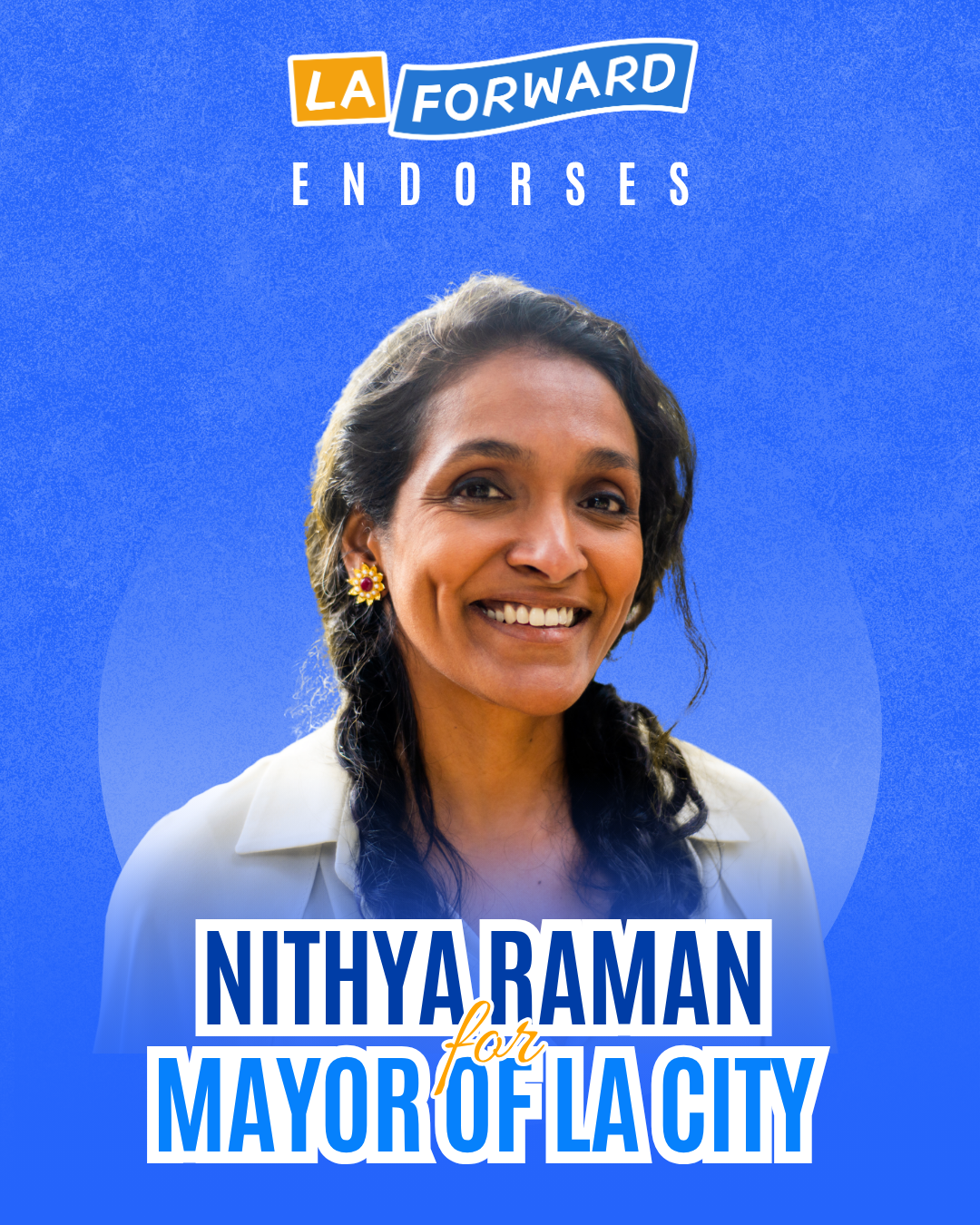
LA Forward members determine who we endorse in every race and their choice in this race was decisive. More than 90% of our members voted to endorse Nithya Raman as the best option for Mayor.
Being LA’s Mayor is an incredibly difficult job in the best of times. And needless to say, these are not the best of times. As former Deputy Mayor and Deputy Controller Rick Cole has noted, “beneath the broken sidewalks is a broken system that desperately needs fixing.”
Of the two candidates in this race, we believe Councilmember Raman is best suited to ensure LA City government truly delivers for all Angelenos.
Mayor Bass is smart, hard-working, and rooted in a long history of organizing and public service. That’s why we were proud to endorse her in 2022. But with notable exceptions such as standing up to ICE, she hasn’t risen to the challenge of being Mayor, especially when it comes to managing our city government and communicating effectively with the public. Bass has frequently taken the political path of least resistance, taking for granted the progressive voter base that got her elected initially. She’s prioritized appeasing powerful interests like the police union and Airbnb, which are the same forces that have funded conservative candidates across the city, and are now spending millions of dollars to boost her re-election campaign.
Despite Raman’s much shorter tenure in local politics, she has a clearer understanding of the ineffective areas of our city government, and a vision for how to fix them.
Raman’s track record in office over the last six years has largely aligned with LA Forward’s priorities. She helped move LA toward a citywide unarmed crisis response system, spearheaded new protections for renters (even before new progressive colleagues joined her on council in 2022), co-authored the sanctuary city ordinance to protect immigrants, championed good governance reforms to reduce corruption and increase the effectiveness of government, secured a unanimous council vote for building electrification climate policy, and backed expanded transportation and mobility options.
Raman used her position as chair of the Council’s Housing and Homelessness Committee to try to get the Venice Dell affordable housing project out of the red tape purgatory to which Mayor Bass, City Attorney Hydee Feldstein Soto, and Councilmember Traci Park had consigned it.
Raman was one of only a few votes against deals created by Mayor Bass that drained the city’s coffers through overspending on police salaries and a Convention Center overhaul, leading to cutbacks of other vital city services.
Raman fought for real charter reform, including council expansion, greater oversight powers for the City Controller, and increased police accountability, while Mayor Bass unnecessarily delayed the Charter Commission’s start by eight months and then thwarted attempts at broader reform.
Raman used her role on the AQMD board to fight climate change and air pollution before Mayor Bass removed her for being too hard-charging.
Aside from all the issues where we’ve appreciated Raman’s leadership more than Bass’s, we are most hopeful about things that are not policy-specific.
Recently Bass supporters have been spreading the idea that LA City’s mayor is “weak” and that the Council has all the real power. While the Council wields tremendous power, the Mayor has extensive authority to make change within city government, as long-time nonpartisan observers have noted in recent pieces by Robert Greene and Jim Newton.
We need a Mayor who pays attention to management, hires top leaders who understand how to get things done at City Hall, and communicates in a way that meets the challenges of the always-on media landscape.
We need a Mayor who is laser-focused on ensuring LA City government works well on a daily basis, holds Department leaders accountable for outcomes, and keeps policy implementation and Angelenos’ experience of government top of mind for everyone in leadership, as well as the rank-and-file.
This is not an easy task for anyone but Bass has been largely missing in action on this front and we see Raman asking the right questions and setting the right priorities.
We’re also impressed by Raman’s ambitious and detailed policy agenda. We’re reassured by the commitments she’s made to us personally for collaborative governance and coalition-building, including on issues where we don’t agree.
While we appreciate Bass’ focus on homelessness, we agree with Raman’s assessments about the flaws of “Inside Safe” which is getting more expensive and less effective. And while we appreciate some of the achievements that have occurred during Bass’ tenure in office, like getting LA off of coal power, in most cases, Bass is getting/taking credit for policies that others spearheaded long before she was Mayor. Bass was not the first mayor to notice and address homelessness despite what she has claimed. Eric Garcetti, for all his own flaws, spent real political capital to campaign for more funding for homeless housing with Measure HHH in 2016 and work to get bridge/interim housing built across the city.
Raman has received an impressive array of endorsements including City Controller Kenneth Mejia, former Controller Laura Chick, the California Working Families Party, Eastside Padres, Latino Coalition of Los Angele, ACCE, IJ Action, nearly all environmental environmental organizations – LA League of Conservation Voters, Sunrise Movement, Food & Water Action, Climate Action California, California Environmental Voters –, a growing number of Democratic clubs, plus unions of healthcare workers (SEIU 121RN Nurse Alliance, Committee of Interns and Residents/SEIU), transportation workers (Transportation Communications Union/IAM, Transport Workers Union of America), hospitality workers (UNITE HERE 11), LA City professional workers (EAA Union) Writers Guild of America West, Carpenters, Inlandboatmen’s Union of Pacific (ILWU), AFT Local 1521A, and UAW Region 6.
For all these reasons and more, LA Forward is proud to join partners such as and in endorsing Nithya Raman for Mayor.
LA CITY ATTORNEY: MARISSA ROY
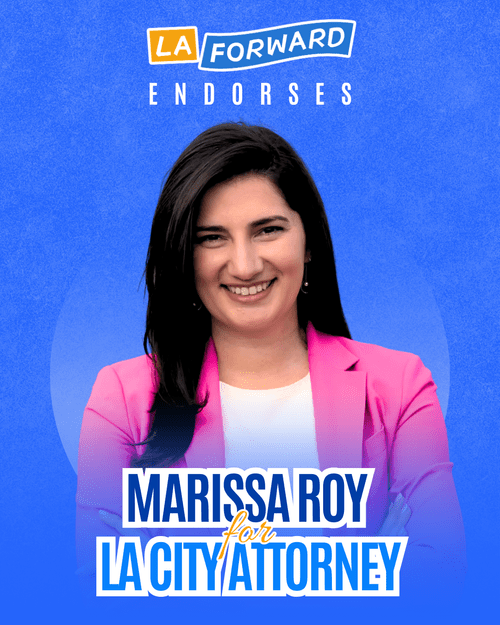
In the race for LA City Attorney, voters have one of the easiest choices on the ballot. Marissa Roy is the best choice for LA City Attorney. After a disastrous four years of incumbent Hydee Feldstein Soto, Roy promises to make the office of City Attorney a true public interest law firm that protects workers, tenants, immigrants, and communities from corporate abuse — not a rubber stamp for the powerful. We endorse Marissa Roy for LA City Attorney.
The City Attorney is LA’s lawyer: they advise the mayor and City Council, prosecute misdemeanors, and decide how aggressively the city takes on wage theft, illegal evictions, consumer fraud, and environmental harms. In practice, that means the City Attorney can either use the law to hold slumlords, union‑busting employers, polluters, and abusive police accountable – or duck those fights and leave communities on their own.
Recent years have shown how much damage a cautious, corporate‑friendly City Attorney can do, from weak enforcement against bad landlords to settlements that protect city departments more than residents. A progressive, movement‑aligned City Attorney can instead shift the office toward impact litigation, civil rights enforcement, and real accountability for abuses that fuel homelessness, displacement, and distrust.
Marissa Roy is a lifelong Angeleno who decided to go into public service when Proposition 8 stripped marriage equality from LGBTQ Californians, including her younger brother. She began her legal career in the LA City Attorney’s Office, bringing major workers’ rights cases to protect people from wage theft and other exploitation. Roy later served as outside counsel for Los Angeles County, where she joined legal actions against the Trump administration to defend sanctuary policies, DACA recipients, students, and immigrants seeking asylum. Today she is a Deputy Attorney General in the California Department of Justice, suing large tech companies over practices that threaten public health and safety and standing up for tenants who are wrongfully evicted and consumers who are defrauded.
Roy is explicit: she is running to transform the City Attorney’s Office into the largest public interest law firm in Los Angeles. Her agenda includes:
Protecting workers and tenants by aggressively enforcing wage and hour laws, cracking down on wage theft, and defending renters from illegal evictions and abusive landlord practices.
Taking on corporate and tech abuse by scaling up impact litigation against corporations engaged in unlawful, unfair, or deceptive conduct that harms Angelenos.
Making civil rights and immigrants’ rights central to the office’s mandate, including pushing back on racial profiling, unconstitutional policing, and ongoing attacks from the Trump administration.
Pursuing smart public safety by prioritizing strategies that actually make communities safer—diversion, prevention, accountability—rather than reflexive criminalization that feeds mass incarceration.
Roy’s entire career has been about using the law as a tool for economic and social justice, not as a shield for powerful institutions.
The incumbent, Hydee Feldstein Soto, came in third during the primary so Roy will be up against John McKinney, the second-place finisher.
McKinney, a deputy district attorney, comes from a traditional “tough on crime” background and has run on a more carceral, prosecutor‑first approach that would exacerbate the very problems progressives are trying to solve. He’s been backed by the Republican Party, the LAPPL police union, Republican DA Nathan Hochman, and a whopping $3 million of outside spending from Airbnb during the primary alone.
John McKinney’s right-wing ties are deeply disturbing. His campaign is backed by some of the biggest Republican and MAGA donors in California. And his campaign is being run by Republican consultants who have come under scrutiny for unethical conduct while working for Trump, including a controversial fundraiser accused of shady practices like money laundering.
Roy stands alone as the candidate who is both rooted in Los Angeles and clearly committed to turning the office loose on wage thieves, slumlords, polluters, and abusive corporations – and to reorienting the City Attorney’s work around workers, tenants, and over‑policed communities instead of City Hall insiders.
LA CITY COUNCIL DISTRICT 3: BARRI WORTH GIRVAN
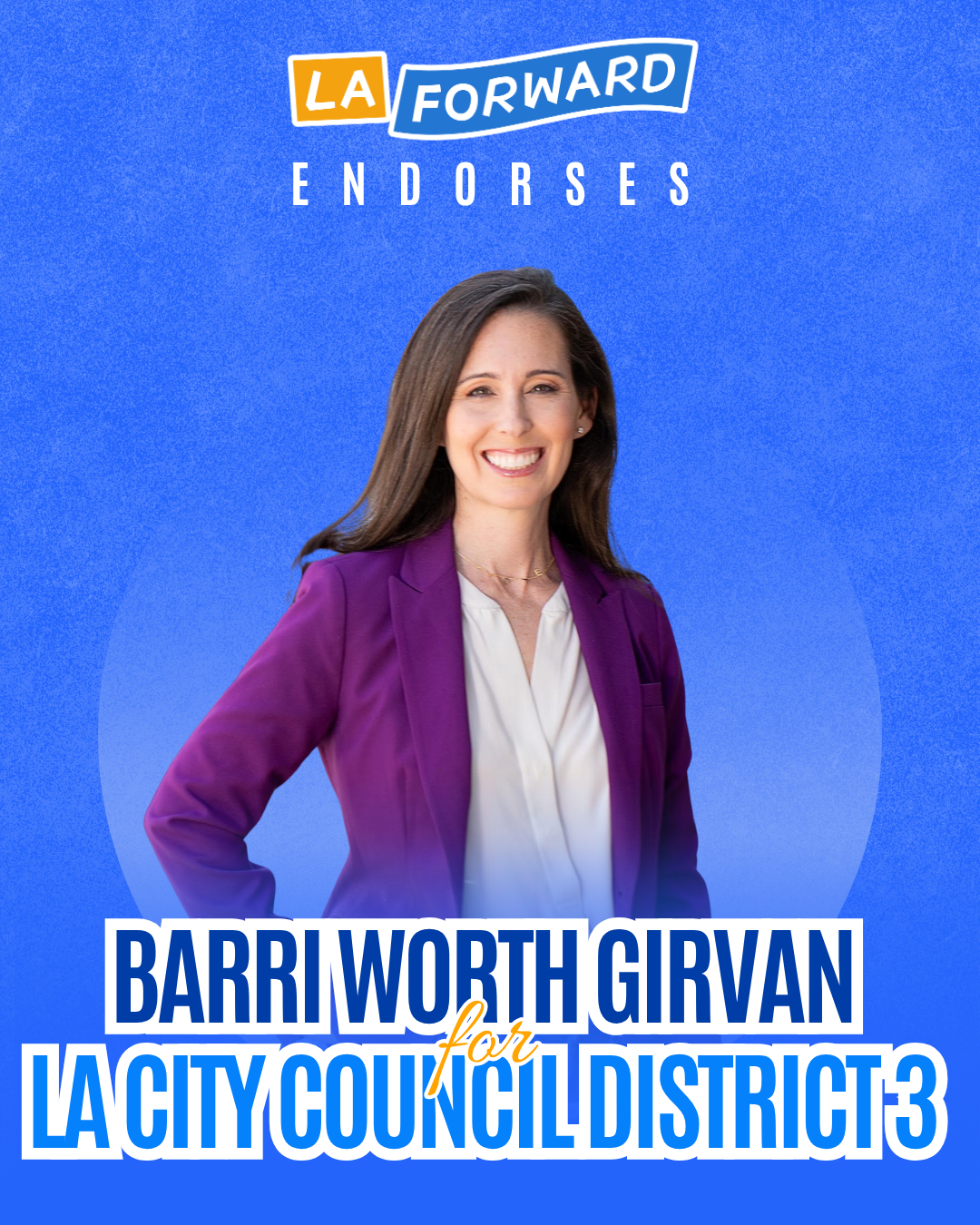
Councilmember Bob Blumenfield is termed out and so the southwest corner of the Valley has the first open race in more than a dozen years.
Barri Worth Girvan is the best choice for the West Valley, and LA Forward is proud to endorse her for LA City Council District 3.
She backs policies to tackle the housing crisis directly and supports a compassionate approach to homelessness that effectively gets people off the streets and into housing, instead of relying on criminalization.
She’s eager to promote the expansion of unarmed crisis response services across the Valley, so we’re not sending armed people to deal with issues that deserve trained mental health responders.
She’ll champion climate solutions that combat global warming which is driving up temperatures in the Valley year after year. And, she will back long-term, comprehensive infrastructure planning to help fix the broken sidewalks, streetlights, and potholes across our city.
Barri has had a long career in public service and a great reputation among people who know her. Her supporters include environmental organizations, including the LA League of Conservation Voters (LALCV) and Sierra Club, the Democratic Party of San Fernando Valley (DPSFV), the San Fernando Valley Young Democrats (SFVYD), the National Union of Healthcare Workers (NUHW), the Engineers & Architects Association (EAA), Women's Political Committee of Los Angeles (WPC) and California Women's List.
She also has endorsements from a wide range of Valley political and community leaders:
Congresswomen Julia Brownley, Luz Rivas, and Sydney Kamlager-Dove;
State Senators Henry Stern, Caroline Menjivar, Ben Allen, Maria Elena Durazo;
State Assemblymembers Mark González, Rick Chavez Zbur, Nick Schultz, Jesse Gabriel, Celeste Rodriguez, Mike Fong, Pilar Schiavo
Andra Hoffman, Los Angeles Community College Board of Trustees
Nick Melvoin, LAUSD Board Member
Nikki Perez, Mayor, City of Burbank
Ray Pearl, Westlake Village Mayor and Councilmember
Jeremy Wolf, Mayor Pro Tempore, City of Agoura Hills
Alicia Weintraub, Calabasas City Councilmember and former Mayor
David Shapiro, Councilmember and Former Mayor, City of Calabasas
Danny Hang, West Hollywood Councilmember
Ed Albrecht, Councilmember, City of Calabasas
Deborah Klein Lopez, Agoura Hills Councilmember
In contrast, her opponent is backed by the police union, landlord lobby, real estate interests, and the most conservative members of the City Council.
Barri is not a movement progressive like most of our endorsed candidates, but we trust that she will work with us closely and partner to help make Los Angeles a fair, flourishing place for everyone, unlike her opponent who would consolidate a growing conservative presence on council.
For all these reasons and more, LA Forward endorses Barri Worth Girvan and encourages West Valley residents to vote for her!
LA CITY COUNCIL DISTRICT 9: ESTUARDO MAZARIEGOS
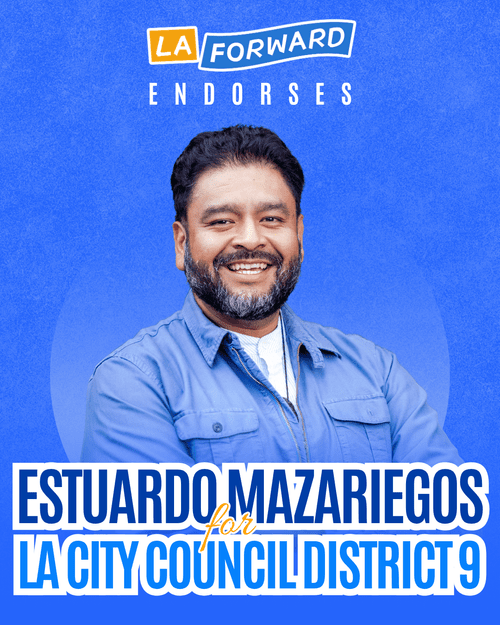
Estuardo Mazariegos is the best choice in City Council District 9, endorsed local teachers (UTLA), healthcare workers, environmental justice groups, and Bernie Sanders, and and all of us at LA Forward
Estuardo will be an unapologetic champion for working families, young people, immigrants, renters, and neighborhoods that City Hall has neglected for far too long.
He’s the only candidate with real plans to:
Address homelessness with dignity, getting people off the streets and into housing with supportive services
Fix streets, sidewalks and streetlights
Improve police accountability and address the causes of crime
Protect and support the immigrant community
Council District 9 is one of the youngest, poorest, and most heavily burdened districts in Los Angeles, stretching from the southern edge of Downtown through South Los Angeles communities that face housing insecurity, disinvestment, and environmental harms. With Curren Price termed out, this is the first open-seat race in the district since 2013. It’s a real chance to send someone to City Hall who is rooted in community, instead of the insider culture that has repeatedly failed South L.A.
This is also a contest over what representation should look like in a district where residents are too often over-policed, under-served, and only remembered during election season. District 9 does not need another manager of decline or another politician promising ribbon cuttings while basic services fall apart; it needs a fighter.
Estuardo Mazariegos is a father, immigrant, and longtime community organizer who has spent nearly two decades working alongside low-income residents, tenants, immigrants, and Black and Brown families. He is the co-director of ACCE Los Angeles, a grassroots organization that has been central to major fights for renter protections, economic justice, and racial justice across the city.
Mazariegos’ story matters here because it is inseparable from the district he wants to represent. He came to the United States from Guatemala as a child, grew up in working-class neighborhoods in Los Angeles, studied labor and public administration at Cal State Dominguez Hills and Cal State L.A., and has said his family’s union jobs taught him how closely immigrant dignity is tied to worker organizing and collective power.
Unlike candidates who discover justice and equity when they file paperwork for office, Mazariegos has made a career out of building power with people whom City Hall tends to ignore. That is exactly the kind of perspective District 9 needs.
Mazariegos is running on a platform centered on affordable homes, renter rights, Black-Latino solidarity, and a city government that actually shows up for working people. He has pledged to expand social housing, enforce tenant protections, invest in neglected neighborhoods, and reject the influence of corporate PACs, real-estate developers, and police associations.
He has also drawn a sharp and welcome distinction on public safety. Mazariegos does not support increasing the size of LAPD, and he argues that safety means safe streets, functioning lights, responsive services, and neighborhoods that receive public investment rather than abandonment. That is a far more honest vision than the tired City Hall script that treats policing as the answer to every social failure.
On government reform, Mazariegos has recognized something many Angelenos feel every day: trust in City Hall has collapsed. He says District 9 has the lowest voter turnout in the city, links that disengagement to unanswered 311 calls and broken basic services, and supports ethics reforms, stronger conflict-of-interest rules, stricter outside-income disclosure, and efforts to close the revolving door between lobbyists and public office.
His opponent is Jose Ugarte, who’s a City Hall insider – a staffer for Curren Price and a longtime political consultant who would be another voice for the establishment. Ugarte started a lobbying firm while he still was working for Price and he was fined $25,000 by the L.A. Ethics Commission for failing to disclose multiple years’ worth of income he made from lobbying. The owners of upscale L.A. hotels have spent nearly $150,000 to elect Ugarte, while Ugarte’s boss voted to delay a wage increase for hotel and airport workers until after the 2028 Olympics. Ugarte has also taken thousands in campaign contributions from a developer that needs City Council approval to build their new hotel.
Mazariegos is running as an organizer, and that matters. In a district battered by displacement, speculative development, and long-term neglect, the district needs a leader who has been in the trenches fighting for renters, immigrants, and low-income families before there was a title attached. On that test, Mazariegos is the clear choice.
His coalition reflects that politics. He is backed by Bernie Sanders, California Working Families Party, Initiate Justice Action, EAA Union, the National Union of Healthcare Workers, the teachers union, the environmental group LA League of Conservation Voters, LGBT groups like Stonewall Democrats, Controller Kenneth Mejia, and Councilwoman Eunisses Hernandez. The teachers unions (UTLA) describe him as a community and labor organizer committed to South Central who has partnered on affordable housing issues. He is also supported by movement organizations that know firsthand that he has spent years doing the work, not just talking about it.
He proudly refuses all corporate campaign contributions because he understands that the corporate-politician complex is part of what is holding us down. He has a record of taking on City Hall and winning, leading the fights to cap rent increases, preserve affordable housing, and protect immigrant families. Now he will address homelessness, fix crumbling roads, sidewalks, and streetlights to make our neighborhoods safer, cleaner, and more affordable.
Mazariegos’s record is not polished for elite comfort, and that is part of why he is compelling. He has been open about mistakes he made that got him arrested as a young person. He makes the case that this creates a deeper connection with residents whose lives are shaped by the policing and legal system rather than protected by it. In a district where too many people know what it means to be targeted, discarded, or written off, that honesty is a strength, not a liability.
LA City Ballot Propositions
LA City Measure EE - OPPOSE
Measure EE is a set of amendments to the LA City Charter proposed by LA City Council ostensibly related to Ethics. With a couple notable exceptions (e.g. Measure LA, PRK), LA City Council ditched most of the substantive amendments proposed by the Charter Commission on the theory that they required more study. More study was not apparently required for a set of ideas that the Commission had not even proposed but which Councilmembers themselves favored. First and foremost, reducing the number of full City Council meetings required by the Charter from three times per week to once a week. There’s nothing inherently wrong with reducing the charter requirements for meeting frequency, but we find it deeply disappointing that the Council chose to advance this little-studied reform with no accompanying reforms would promote greater public access to Council deliberations
EE also would increase the number of signatures needed for a ballot referendum by 50%. Currently petitioners must collect a number of signatures equal to 10% of the votes cast in the last mayoral election to qualify a referendum. Amendment EE would increase this to 15% of ballots cast. Proponents say this makes the number of signatures needed for referendums and voter initiatives the same. Opponents note that with initiatives signature gatherers have four months, while with a referendum they have only one. The effect of this provision is to make referenda basically impossible. A referendum is when voters want to overturn a policy just passed by the City Council, whereas an initiative is a new policy.
While in theory this change is a bad thing, in practice, the referendum has been used mostly by corporate interests to undermine pro-worker policies passed by the council. The most recent example is when business groups attempted to overturn the Olympic wage ($30/hr for tourism workers), with ample financing from the airline and hotel industries.
EE also includes several provisions that function more as feel-good sweeteners for voters than solutions to real problems.
Specifically, the measure will enable independent inspectors for the Los Angeles Police Department and Fire Department more power even over the objections of the LAPD and LAFD commissions (there’s not a history of commissions objecting) and will ban alums of the City Ethics Commission from running for local office for five years after leaving office (this hasn’t been problem).
Measure EE is likely to pass but we recommend you vote No to send a message to City Council to get serious and stop kicking the bucket down the road when it comes to real reform for good government. We’re sick and tired of it.
Measure FD - Sales Tax to Support Fire Response Efforts - SUPPORT
Measure FD would add 0.5% sales tax in the City of Los Angeles, generating about $345 million annually for the Los Angeles Fire Department. The money could fund firefighters, paramedics, fire engines, ambulances, fire station construction and repairs, communication systems, and wildfire preparedness. The tax would remain in place until voters repeal it.
Because Los Angeles County voters approved Measure ER in June 2026, the City's sales tax is already scheduled to increase from 9.75% to 10.25% on October 1st. Measure FD would add another half percentage point, bringing the rate to 10.75% if approved and implemented.
LA recommends a YES vote on Measure FD. Asking working-class Angelenos to absorb another increase deserves careful consideration and scrutiny. However, the City of Los Angeles has significant unmet fire and emergency-response needs, and Measure FD creates a dedicated funding source with a strong requirement for maintenance-of-effort, annual audits, and public oversight.
Why is Measure FD on the ballot?
Measure FD originated as a voter initiative spearheaded by the United Firefighters of Los Angeles City Local 112 (UFLAC), which represents nearly 3,400 firefighters. The union began gathering signatures in January 2026. The union argues that Los Angeles Fire Department staff, facilities, and equipment have failed to keep pace with population growth and emergency call volume. After supporters submitted enough valid signatures, the City Council voted 14-0 in June to place the measure on the November ballot.
Supporters argue that Los Angeles has roughly the same number of firefighters today as it did decades ago while annual emergency calls have increased dramatically. The campaign says LAFD had 3,370 firefighters in 1965 compared with approximately 3,387 today, while the City has grown substantially and annual calls for services have increased roughly fivefold.
The January 2025 Palisades Fire and the June 2026 Lineage Fire have also heightened public attention to LAFD staffing and preparedness. More staffing cannot replace accountability for deployment, management, or command decisions. But major fires and other recent emergencies have strengthened the argument that Los Angeles needs greater emergency-response capacity.
What would the money pay for?
Measure FD is a special tax, meaning the revenue must be spent on LAFD functions rather than deposited into the City’s unrestricted General Fund.
The ordinance allows funding for additional firefighters, paramedics and civilian personnel, fire engines, trucks, ambulances, aircraft and helicopters, firefighting and rescue requirements, new and upgraded fire stations and emergency medical service facilities; emergency communications; and brush clearance and wildfire readiness. The City would deposit revenue into a dedicated account and keep it available exclusively for authorized uses
The City must continue providing LAFD at least the average percentage of discretionary budget funding that the department received during the 10 fiscal years preceding implementation. If the City fails to meet that requirement in a fiscal year, it cannot levy the Measure FD tax that year. The provision is explicitly designed to ensure that new revenue supplements rather than replaces existing LAFD expenditures.
Measure FD also requires an annual independent financial audit and creates a five-member citizens’ oversight committee. The Mayor, Fire Chief, City Controller, City Administrative Officer, and Chair of the City Council committee overseeing public safety would appoint committee members. The committee would review whether Measure FD revenue was spent for legally authorized purposes and report publicly at least annually. However, the committee would be advisory only, and would not determine spending priorities, manage projects, or oversee other sources of LAFD funding. The Mayor and City Council would also review and approve reporting and audits.
Who supports Measure FD?
The campaign is organized through Repair, Rebuild, Respond - Fund LA Fire Now, sponsored by UFLAC which is the union of LA City Firefighters. The campaign identifies its top funders as UFLAC, the State Building and Construction Trades Council of California, and the law firm of McNicholas & McNicholas LLP.
Mayor Bass has supported the initiative, and the City Council voted 14-0 to place it on the ballot. The Central City Association, representing downtown business interests, has supported the measure.
Some supporters have clear institutional interests. Firefighters would benefit from expanded staffing and departmental resources, while construction unions could benefit from new station construction and modernization projects. The initiative requires new and replacement fire-station projects funded by Measure FD to operate under the City’s applicable project labor agreement and prevailing-wage requirements, while also permitting workforce-development programs aimed at City residents. LA Forward believes the public would be better served by additional firefighters, functioning stations, and modern emergency equipment.
Who opposes Measure FD?
While the Howard Jarvis Taxpayers Association is opposing, the group spending the most money against FD is the police union, the LA Police Protective League. We think they’re wrong about most things so that doesn’t give us concern.
We take more seriously the opposition argument that sales taxes are regressive. Increasing the sales tax disproportionately burdens residents who can least afford higher everyday costs, and fire protection should instead be prioritized within the City’s existing budget. Opponents also argue that Measure FD has no end date. The ordinance states that the tax remains in effect until voters repeal it. Opponents ask whether every underfunded public service should be funded by increasing consumption taxes rather than other revenue sources.
How should progressives think about Measure FD?
A progressive revenue system should place more of the burden on those with the greatest ability to pay. A sales tax does the opposite: households that spend a larger portion of their income on consumption bear a disproportionately large burden, but that’s not the debate.
The practical choice is whether to approve this funding mechanism or continue relying primarily on annual City budgets, which have failed to address long-term staffing, facilities, and equipment needs. Measure FD includes safeguards, such as making the revenue available only to LAFD, prohibiting supplementation of existing City support, requiring expenditure audits, and revoking the City's authority to levy the tax if it violates the maintenance-of-effort requirement.
Measure FD is not an ideal revenue measure. But increasing wildfires, especially in the wake of the Palisades and Lineage Fires, and the ever-present threat of earthquakes require Angelenos to address longstanding emergency-response infrastructure needs now rather than when the next disaster hits.
LA Forward suggests a YES vote on Measure FD.
City Measure LA - SUPPORT
LA Forward endorses LA City Charter Amendment LA.
Measure LA comes out of the comprehensive Charter reform process Los Angeles undertook over the past year, the first major examination of the City Charter in decades. Across numerous public meetings, there was widespread support for several of the changes now packaged under Measure LA, especially those on long-term infrastructure planning and reforms to the City’s budgeting process. The final package of reform was placed on the ballot by the City Council on a 13–0 vote, with two members absent.
Los Angeles Needs to Plan Beyond One Year
Los Angeles maintains an enormous network of streets, sidewalks, parks, bridges, buildings, and other public infrastructure. Historically, however, the City has not been required to produce a citywide Capital Infrastructure Plan (CIP), making it harder to prioritize projects across departments. The Bass Administration recently released Los Angeles's first citywide CIP, an important step toward more coordinated infrastructure planning. But the first iteration has also generated critiques about both the process used to develop it and the usefulness of the final product. We want long-term capital planning to become embedded in the City's culture, improve over time, and continue regardless of who occupies the Mayor's Office. Measure LA would put that expectation into the Charter by requiring the City to regularly produce a Capital Infrastructure Plan and move Los Angeles toward a two-year budget cycle, while retaining annual budget actions and updates.
Clear Responsibility for Public Works
Measure LA would also restructure how the Department of Public Works is managed. Today, authority is divided among the Board of Public Works, Director of Public Works, and the heads of the Department's bureaus. Measure LA would give the Director greater responsibility for managing construction projects, administering contracts, granting street permits, and recommending Public Works budgets. While the Board of Public Works is not eliminated and retains important responsibilities, Measure LA also gives the City Council the ability to modify or eliminate the Board in the future through an ordinance.
Modernizing How the City Uses Its Money and Assets
Measure LA would also update several longstanding Charter provisions governing City finances and contracting. It would remove Charter prohibitions on a) mortgaging City-owned property (Charter Section 104a) and b) the City engaging in purely commercial or industrial enterprises without voter approval (Charter Section 104g). As an article in the new publication, L.A. Material notes, LA is one of very few cities in the U.S. with these provisions. It’s led to absurd situations like the City Council needing to ask voter approval for starting a snack stand at the Greek Theatre. In removing these restrictions, Measure LA provides additional flexibility and creative financing mechanisms to our City leaders, which can be crucial in addressing the City’s most pressing concerns.
What It Will Cost
The City Administrative Officer estimates that establishing the two-year budget process and Capital Infrastructure Plan would require approximately $4 million to $6 million in one-time costs, but expects these ongoing costs will be absorbed by reorganizing existing resources. LA Forward believes this tradeoff is imperative so that our City can build the processes necessary to plan and manage our investments effectively.
Measure LA is championed by LA City Controller Kenneth Mejia, former controller Ron Galperin, current and former council budget chairs Katy Yaroslavsky and Bob Blumenfield, LA Forward, Streets For All, and by the nonprofit Investing In Place, led by Jessica Meaney, which has truly led the thinking around the need for a comprehensive plan for spending our infrastructure dollars.
We urge you to vote Yes on Measure LA.
LA City Measure PL
If enacted, this Measure PL would implement reforms proposed by the City Charter Commission to the City’s land use process.
The biggest change would involve the dissolution of the City’s Area Planning Commissions – these seven regional commissions are the decision making bodies for small projects in their designated region and handle appeals of decisions made by the City Planning Department staff. Instead, a new Neighborhood Appeals Commission would take their place. This new Commission would have seven members and would consider appeals of decisions made by the City’s Planning Department staff. The City would continue to have a City Planning Commission, the body that considers large scale projects proposed within the City.
The measure would also amend the process for making changes to the City’s General Plan by reducing the wait time before the proposed amendment is adopted. The measure would give the City Council 75 days to consider any proposed amendment that was recommended for approval by the City Planning Commission and the Mayor; if the City Council does not act in 75 days, the proposed amendment would be adopted.
The measure would also allow the Department of Planning to appoint staff to review, investigate, and hold hearings for discretionary land use applications. Currently, only staff in the Office of Zoning Administration can conduct these reviews; this measure would allow additional staff to be appointed to decrease application processing periods.
Overall, the measure will likely decrease application processing periods because of the additional staff that can review and hear applications - however, it should be noted that consolidating the seven Area Planning Commissions into a single Neighborhood Planning Commission may introduce a new bottleneck into the process (if an appeal is filed). But, having seven different bodies hear land use applications also runs the risk of uneven development practices in different parts of the City - a single appeals body will provide a uniform voice to (hopefully) promote equitable land use practices across the City.
Measure PRK - SUPPORT
LA Forward endorses LA City Charter Amendment PRK.
Los Angeles loves our parks, but over the last decade we’ve seen them decline with funding cuts. Park facilities need almost $3 billion in repairs, and pools, recreation, and senior centers have cut hours.
The reason is chronic underfunding. LA City parks are funded two-thirds less than similar cities. Park funding hasn’t kept up with other City services. We’ve lost one-third of the full-time park staff needed to keep parks safe and clean.
Measure PRK is a once-in-a-generation opportunity to transform our parks system for working families across Los Angeles – restoring clean beaches, safe playgrounds and facilities, expanding recreational and community programming that keeps kids and seniors connected, safe and active, and ensuring every Angeleno has a welcoming place to gather with family and friends, build community, and stay cool.
Measure PRK does this by increasing the parks guaranteed budget over 10 years, so our parks can give Angelenos the services they need.
Currently the City Charter requires that the parks department receive .0325% of the total assessed value of taxable properties in Los Angeles, which means $303 million for the park system. In ten years, that allocation would grow to approximately $493 million. If PRK passes, the allocation would double to $986 million by 2036.
Measure PRK would help fund a variety of critical services Angelenos rely on without raising taxes, including:
Restoring public hours and programs at the City's 120+ recreation centers, senior centers, museums, and historic sites - making sure they can stay open 7 days a week
Restoring services at public pools and beaches
Repairing aging facilities and addressing a $3 billion backlog of deferred repairs
Restoring groundskeeping and restroom cleaning at 500 parks citywide
Rebuilding the Park Ranger Division for safety and fire prevention
Staffing and resourcing cooling centers and evacuation centers for emergency management
Planting trees and managing natural resources and ecologically sensitive areas
Addressing gaps in park equity for underserved neighborhoods through new park acquisition and activating community school parks
Improving safety and cleanliness
Expanding youth & senior programming
Maintaining playgrounds and sports fields
Keeping trash & pollutants out of creeks, rivers, lakes, coastal waters and beaches
There are no new taxes as part of this measure and no new borrowing. That’s the reason the police union is opposed. They don’t like the idea of park funding taking a slightly larger amount of the city budget, even though the Police Department already gets more than half. Just another reason they’re terrible.
The lone nay vote City Council was Bob Blumenfield. Everyone else supported it and the measure is championed by City Parks Commissioners, the LA Neighborhood Land Trust, the Trust for Public Land, and is endorsed by the LA County Federation of Labor, LA County Democratic Party, LA League of Conservation Voters, League of Women Voters, LAANE, Sierra Club, both DSA-LA and the conservative “Thrive” group and dozens more.
LA Forward strongly recommends that you vote YES on PRK.
Measure PRT - SUPPORT
Measure PRT is a proposed amendment to the City of LA Charter regarding governance of the Harbor and Airports Departments.
The Departments of Airports, Harbor, and Water and Power are known as Proprietary Departments within the City of Los Angeles. Each of these departments is controlled and managed by a board of commissioners. These departments are governed by the Charter, so any changes to the governance, structure or powers of these departments must be accomplished by Charter amendment as opposed to city council action. This ballot measure contains a few modest reforms to the existing Charter language concerning these departments.
The first proposal concerns the makeup of the Board of Airport Commissioners. The Board currently consists of seven members, with one member residing “within the area surrounding Los Angeles International Airport" and one member residing “within the area surrounding Van Nuys airport.” This proposal would require that three members live near LAX and two members live near Van Nuys airport, thereby giving these residents majority control over the board. Those “areas” are defined by ordinance of the city council. The Commission would remain a seven-member board. We appreciate the idea of making the Commission especially sensitive to the needs of people directly impacted by the noise and air pollution generated by the airports. Airports affect the entire region as well, so we’ll need to monitor how the Commission operates with new makeup to ensure the change in composition isn’t having negative consequences.
The second proposal adds a section to the Charter specifying how the Harbor Board manages and funds its public use assets. The Harbor Board controls the assets within the Harbor District for the public’s benefit. The Charter requires that some amount of the water frontage is reserved for public use. This new section creates a Public Asset Investment Plan and codifies the existing annual practice of allocating 10% of the operating income of the Harbor Department to fund waterfront public access projects.
The third proposal involves the approval process for leases and property development within the Harbor District. The Harbor Board controls the development of the Harbor District and may purchase or lease various assets consistent with the department’s purpose. This proposal would give the Board the authority to require applicants seeking a lease, a lease extension, or to develop certain property within the Harbor District to provide an assessment of the economic impact, including the estimated workforce effects, on the Los Angeles region. Small businesses and non-profits may be exempt from this requirement.
Finally, the measure streamlines for all departments the maximum length of lease terms. Each of these departments controls and manages certain property and has the power to enter into leases consistent with the department’s purpose. Currently, leases may be entered into for a period of 30 years or up to a maximum of 50 years with city council approval. But for the Harbor Department alone, the city council may approve a lease up to a maximum of 66 years. There is no explanation for this disparity. Thus, the proposed language allows the city council to also approve maximum 66-year leases for the departments of Airport and Water and Power to align with the Harbor Department.
We recommend you support this measure. These are modest changes to streamline and strengthen these departments’ operations. Codifying an existing operational policy that has shown to be effective, like the Harbor District’s annual allocation of funds to public access projects, is a good government measure to ensure adherence.
Measure TE - OPPOSE
Measure TE would create a temporary exemption from Los Angeles’s Measure ULA real estate transfer tax for certain properties damaged or destroyed in the January 2025 Palisades Fire and sold within five years of the fire.
Why is Measure TE on the ballot?
Measure ULA, approved by Los Angeles voters in 2022, imposes an additional transfer tax on high-value real estate transactions and dedicates the revenue to affordable housing, homelessness prevention, rental assistance, eviction defense, and related programs. ULA has generated nearly $1.2 billion from 1,633 transactions through April 30, 2026.
Following the January 2025 Palisades Fire, city officials began considering whether homeowners whose properties were destroyed or seriously damaged should have to pay the ULA tax if they sold rather than rebuilt. Councilmember Traci Park, whose district includes Pacific Palisades, became the leading advocate for an exemption. The proposal was introduced with Councilmember Imelda Padilla and seconded by Councilmember Bob Blumenfield.
The City Attorney concluded that the City Council could not create the exemption itself because its authority to amend the voter-approved Measure ULA is limited. As a result, voters must amend the measure.
The Council initially voted 15-0 to advance the proposal. The final ballot action passed 13-1, with Councilmember Eunisses Hernandez opposed and Councilmember Curren Price absent.
What do supporters say?
Supporters argue that the measure provides basic disaster relief. Some Palisades homeowners face inadequate insurance proceeds, rebuilding requirements, lengthy permitting processes, or personal circumstances that make rebuilding unrealistic. Applying an additional transfer tax when they sell damaged property could further reduce the resources they have available to recover.
Councilmember Park emphasized that the exemption is limited: it applies to residential property damaged or destroyed in the Palisades Fire, only to the original owner and first qualifying transaction, and expires five years after the fire.
Political support has been broad. The Council initially unanimously supported moving the measure forward, and nearly every member supported its final placement on the ballot. As of early August, Park had applied to author the official argument in favor, while no applicant had sought to submit an official argument for Measure TE.
What are the concerns and who is opposing?
The most significant criticism is that the exemption may be broader than necessary.
Councilmember Eunisses Hernandez opposed the measure because it was not limited to primary residences. She argued that the relief should focus on people who lost the homes they lived in rather than potentially benefiting investors, owners of multiple properties, or wealthier property owners with greater financial resources. Indeed, the City Clerk, in the summary of Measure TE, writes, “The exemption would apply to all residential properties, whether or not owner-occupied, that are sold by the owner or owners who are also the owner or owners at the time the residential property was damaged or destroyed by the Palisades Fire.” Indeed, people with properties worth less than $5 million are not affected at all, so by definition this is tax relief for those with more assets than most Angelenos can even dream of having.
Additionally, the City Clerk leaves the term “residential property” vague, though the reason differs from that of Councilmember Hernandez. The City Clerk explains that “‘Residential property’ is left undefined in the ballot text to afford the City the ability to apply a broad interpretation (emphasis added) to avoid the inadvertent exclusion of eligible transfers or properties.”
There is also a financial cost. The Los Angeles Housing Department estimated that a broader residential exemption related to the Palisades Fire could reduce ULA revenues by about 6% ($32 million), while a narrower exemption involving destroyed single-family properties was estimated at 2%, or roughly $8 million.
LA Forward joins with Councilmember Hernandez in opposing Measure TE as an overly broad exemption that is not only restricted to people who lost their primary family home and that opens the door to further attempts to cut ULA and reduce this key source of revenue for homelessness prevention.
LAUSD Measure SC - SUPPORT
Measure SC is a relatively minor charter amendment that clarifies campaign finance rules for LAUSD board candidates and aligns those rules with rules for LA City Mayor. It pertains to rules that cover campaign contribution limits, filing deadlines, fundraising windows, and public disclosures.
There are no organized campaigns for or against the charter amendment. It’s backed by Diego Andrades, a former member of the city’s Charter Reform Commission.
LA Forward recommends a YES vote.
State Ballot Propositions
Prop 1 - Fund Affordable Housing Across the State
LA Forward strongly recommends a YES vote on Proposition 1, a $11.25 billion bond measure to fund affordable housing targeting the lowest income people across the state. Housing affordability continues to be one of, if not the biggest, challenge facing California. A third of renter households pay more than half their income on housing, while 80% of extremely low-income households pay more than half their income on housing. Put simply, that’s a million California households facing hard choices between groceries, needed healthcare, schoolbooks for their kids, and paying the rent.
Proposition 1 would address this by replenishing California’s main program for building deed-restricted affordable housing that targets the lowest income people, the Multifamily Housing Program, with over $5 billion in bond funds, $1 billion of which would be reserved for supportive housing for people experiencing homelessness. A host of other affordable housing programs, including those serving veterans, farm workers, and tribal communities, would see their funding boosted. Taken together, these investments are estimated to produce over 40,000 new affordable homes and preserve over 5,000 homes that are anticipated to lose their affordability status.
Recent headlines have given the impression that California spends excessively on housing and homelessness. But that has largely consisted of one-time splashes of funding in years when the state budget had a surplus and was buoyed by federal relief funding. In recent years, the State of California spends approximately 0.5% of its budget on housing and homelessness, out of step with where voters consistently rank the importance of this issue. California needs to set aside ongoing funding in the billions in a consistent, ongoing manner to solve our affordability challenges, but has not been able to accomplish that goal. In the meantime, Prop 1 is a critical stopgap to ensure new affordable homes continue to be produced to house the most vulnerable people.
For more details and analysis, check out this excellent write-up by the California Budget and Policy Center.
LA Forward encourages you to vote YES on Prop 1.
Proposition 2 - Increase the Size of the State’s Rainy Day Fund
Proposition 2 would double the cap on the state’s rainy-day fund (the Budget Stabilization Account, BSA) from 10% to 20% of annual tax revenue, and allow state lawmakers and the governor to use reserve funds to pay off state debt (but would not be required). Under current state law, California lawmakers may save only 10% of the general fund to the BSA. LA Forward suggests voters should support Proposition 2.
Proposition 2 is a legislative-referred state constitutional amendment. Supporters, including the Democratic Party of California, Governor Gavin Newsom, Speaker of the Assembly Robert Rivas, and Senate President pro Tempore Monique Limón, believe the 10% reserve cap is not enough given the volatility in state finances California has experienced in recent years. For example, according to the Department of Finance, California estimated a $101 billion surplus in 2022-2023, but in 2024-2025 the state faced a projected $47 billion deficit.
The nonpartisan Legislative Analyst’s Office (LAO) analyzed the state’s finances through thousands of hypothetical scenarios over the next 50 years. It continued to predict economic swings, whereby cuts to core services and programs or tax increases would be necessary to sustain spending if the proposition were not passed. The LAO recommended a 50% reserve cap given California finance volatility, though this proposition would raise the reserve cap to 20%.
In 2004, California voters supported Proposition 58, which required balanced budgets and established the BSA (71% in support versus 29% opposed). In 2014, California voters increased the potential savings cap from 5% to 10% of the General Fund (69% in support versus 31% opposed). There is historical precedent for saving excess gains during “boom” years. It is also important to understand the basics of California state revenue.
California raises revenue through the state income tax and funds most programs through the General Fund. High-income taxpayers pay much of the income tax, and their incomes often include gains from stocks and other investments. These revenue streams depend on the economy and the stock market, which can vary year to year. To avoid potential cuts to core programs and services, Proposition 2 would allow state lawmakers and the Governor to save money in anticipation of bad fiscal years and pay back state debts.
For more detailed analysis, check out California Budget and Policy Center’s write-up.
Opponents of Proposition 2, including Republican State Assemblymember Joe Patterson, Republican State Senator Tony Strickland of Huntington Beach, and Reform California, argue the measure enables overspending and that savings from surplus years should go directly to taxpayers as refunds or tax cuts. We don’t agree.
Prop 2 is an important step for fiscal responsibility and LA Forward recommends you vote YES.
Prop 3 - Make high-earner income tax permanent - SUPPORT
This measure provides permanent funding for schools and health care services by making an existing temporary tax on the top 2% of incomes in California permanent. The increased tax rates (ranging from 10.3%-12.3%) apply to single filers who earn above $371,000 and above $743,000 for joint filers. The tax initially approved by voters in 2012 and extended in 2016 is set to expire in 2031. It generates billions of dollars annually in state revenue with funds allocated towards TK-12 schools and community colleges. Without Prop 3 California would lose a core component of the TK-14 education budget.
Opponents like the California Taxpayers Association argue that California already has some of the highest income taxes and making this tax permanent would further increase the cost of living. However it is important to clarify that this tax only affects the top 2% of incomes, and Prop 3 is not a new tax but simply an extension of a tax that has been in place for more than a decade. If these top tax rates expire, Californians in the top 2% would pay a lower tax rate than the bottom 20%. Even with these top tax rates the top 1% of Californians pay an average of 12% tax rate, only marginally higher than the 11.7% tax rate that the bottom 20% of Californians pay.
Supporters of Prop 3 include one of the largest teachers unions in the state, the California Teachers Association (CTA). CTA led the campaign to extend the tax in 2016 and led the initiative to qualify this measure for the November ballot.Since the tax was first introduced it has generated $120 billion in revenue for public education. The teachers’ union recognizes that passing Prop 3 is crucial for protecting continued funding for schools to ensure students receive the resources they need, and that it is a simple choice between providing funding to public schools and their students vs a tax cut to the wealthiest Californians if the tax expires.
If the tax rate were to expire, the state would need to replace billions of dollars in funding for schools from other revenue sources, reducing available funding for critical health, housing, and economic security programs. The strain on the state budget would be compounded by the federal budget cuts from H.R.1. coupled with the increasing costs in providing these services due to inflation. The state budget does not currently have the capacity to address all these budget cuts putting millions of Californians at risk of losing critical services.
California Budget and Policy Center has additional analysis here if you want a deep dive.
LA Forward recommends you vote YES vote on making the millionaires tax permanent so we don’t gut our state’s education system.
Proposition 4 Repeals California’s Restriction on Public Financing of Elections - SUPPORT
Right now, California law prevents the state and most cities and counties from choosing to publicly finance campaigns. Proposition 4 merely removes that prohibition. Local communities, cities, and counties across the state can then decide whether they want a public-financing program and, if so, separately determine how the program works, how much it costs, where the money comes from, and what candidates must do to qualify. A Yes vote on Prop 4 does not automatically spend taxpayer money on campaigns. It gives California communities the ability to make that decision for themselves.
The City of Los Angeles already provides public matching funds to qualifying candidates. San Francisco, Long Beach, Oakland, and Berkeley also have similar public-financing programs because our cities’ charters are exempt from the statewide prohibition. Ultimately, Proposition 4 would have little immediate impact on LA City's existing public finance system. Instead, it would give other cities and counties the ability to consider public-financing systems of their own.
Other communities should be able to activate public financing of our campaign. Campaigns cost money, and that money has to come from somewhere. Without public financing, candidates largely have to raise it from private donors. That can give wealthy donors and special interests an outsized role in determining who has enough resources to run a competitive campaign. Public financing creates another alternative, more equitable path. When designed appropriately, public dollars can amplify small donor contributions and help candidates demonstrate that a broad base of ordinary people supports their campaign.
There are guardrails.
Proposition 4 requires candidates receiving public financing to demonstrate a threshold of public support and agree to spending limits as established by the appropriate jurisdiction. The initiative also specifically protects money dedicated to education, transportation, and public safety from being diverted to campaign financing. Prop 4 prohibit candidates that receive public funds from repaying personal loans with public funds, or repaying personal loans with private donations after the campaign ends. And the measure doesn’t allow public funding to discriminate based on party affiliation.
While Prop 4 will not immediately remove mega-spending by big corporations, billionaires, and other special interests from politics, it gives an effective alternative to grassroots campaigns and candidates to compete against candidates that may represent the wealthy interests. We’ve seen the result in Los Angeles of a robust grassroots matching fund system and other cities and counties across the state should be allowed to create their own programs if their citizens want them.
There is a broad coalition of supporters behind Prop 4 including League of Women Voters, CA Clean Money Campaign, Common Cause, ACLU California, CA Teachers Association, CA Working Families Party, CA Democratic Party, CA Labor Federation, Indivisible California Statestrong, and Sierra Club
Opposition comes from conservative groups like the Howard Jarvis Taxpayers Association and the California Taxpayers Association
LA Forward recommends voting YES on Proposition 4
Proposition 5 - Reform recall elections - SUPPORT
Currently, if a recall is initiated for a statewide office, voters are presented with two questions: 1) should the official be recalled; and 2) if yes, who should fill that seat. This process differs from the process when a vacancy occurs for reasons such as resignation or death. In that case, a separate special election may be called for certain offices. If the governor’s office is vacant, the lieutenant governor assumes the office for the remainder of the term.
This ballot measure amends the state constitution to make the recall process align with the process for filling vacancies in statewide offices. It eliminates the second question, which asks voters to immediately choose a replacement if the official is recalled. Instead, if the recall is successful, the subsequent vacancy is filled per the vacancy laws with some exceptions if the governor is recalled.
If the governor is recalled, the vacancy is filled by the lieutenant governor, unless the recall occurs during the first two years of the term and before the nomination period closes for the next statewide election. In that case a special election is held to determine a replacement. If a special election for governor is needed, if no candidate receives a majority of the vote during the primary, the top two vote-getters advance to the general statewide election. The winner of that election serves out the remainder of the unexpired term.
Since 1913, there have been 11 recall elections to remove 9 legislators and 2 governors. Six were successful and removed five legislators and one governor. Because of the uniqueness of California’s current process in asking voters to decide not only whether to recall the official but also to decide the official’s replacement, voters are usually confronted with a long list of hopefuls vying for the seat with little time to learn about their qualifications. In addition, the winning candidate need only receive a plurality of votes (the most votes) and may become governor with very little support. In the 2003 recall of then-governor Davis, there were 135 candidates on the ballot to replace him. In the 2021 gubernatorial recall election, there were 46 candidates. The current process allows someone with only a minority of voter support to nonetheless ascend to the governor’s office. This amendment would ensure that if a recall is successful, the replacement would have the support of a majority of the state’s voters.
Importantly, this amendment makes no change to the requirements to qualify a recall petition for the ballot.
LA Forward recommends that you vote yes on Prop 5.
Prop 37 - OPPOSE
LA Forward leans toward an opposed position on Proposition 37. Despite noble aims of the measure, its flawed design represents a missed opportunity that could, at worst, widen racial and ethnic disparities in homeownership rates and wealth. Prop 37, if passed, would be a $25 billion bond measure to fund new homeownership housing for “middle-income households.”
Creating more affordable ownership is a laudable goal. Despite its flaws, homeownership continues to be one of the only reliable wealth-building tools for middle-class and low-income communities to achieve financial stability. And California’s sky-high housing costs continue to lock too many households out of homeownership, with our state’s ownership rate (55% of households owning) trailing the national rate of 65%. More assistance is needed to help California homebuyers, especially lower-income ones, access the tools to buy a home.
Unfortunately, the design of Prop 37 falls short of ensuring this funding will open new doors to homeownership for families that might otherwise struggle to achieve it. The program is open to people at 200% of Area Median Income. In Los Angeles County, that’s a household of four earning about $200,000 annually. In San Francisco, that will be a household of four earning $342,000 annually. Those high thresholds, coupled with limits on home purchase prices, could mean that many households who don’t actually need assistance to get a mortgage will use the assistance at the expense of lower-income households being able to buy homes.
Moreover, the structure of the home purchase assistance, a “silent second” mortgage to assist with the downpayment, will add significant interest to monthly housing payments and may push the cost of home purchase further out of reach for lower-income homes.
Under California’s other downpayment assistance programs (e.g. CalHFA’s MyHome Assistance Program and the Dream for All Shared Appreciation), where nothing is due on the “silent second” mortgage until the homeowner sells, refinances, or pays off the first mortgage, the design of Prop 37 seems likely to make homeowners pay the second mortgage back at the same time the first mortgage is being paid back.
According to a detailed analysis from California Budget and Policy Center
Prop. 37’s approach is likely to require monthly payments. This is because CalHFA would issue up to $25 billion in revenue bonds, and by law those bonds must be repaid from the proceeds of the program itself — meaning the principal and interest of the second mortgages CalHFA issues. The second mortgages would need to generate steady, ongoing revenue to pay the debt from the revenue bonds. Language in the measure also states “a borrower may request a temporary hardship deferral of monthly interest payments on its middle-class homeownership loan,” further alluding to its intended structure
Under Prop. 37, the second mortgage payment could also likely carry higher interest rates above conventional first mortgage rates. Although the measure states the intent to provide below-market downpayment assistance financing, it doesn’t guarantee it. The interest rate on the second mortgages would ultimately depend on the terms under which the bonds are issued and market conditions at the time of implementation, which are largely outside CalHFA’s control.
Revenue bonds that finance second mortgages are inherently riskier for investors because if a homeowner defaults, the first mortgage gets repaid before the second, leaving the bond investors more exposed to loss. Investors may therefore require a higher return to compensate for that additional risk, which could increase the interest rate on the second mortgage. This means Prop. 37’s second mortgage rate could land above the roughly 6.5% conventional first-mortgage rates buyers already face today. CalHFA wouldn’t set the actual rate or terms on the second mortgage until implementation, so the interest rate cannot be known before voters decide on Prop. 37.
Ultimately, while Prop. 37 could help get homebuyers to a 20% downpayment to avoid private mortgage insurance, the monthly repayment costs for the second mortgage could erode much of the benefit the downpayment assistance was meant to provide.
Taken together, the program is likely to be more accessible to upper middle-income households, a disproportionately white group of Californians. Racial disparities around homeownership and wealth holdings may grow wider. This is one of the reasons that groups like ACCE and the League of Women Voters oppose Prop 37.
Finally, and critically, the bond measure cannot be used to purchase existing homes, but must be used on newly-constructed homeownership housing. While new stock is needed, this could fuel the construction of more suburban subdivisions that fuel sprawl and endanger California’s fragile climate progress.
While the measure is widely supported and is very likely to pass, LA Forward joins with the League of Women Voters, ACCE and other groups in suggesting you vote no on this proposition.
Proposition 38 - OPPOSE
Proposition 38 would allow the state to issue up to $8.4 billion in bonds specifically for research into immunology, the study of the body’s immune system, and immunotherapy, therapies that can support the body’s immune system in fighting diseases more effectively. Half of the money would be required to fund research on Alzheimer’s disease, cancer, and heart disease. Half of the money would go to a single institute specializing in immunology and immunotherapy and would be selected by the California Department of Public Health (CDPH). CDPH would select the institute based on explicit criteria listed in the proposition, including that the institute have an established collaboration with a University of California university. The other half of the bond money would be distributed to institutes as selected by a council, made up of seven representatives from the University of California system and ten to fifteen other California based nonprofits and colleges. This council would select which of their member organizations would receive the funds. Best faith efforts must be made to purchase at least half of all supplies necessary for the research from California based companies.
Ten percent of any revenue generated by this research, such as marketable treatments from the immunotherapy research, would be paid back to the state to cover the cost of the bond plus interest. If the bond is fully paid off, the state would continue to collect the revenue and reinvest the money into additional immunology and immunotherapy research. Additionally, any therapy that is developed and purchased by a California patient would have to be offered with a 20% discount. This bond would cost the General Fund an additional $500 to $600 million annually over 20 years.
As former LAT opinion editor Paul Thorton explains in depth at Golden State Report, it is deeply troubling that the vast majority of this government funding would go to one specific institute - the brand new California Institute for Immunology and Immunotherapy. Two of that institute’s co-founders have contributed more than $20 million to the Yes on Proposition 38 campaign. That doesn’t look great. We don’t think it makes sense for a research organization that isn’t even open yet to have access to this much government funding.
According to Thorton:
There’s a better option to fund important research: Senate Bill 895 by state Sen. Scott Wiener (D-Francisco), which awaits Gov. Gavin Newsom’s signature. It would put a $7.5-billion bond measure on the ballot in 2028 to fund competitive science and health research grants in the state.. passing Proposition 38, a gargantuan funding source for a single field, could sour voters on a better bond measure to fund a wider range of research in an open, competitive manner.
We join with the League of Women Voters, Courage California and a growing number of editorial boards to recommend you vote NO on Prop 38.
Proposition 39 - OPPOSE
Do you want to make it harder to vote? Do you want it to take even longer to count ballots? Do you want to be told how to vote by the wealthiest enclaves in this state and a lot of people out of state? Do you want to follow the lead of a Republican state assemblymember who has recently been accused by his own state party of making a “calculated deception” to mislead Republican voters?
Prop 39 might be for you.
Proposition 39 seeks to “prohibit citizens from voting unless they present government issued identification.” Mail ballots would have to require the last four digits of a designated government-issued identification and in-person voting would have to present a government ID. And the neat part is it would still require legislative action, like even defining which government IDs may be used. All the chilling effect of any voter ID requirement, with a little boost of voter suppression through confusion.
Prop 39 seeks to address a phantom issue. Champions for voter ID struggle to find examples of voter fraud in California. The Heritage Foundation, long-time advocate of voter ID laws, can cite only 71 examples in a database covering 1982 to 2025, and only two were instances of “alien” (non-citizen) voting Two instances of non-citizen “voter fraud” in a time period where 416 million votes have been cast in primary and general statewide elections, or a chance of one in 208 million.
And the cost won’t just be the Legislative Analyst Office estimate of as much as hundreds of millions of dollars to implement, it’ll drastically suppress votes in California. Getting so much as getting “one digit wrong” could mean your ballot being thrown out, to say nothing of the increased threat of identity theft.
Who else agrees that Prop 39 is terrible? Its own supporters. They sued AG Rob Bonta over his framing of Prop 39 for just specifying if you can’t provide an ID, you can’t vote. Initially, it stated Prop 39 “establishes additional voter identification and citizenship verification requirements”, and now states it “prohibits citizens from voting unless they present government issued identification. The difference is obvious: the former also describes what happens should Prop 39 pass, and the original framing did not.
And who are its supporters? It’s financially backed by the wealthiest enclaves of California – nearly a third of the $15 million in support is from just Alameda, Newport Beach and Agoura Hills – with over a third of the $15 million coming from out of state.
A chief proponent of Prop 39, Republican state assemblyman Carl DeMaio, ironically, was recently sent a cease-and-desist letter from the California Republican Party, accusing him of “a calculated deception of California’s Republican voters,” by co-opting the party’s brand for his own group “Reform California”9 As the saying goes, accusation is often a form of confession.
The good news is it would appear this new framing is helping California voters realize the consequences of Prop 39. Berkeley IGS polled the question in March and April of this year, phrasing Prop 39 to registered voters as Yes on Prop 39 wants it to appear, and then again a few weeks ago in August to likely voters as it will appear on the ballot, after Attorney General Rob Bonta won in court to keep the Proposition’s retitling. It went from +17 in support of Prop 39 in April, to -9 in early August, though 7% are still undecided. That is a worryingly close margin.
For additional analysis, read this piece by former LA Times Editorial Editor, Mariel Garza, at Golden State Report.
Prop 39 is conspiracy theory as policy. It’s led by a dishonest actor his own party doesn’t trust, and is backed by non-Californians and the wealthiest residents of this state who, my fellow Angelenos, want to suppress your right to vote. It’s bringing the Trump and MAGA agenda straight to California and if they win here, they won’t stop until they win everywhere.
LA Forward urges you to Vote No on Prop 39.
Proposition 40 - SUPPORT
Write-up coming soon
Proposition 41 - OPPOSE
Write-up coming soon
Proposition 42 - OPPOSE
Proposition 42, cynically named the Retirement and Personal Savings Protection Act of 2026, is yet another attempt to nullify Proposition 40 if successfully passed by the voters this cycle. If Proposition 42 passes, any new taxes on an individual’s personal assets, including any passed in the November 2026 election, will be prohibited. This would encompass any personal asset other than real property (i.e. your house), such as investment accounts, personal property like artwork and airplanes, and business interests. Typically, individuals only pay taxes on these assets when they are sold or generate income.
However, there is no real movement to tax the average individual’s personal assets. Instead, the opponents of Proposition 40 hope that voters are worried enough about taxes on their personal assets to defeat the billionaires’ tax.
Supporters of Proposition 42 have already amassed close to $60 million in hopes of pushing both 41 and 42 through.
Proposition 43 - OPPOSE
Proposition 43 limits local voters' ability to fund essential local services and gives even more power to corporations. LA Forward strongly recommends a NO vote.
Prop 43 makes it harder for communities to come together and provide critical funding to support fire departments and wildfire prevention, fix local roads, staff our local schools or backfill federal health care cuts.
Communities around California are passing local measures to fund essential local services. Prop 43 lets a small minority block that funding, even when a clear majority of voters are supportive.
Today, when voters put a local funding measure on their own ballot, a majority decides. Under Prop 43, just one third of voters could block what two out of three neighbors vote for.
If Prop 43 had been the law, California communities would have lost nearly $3 billion a year in funding for firefighters, 911 response, childcare, homelessness solutions, street repair, parks, and libraries. And it does not lower anyone's taxes.
Making it harder to pass local ballot measures only empowers the corporations who don't want to pay their fair share. Corporations already have too much power in our elections. Prop 43 gives them even more. When voters try to pass local ballot measures to make corporations pay their fair share, the corporations would only need one third of the vote to block it. Prop 43 protects the powerful few at everyone else's expense.
The measure is backed by the Howard Jarvis Taxpayers Association. Currently, to pass a new tax revenue measure put forward by a local legislative body such as a city council, two-thirds of voters must support the measure for it to pass. However, when citizen groups gather signatures to put a measure on the ballot, it only needs a majority of votes, or 50% plus one vote to pass.
It is virtually impossible, in an age of polarized politics, to get two-thirds of voters to pass anything. But many citizen-led measures have moved forward with resounding majorities of votes. Los Angeles County’s Measure A to fund services to address homelessness and affordable housing to keep people housed dozens of measures across the state have all advanced in recent years with strong majorities of voters in the upper fifties and low sixties supporting, but still falling short of that 66.67% threshold.
Many of California’s problems in education, housing, and social services can be traced to the passage of Prop 13 in 1978 (thanks to Howard Jarvis), when property taxes were capped, leading to massive challenges in the funding of local schools and services. As a result, many cash-strapped local jurisdictions have turned to sales tax measures, transfer taxes, and other measures to keep their critical services afloat. Prop 43 would make it even harder to keep funding abreast of California’s needs. This is one of the worst propositions on the ballot.
For a deep dive, check out the California Budget and Policy Center’s write-up.
With federal revenue to California more uncertain than ever under a Presidential administration that plays politics with disaster relief funding, and billionaires launching a counter revolt on the ballot to try and hoard their ballooning wealth, LA Forward is proud to join with the League of Women Voters, California Labor Federation, the California Teachers Association, the League of California Cities, and many others in urging you to vote NO on Prop 43.
Proposition 44 - OPPOSE
Proposition 44 would impose a one-size-fits-all spending requirement on nonprofit community health centers, putting additional financial pressure on the safety-net clinics millions of Californians depend on for care.
California’s Community Health Centers Are a Critical Part of Our Safety Net
California’s community health centers provide primary care, behavioral health, dental care, and other essential services, particularly for low-income, uninsured, and medically underserved Californians. Approximately 7.8 million Californians receive care through a network of roughly 2,000 community health center sites across the state. These clinics have played a critical role in reducing disparities in access to health care.
Proposition 44 Imposes a One-Size-Fits-All Spending Requirement
Proposition 44 would require nonprofit Federally Qualified Health Centers to spend at least 90% of their revenue on qualifying program services, and the Attorney General would be responsible for determining which expenses count toward that threshold.
Clinics that fall short would generally have to pay the difference to the state as a penalty. While clinics could recover those funds if they later comply and could seek temporary waivers in certain circumstances, the fundamental problem remains: Proposition 44 imposes a rigid spending formula on a diverse network of clinics with very different patients, facilities, staffing models, and operating costs.
A 90% Requirement Could Weaken Clinics Instead of Strengthening Them
Running a community health center requires more than paying for direct clinical care. Clinics must maintain facilities, invest in technology, administer complex public health programs, recruit and train staff, comply with regulatory requirements, and maintain the infrastructure necessary to deliver care.
Proposition 44 risks treating some of these necessary costs as excessive overhead. The Legislative Analyst’s Office acknowledges that clinics unable to meet the requirement could close, although the number that could be affected is uncertain. An economic analysis estimates that Proposition 44 could result in $1.7 billion in penalties in its first year and leave 88% of affected clinics operating at a loss.
Clinic closures or service reductions would ultimately be felt by patients through longer waits, fewer places to receive care, and potentially more people delaying treatment until health problems become serious enough to require an emergency room.
We Should Reinforce the Safety Net, Not Put It at Risk
Proposition 44 is sponsored by SEIU-UHW (backers of all those dialysis clinic props), which argues that community clinics receive billions in public funding and should be required to devote more of those resources to patients rather than executive compensation and administrative expenses. Greater transparency and accountability for public health care dollars are worthwhile goals.
But Proposition 44 is the wrong mechanism. Community health centers have worked too hard and come too far in expanding access to care for California’s most vulnerable communities to put that progress at risk through an inflexible spending formula.
It’s one thing for SEIU-UHW to seek regulations for wildly profitable dialysis clinics run by exploitative companies, it’s another thing entirely to go after community clinics. This was a bad mistake on the part of our friends in labor.
Read more analysis from our friends at Golden State Report.
At a time when community health providers are already facing significant financial uncertainty due to federal funding cuts, California should be strengthening its health care safety net and not creating another constraint that could reduce access to care. LA Forward recommends that you vote no on Proposition 44.
Proposition 45 - OPPOSE
Proposition 45 makes major revisions to the California Environmental Quality Act (“CEQA”), the 1970 state bill that mandates a process for including environmental protection in the approval process of developments throughout the state. For a broad variety of projects deemed “essential” Prop 45 changes and limits both the CEQA review process by public agencies and the court review process for CEQA lawsuits. It also, again for “essential” projects, establishes time limits for CEQA review, public comment, and CEQA litigation. LA Forward recommends voting “no” on Prop 45.
CEQA approval and CEQA lawsuits create delays and expenses for building projects and, for this reason, the law has long drawn the ire of developers and corporate interests. This California Chamber of Commerce-led proposition seeks to make building an expansive array of projects in the state easier and less time consuming by slashing the hurdles imposed by CEQA. The Yes campaign promotes the proposition as a way to reduce the cost of living by lowering costs and delays for important infrastructure projects, including housing. Beyond the business community, Prop 45’s coalition includes tech executives, developers, the hospital and health system lobby, and the water utilities. Top funders include Google cofounder Sergy Brin’s Building a Better California and the California Building Industry Association.
California needs infrastructure and it needs housing, and there are legitimate reasons to consider CEQA reform. Indeed, the state legislature passed and Gavin Newsom signed two major reforms in 2025 – AB 130 and SB13 – that streamlined review for many housing projects and exempted infill housing from CEQA review entirely.
The answer to the reform impulse, though, is not a Chamber of Commerce rewrite of a bedrock standard for environmental protection.
The Chamber’s talk of “red tape” obscures the real dangers posed by taking short cuts in environmental review. From June’s Lineage Logistics fire in Boyle Heights and the chemical leak and near-explosion last May at GKN Aerospace in Garden Grove, to the decades-long lead contamination from the Exide Technologies plant in southeast Los Angeles, our region has experienced the devastating human and financial costs of corporate environmental damage. CEQA provides key public oversight over projects that might poison our water, destroy ecosystems, and fill neighborhood air with emissions.
Prop 45’s approach to this crucial government function is to add rigid timelines; to replace a public agency’s consideration of multiple project alternatives with a single, applicant-developed alternative; to tell courts which environmental studies they can take into account; to restrict democratic participation by limiting the length of public comment to 45 days maximum; and to reduce the list of native tribes deemed worthy of consultation. CEQA offends corporate interests precisely because it is a strong tool that protects the environment. Whatever legitimate critiques there may be, and whatever reforms we might consider, CEQA’s real ability to protect our environment must remain. The solution is not Prop 45’s drastic corporate rewrite.
Prop 45 is opposed by the Democratic Party of California, climate groups, environmental justice organizations, organized labor, and civil rights groups. Top funders of the No campaign include Clean and Healthy California, Sponsored by Environmental Organizations, the State Building & Construction Trades Council of California, and the District Council of Iron Workers of the State of California and Vicinity. For labor, it should be noted, tied in with their support is the added feature that CEQA has become a lever used to negotiate with and secure concessions from developers. The No campaign focuses on environmental harms, the cost to taxpayers, and the suppression of community voices and participation. These are valid critiques. With respect to CEQA’s price tag, the administrative cost to the state, as the Legislative Analysts Office has written, would likely increase in the short term as public agencies adapted to the new law. It appears likely, though, that they would then decrease once the system of quick timelines and limited environmental review established itself. The potential costs to the state in environmental impact and public health, on the other hand, are quite high.
Because of the considerable harms represented by 45, especially those to our environment and public health, LA Forward urges you to vote NO.
STATE CANDIDATES
State Justices
Vote to Retain all Justices on California Supreme Court
Vote to Retain all Justices on 2nd District - California Court of Appeal Justices
GOVERNOR
Xavier Becerra is likable and has an impressive resume, including stints as a Congressman, CA Attorney General, and Secretary of Health and Human Services under Joe Biden. Furthermore, Becerra is the Democrat in the race and unquestionably the superior choice to Trump-endorsed Republican Steve Hilton.
We were disappointed in multiple aspects of Becerra’s primary campaign, which included walking back support for Medicare for All to win over a powerful lobbying group (California Medical Association), accepting a max-out contribution from Chevron, and benefitting from millions of dollars of Independent Expenditures from Big Oil, Airbnb, Meta, and other tech giants.
While Becerra hardly seems poised to challenge the broken status quo in our state’s capitol, he does want to fight the Trump administration’s cruelty, doing what he can to challenge ICE abductions, backfill healthcare cuts, and protect public education. On housing, he intends to declare a housing emergency on day 1, enforce state housing laws against cities that block housing, protect renters, and use state financing for more affordable housing. His campaign is also focused heavily on affordability, working to tackle price gouging and unjustified rate hikes, expanding state support for childcare, and “use the power of the state to lower prices where the market has failed.”
Becerra is sure to win – fingers crossed that he rises to the occasion.
LIEUTENANT GOVERNOR
The general election features a contest between Democrat Fiona Ma, who’s been California’s elected State Treasurer since 2019 and Republican Gloria Romero.
The most important job for the Lieutenant Governor is taking the Governor’s place if he steps (or if Prop 5 passes, is recalled). The real day-to-day power of the Lieutenant Governor of CA lies in the boards on which s/he has a reserved seat. Most of these are related to either higher education (UC Board of Regents, CSU Board of Trustees, CA Community College Board of Governors) or the environment (CA Coastal Commission, State Lands Commission, Ocean Protection Council).
Fiona Ma has specific policy priorities for the former, such as improving higher education affordability, expanding paid internships, and reducing student debt. For the latter, she has far fewer beyond vague support for a “healthy climate.” Her strongest proposals relate to her potential seat on the Commission for Economic Development (expanding Opportunity Zones, attracting investment, supporting small business).
While Ma is not especially progressive, the alternative is a Republican who is far worse.
CONTROLLER
The State Controller is California’s chief fiscal officer and accountant and is responsible for accountability and disbursement of California’s financial resources. This means, maintaining the statewide accounting system, issuing reports on the state’s financial standing, administering payroll to state employees, administering unclaimed property laws, overseeing audits of state agencies and supervising local government finances. Additionally, the Controller serves on over 70 boards and commissions.
LA Forward recommends incumbent Malia Cohen for a second four-year term. Cohen is backed by the California Labor Federation, California Environmental Voters, CA Council for Affordable Housing, California Nurses Association and more. Cohen has made addressing the housing crisis and expanding affordable housing priorities during her time in office. She used property tax abatements to stimulate affordable housing, backed AB 2353 which helps non-profit affordable housing developers secure the welfare property tax exemption and also approved $804 million in bond authority for affordable student housing. Cohen also led the way on property tax relief for those affected by the Palisades and Altadena fires. In addition to housing she has prioritized expanding health care, protecting the environment and equal rights as top issues of her campaign.
TREASURER
The State Treasurer is one of those offices that most voters skip past on the ballot, which is a shame because whoever holds it controls how California borrows money, issues bonds, and channels billions in financing toward housing, climate, and infrastructure.
There is one Democrat in the November 3 primary – Lieutenant Governor Eleni Kounalakis.
Kounalakis was the best-funded and highest-profile candidate in the primary and her priorities, including housing production and clean energy investment, are broadly in the right place. She has secured an impressive establishment coalition: the California Federation of Labor Unions, the South Bay AFL-CIO, Governor Newsom, and Nancy Pelosi are all in her corner, along with former Oakland Mayor Libby Schaaf, who dropped her own treasurer bid to endorse Kounalakis. The labor endorsements deserve acknowledgment; the California Federation of Labor Unions doesn’t back candidates casually, and workers have concrete stakes in how the Treasurer finances public infrastructure and allocates bonds for housing and economic development. But endorsements tell you who a candidate has built relationships with; they don’t resolve the underlying question of whose interests will shape her decision-making in office. On policy, she has named the right priorities without saying much about how she’d actually use the Treasurer’s financing powers to advance them.
The most substantive window into Kounalakis’s record comes from her role as an ex officio UC Regent. She was one of only three regents to vote against the UC tuition hike in November 2025, a meaningful stand on affordability. But in 2023, she voted to delay a 545-bed student housing project at UCLA over concerns about room size, a decision that slowed housing production in a city with a severe housing crisis. We leave it to readers to weigh that vote alongside the fact that she spent nearly two decades leading her family’s real estate and land development company. Her public record doesn’t show direct self-dealing, but voters deserve to ask whether someone whose family wealth was built on land development should be the one deciding who gets access to California’s public financing. Her entry into this race also came after her gubernatorial campaign stalled at 3% despite raising nearly $9 million, which raises fair questions about whether she can build a winning statewide coalition, and whether her commitment to the Treasurer’s office reflects genuine passion for the work or a search for a softer landing.
Her opponent is Republican retired businesswoman Jennifer Hawks. Hawks served as a signature gatherer for Prop 39, which threatens citizen access to voting.
Against a Republican, Kounalakis is the clear choice. Vote for her or leave it blank.
INSURANCE COMMISSIONER
The Insurance Commissioner regulates all insurance products and services in California (except for the majority of health insurance plans), from auto and homeowner's policies to life insurance. This means the primary role of the Commissioner is to protect consumers and ensure insurance markets are stable. The Insurance Commissioner wields a great deal of power, for example, if an insurer wants to raise rates they must show there is cause for the increase and get approval from the Commissioner. The job of Insurance Commissioner is very complex and it’s only gotten more difficult over the last few years with devastating wildfires across the state driving up rates and contracting the market. The outgoing Commissioner cozied up to the insurance industry and approved rate hikes opposed by people impacted by the wildfires making it imperative the next commissioner maintains independence and puts consumers first.
Voters will have the option of two great but very different candidates in the upcoming election – former San Francisco Supervisor Jane Kim and CA State Senator Ben Allen. Both are Democrats. Kim is the more radical option, while Allen is the more incremental, moderate choice.
Kim served on the San Francisco Board of Supervisors from 2011 to 2019 and worked as the California Director of the Working Families Party from 2022 to 2025. She also worked as a California director for Bernie Sanders’ 2020 presidential campaign. Some of Kim’s signature achievements during her tenure on the Board of Supervisors include, fighting for free community college tuition, brokering deals for an increase in affordable housing units and eviction protections for tenants.
Kim has proposed a natural disaster insurance policy for every Californian. Under the Natural Disaster Insurance for All model, homeowners would continue to purchase private coverage for routine claims such as theft or water damage, while paying a government-administered fee tied to income and property value to fund disaster protection. Other countries including New Zealand have similar models. She sees this as an option to move people away from the FAIR Plan which is administered by the state and considered the “insurer of last resort” for homeowners who, through no fault of their own, cannot acquire coverage on the open market. She has also advanced the idea of a state affordable auto insurance option open to everyone. Kim has won the endorsements of Senator Bernie Sanders, Dolores Huerta, the CA Working Families Party (which she led for four years), California Labor Federation, unions – SEIU California, CA Teachers Union, CNA, CFT, NUHW, Teamsters, UAW, UDW – and a whole bunch of Democratic clubs and movement organizations.
Allen has served in the CA Senate since 2014 representing the Westside and South Bay. He has been a champion for the environment leading the way on legislation committing California to 90% clean energy by 2035 and 100% carbon free electricity by 2045. He also authored the state’s $10 billion climate bond which was overwhelmingly approved by voters in 2024. During his time in the Senate he fought to expand access at the ballot box and to increase film and tax credits to help keep production in California. Allen’s district has been affected by devastating wildfires giving him first-hand experience dealing with homeowners and their difficulty getting the payouts they deserve from insurers. He has focused his campaign on stabilizing the insurance market, getting people off the FAIR plan and ensuring affordability.
Allen has been endorsed by California Environmental Voters, Sierra Club, Jane Fonda Climate PAC, CA Professional Firefighters, the California Democratic Party, California Democratic Renters Council, California Farm Bureau Federation, Equality California, Planned Parenthood Affiliates of California, U.S. Senators Alex Padilla and Adam Schiff, Former California Insurance Commissioner Dave Jones, and a whole bunch of Democratic clubs and editorial boards.
The biggest criticisms of Kim concern 1) her lack of experience in the insurance field and 2) the viability of her Natural Disaster Insurance for All model. Consumer Watchdog has pointed to the state’s earthquake insurance program as an example of a public model that became too expensive while offering limited coverage, failing to provide meaningful help to consumers. Kim counters that this is an election position for a reason and that the system needs a systemic overhaul, not tweaking around the edges.
On the other hand, while Allen brings deep experience, we’re concerned by his hesitancy to take bold stands generally (which fits with his unfortunate cozying up with more conservative LA electeds such as westside councilmember Traci Park, who he endorsed against progressive challenger Faizah Malik).
With Allen, we know what we’re getting – someone who will work diligently and intelligently within the present system to do what he can to support consumers and the environment. With Kim, we see someone willing to take bigger risks with bigger chance of reward through systemic change. At this juncture, we give the edge to Kim.
To hear from the candidates themselves, listen to excellent interviews with Kim and Allen on Mike Bonin’s podcast.
ATTORNEY GENERAL
The Attorney General is the state's top lawyer and law enforcement official. The Attorney General's responsibilities include safeguarding Californians from harm and promoting community safety, preserving California's natural resources, enforcing civil rights laws, and helping victims of identity theft, mortgage-related fraud, illegal business practices, and other consumer crimes. The Attorney General oversees more than 5,400 lawyers, investigators, sworn peace officers, and other employees,
California Attorney General Rob Bonta has sued the Trump administration more than 50 times including challenging Trump on taking over control of the California National Guard and over his attempt to make mail-in voting illegal. He has also brought suit against Los Angeles County over inhumane conditions in its jail system, and earlier this year he filed a lawsuit against the state’s largest children’s health provider for taking steps to illegally terminate gender-affirming care for transgender youth. Bonta is also leading the effort (along with several other states) to make fossil fuel companies pay billions of dollars for the climate damage they are responsible for. Bonta is as hard working as any AG in the country and is a staunch defender of progressive values. Bonta has been endorsed by Courage California, SEIU, California Nurses Association, California Environmental Voters and others. He filed an important lawsuit to block the Paramount-Warner Brothers merger but after winning initial victories, he sadly crumpled in the face of threats by Paramount to leave California and tremendous pressure from Gov. Newsom and Mayor Bass. The result was a settlement agreement that includes almost no real wins.
Bonta’s opponent is Republican Michael Gates. Gates is a Trump supporter who’s backed the White House on many MAGA issues. He would be a disaster as California Attorney General. Fortunately Bonta has this election in the bag.
Vote for Bonta and hope he can rediscover his backbone when it really counts.
SECRETARY OF STATE
The secretary of state is California's chief elections officer, overseeing all federal and state elections in California. The Secretary is also responsible for disclosure of campaign contributions and lobbyist information. This person also files and maintains records related to corporations, limited liability companies, partnerships and other business entities conducting or planning to conduct business in California
LA Forward recommends Dr. Shirley Weber in re-election bid for California Secretary of State. In 2021 she was appointed by Governor Newsom to the position of Secretary of State to replace Alex Padilla. She won a statewide election in 2022 to continue in the role and is now up for re-election. She is formerly a professor of Africana studies at San Diego State University, a member of the San Diego Board of Education and served in the CA State Assembly from 2012 to 2020. During her time as Secretary of State Weber has prioritized expanding access to the ballot box for every voter and voter education and outreach.
In July 2025 The U.S. Department of Justice) demanded California’s full, unredacted statewide voter registration list in a lawsuit brought by the United States against Secretary of State Weber. After months of fighting the DOJ in court a federal judge granted a motion to dismiss the lawsuit affirming the state of California’s right to shield the personal identifiers of its electorate. Weber is supported by SEIU, Planned Parenthood of California, California Nurses Association, California Environmental Voters and others.
SUPERINTENDENT OF PUBLIC INSTRUCTION
Governor Newsom and the State Legislature just stripped much of the power from the elected State Superintendent of Education. Whoever is elected as Superintendent won’t have the traditional job of running the state Education Department. Instead that job will be taken by a commissioner appointed by the next Governor. The Superintendent role will still exist and they’ll serve as one of 13 members of the state Board of Education, which will continue its role in setting state K-12 education policy. At the collegiate level, the superintendent will join California’s community college board and serve in existing roles as a California State University trustee and University of California regent.
The two candidates for this position are Democrat Richard Barrera and Republican Sonja Shaw. Barrera has been a member of the San Diego Unified School District Board of Education since 2008, where he currently is board president. Backed by teachers unions, Barrera has shepherded four school bonds and a new affordable housing initiative for educators.
Shaw is MAGA aligned. The president of the Chino Valley Unified school board, she has built her national profile in opposing protections for LGBTQ students.
Barrera is the clear choice. Vote for him.
BOARD OF EQUALIZATION - DISTRICT 3: SAMUEL SUKATON
The California State Board of Equalization is responsible for overseeing California's property tax system, as well as the Alcoholic Beverage Tax and Tax on Insurers. The Board consists of five Members who serve concurrent four-year terms. One Member is elected from each of California's four Equalization districts. The State Controller, elected at large, serves as the Board's fifth Member. Each of the four elected Board Members represents approximately 10 million constituents in their respective districts.
The frontrunner in this race is Assemblymember Mike Gipson who has taken over $180,0000 from the oil and gas industry during his time in public office. Fortunately there is a progressive alternative, Sam Sukaton. Sukaton is a California Working Families Party endorsed candidate and currently works as Lead Organizer for AFT Local 1521, the LA Community College Faculty Guild. He formerly directed Senator Bernie Sanders’s 2020 campaign in Inland Southern California and worked at California Environmental Voters. Sukaton hasmade transparency, equity and fiscal responsibility the centerpiece of his campaign.
CA State Senate
CA SENATE DISTRICT 20
Caroline Menjivar is a clear progressive choice in Senate District 20. As an incumbent who flipped this seat in 2022, she has governed as a strong ally of working-class communities, tenants, LGBTQ+ people, and immigrants. Her lived experience as a queer Latina, Marine Corps veteran, and daughter of working‑class immigrants has grounded her work on mental health, economic justice, and services for families who have been left out of California’s prosperity. In Sacramento she has backed renter protections, expanded behavioral health and youth supports, and stood with labor on key fights, including raising standards for low‑wage workers and safeguarding reproductive freedom. Voters in SD 20 should keep her in the Senate to continue pushing for stronger tenant protections, more affordable housing, and a safety net that works for the San Fernando Valley and beyond.
CA SENATE DISTRICT 22
State District 22 covers much of the San Gabriel Valley. Incumbent Susan Rubio is a leader of the corporate Dems in the Legislature and the district deserves much better. Unfortunately, only more conservative candidates are running against her. No one is worth your vote here.
CA SENATE DISTRICT 24: JOHN ERICKSON
John Erickson is the strongest choice for State Senate in District 24 for voters who want a pro‑tenant, pro‑worker, pro‑climate champion with a proven record of bold local leadership. He’s endorsed by California Working Families Party and we recommend voting for him.
Senate District 24 is a big, powerful district that runs from the South Bay up the coast through Santa Monica and Malibu, across the Westside, and into Hollywood and the northwest Valley. It includes communities on the front lines of the housing crisis, climate change, and growing inequality—and it sends someone to Sacramento who will shape state policy on housing, transportation, climate, and education for years.
With Ben Allen termed out, this is an open seat with a crowded field of mostly Democrats and no consensus frontrunner. That makes it one of the few genuine opportunities in 2026 to send a clearly progressive, movement-aligned leader to the State Senate instead of a cautious insider.
John Erickson is a West Hollywood City Councilmember and former mayor who has already helped turn his city into one of the most progressive municipalities in the country. As councilmember and mayor, he championed raising West Hollywood’s minimum wage to the highest in the nation, capping rent increases, creating unarmed mobile crisis response teams, and investing heavily in social services for the LGBTQ community.
Before running for office, Erickson worked as a senior staff member at West Hollywood City Hall and served as Vice President of Planned Parenthood Los Angeles and Chief of Staff at Alliance for a Better Community, where he fought for reproductive freedom, immigrant rights, and equity in education and economic opportunity. He was part of the statewide “End Statute of Limitations on Rape” campaign, which helped repeal California’s statute of limitations on rape and sexual assault in 2016.
Erickson also serves on regional and statewide bodies that matter deeply to SD 24, including the Clean Power Alliance, the Santa Monica Bay Restoration Commission, and the California Contract Cities Association Executive Board. That experience means he already understands how Sacramento, local governments, and regional agencies interact—and where the levers are to move resources and power.
Erickson is running on a platform grounded in what he’s already done in West Hollywood: build a more just, sustainable, and livable California for working‑class people, tenants, and marginalized communities.
Housing and tenants’ rights: Erickson has championed pro‑housing policies on the West Hollywood council, including moves to remove parking minimums citywide and make many smaller housing projects ministerial, while also supporting strong rent protections and social services. In Sacramento, he supports expanding tenant protections and accelerating affordable housing production, not letting corporate landlords and NIMBYs dictate policy.
Economic justice and workers’ rights: As mayor, Erickson backed the highest minimum wage in the country and policies that prioritize workers and small businesses over corporate chains. In the Senate, he’ll push to strengthen labor standards, expand paid leave, and ensure the green transition creates good union jobs rather than precarious gig work.
Climate and coastal protection: Representing a coastal district, Erickson has emphasized climate resilience, fire prevention, and coastal protection, and he serves on the Santa Monica Bay Restoration Commission and Clean Power Alliance. He wants to bring the climate programs he’s helped build locally—clean power, resilience planning, and sustainable transportation—to the state level.
Reproductive freedom and LGBTQ+ equality: With a background at Planned Parenthood Los Angeles and a lifetime of LGBTQ advocacy, Erickson has been on the front lines of fights against attacks on abortion and queer and trans people. He’s made clear he will treat protecting reproductive freedom and LGBTQ+ rights as core parts of his job in the Senate.
Public safety without mass incarceration: Erickson has supported alternative crisis response, gun‑violence prevention, and measures like drink‑spiking test strip distribution, showing a commitment to safety strategies that reduce harm without expanding mass incarceration. In Sacramento, he’s positioned to back reforms that focus on prevention, treatment, and accountability, not carceral theater.
Erickson’s opponent is Democrat Brian Goldsmith, a well-connected political consultant.
Erickson has built a coalition that reflects the district’s progressive base and its diversity. He is backed by L.A. County Supervisors Janice Hahn, Lindsey Horvath, and Hilda Solis, who cite his record of investing in housing, public safety alternatives, and social services while maintaining fiscal health in West Hollywood. He has support from local electeds and regional organizations that have watched him govern and are betting on him to deliver the same values and results at the state level.
Recommendation: Vote for John Erickson for State Senate, District 24.
CA SENATE DISTRICT 26: SARAH RASCÓN
Residents of Senate District 26 deserve a state senator who comes from the community, and is deeply rooted in immigrant neighborhoods, environmental justice, and working-class Los Angeles. That candidate is Sarah Rascon.
The district stretches across some of the most politically dynamic and economically pressured parts of Los Angeles, including Boyle Heights, Downtown, Chinatown, Eagle Rock, East Hollywood, Cypress Park, and Atwater Village. It is a district where questions of housing, immigrant rights, environmental justice, public health, and displacement are not abstract policy debates but lived realities.
With Senator Maria Elena Durazo running for Los Angeles County Supervisor, this open-seat race is a real contest over what kind of Democrat will represent communities that have long powered progressive politics in Los Angeles. The district needs someone whose politics were formed in the struggles of the communities she seeks to represent.
Sarah Rascón offers exactly that kind of candidacy. A first-generation candidate raised by her immigrant grandmother, Rascón has described a life shaped early by children’s court, social workers, and the public systems that families rely on when they are struggling. That background helps explain why her campaign is centered not on technocratic abstraction but on the practical question of whether government actually helps ordinary people survive and thrive.
Rascón has spent her career in public service and community-facing work. She has worked in voter engagement, served in local government offices, and most recently worked at at the Mountains Recreation and Conservation Authority, where she focused on revitalizing the LA River and preserving natural space. She has also highlighted work bringing social services and mental health resources to Eastside families, including support tied to Los Angeles County’s Prop 1 investments. That mix of neighborhood-level service, environmental advocacy, and government experience makes her especially well suited to a district where quality of life is shaped by both economic precarity and environmental neglect.
Just as important, Rascón appears to understand the difference between being adjacent to progressive politics and actually being accountable to it. She has said plainly that “a status quo Democrat isn’t good enough,” and her campaign frames itself as a challenge to politics built around careerism rather than service. In a district like SD 26, that distinction matters.
Another candidate, Sara Hernandez is, by any fair measure, an impressive and well-qualified candidate. She’s whip smart, incredibly hard-working, has raised a ton of money and is running the strongest campaign of any candidate in the district. She is an educator, nonprofit founder, housing attorney, and current Los Angeles Community College District trustee, and she talks fluently and persuasively about the housing crisis and many other topics. On paper, that makes her look like a strong fit for a district drowning in unaffordability. The only current elected official in the race, she has assembled a truly impressive set of endorsements including legislators of diverse ideological leanings, all kinds of labor organizations including the teachers union, several YIMBY groups, Jackie Goldberg and many more.
The problem is not that Hernandez lacks progressive positions; she supports some tenant protections, talks about social housing and community land trusts, and clearly understands the scale of the housing crisis. The issue is that her overall political profile and alliances do not line up with the kind of grounded, movement‑based progressive representation this district has come to expect. Her support from newer “abundance” and “new liberal” formations, and her appeal among more technocratic, professional‑class circles, speak to a different political center of gravity than the one rooted in tenant unions, immigrant‑rights organizations, and long‑time working‑class base‑building groups.
In forums and in her own messaging, Hernandez often frames herself as a pragmatic problem‑solver who can “get things done” and “make government work better.” That has obvious appeal, but it also tends to flatten the power questions that define truly progressive politics in places like Boyle Heights, Chinatown, and East Hollywood: who is at the table, who is being organized, who is being asked to compromise, and who keeps winning. Hernandez is a very strong Democrat who would be a productive legislator, but she has not made a fully convincing case that she will consistently side with tenants and grassroots organizations when their demands collide with the preferences of donors, institutional players, and the political establishment. It’s especially concerning that the real estate interests like the landlords and realtors associations are spending significant amounts of money to support her and that she won’t commit to overturning roadblocks to supporting tenants like the Ellis Act and Costa Hawkins.
That is why, in this race, progressives should appreciate Hernandez’s strengths yet still give the edge to Sarah Rascón.
Rascón’s campaign and pitch is less polished than Hernandez’s, but it is more grounded in the district’s political soul. She is speaking directly to working families, immigrants, excluded communities, and neighborhoods that are tired of being treated as raw material for other people’s agendas. Her emphasis on environmental justice, housing affordability, social services, and community-rooted representation fits a district that has always demanded more than Democratic politics.
The contrast between Rascón and Hernandez gets at the larger question before voters: who best represents the next generation of progressive leadership in central and East Los Angeles. Rascón is making a credible case for it through biography, values, and the constituencies she seems most intent on serving and who she’ll ultimately be accountable to.
CA SENATE DISTRICT 28
The incumbent, Lola Smallwood-Cuevas, deserves your vote for another term. She faces no substantive challengers and she’s endorsed by the CA Working Families Party. She chairs the Senate Labor Committee and has been a reliable supporter of progressive initiatives.
CA SENATE DISTRICT 30
The incumbent, Bob Archuleta, is a Democrat but his record has been disappointing. Unfortunately he’s only facing a challenge from a Republican to his right. Archuleta is a lock to win.
California State Assembly
ASSEMBLY DISTRICT 34: RANDALL PUTZ
AD-34 covers much of the Antelope Valley and High Desert, including Lancaster, Palmdale, Adelanto, Hesperia, and Victorville, communities where long commuting distances, access to public services, environmental health concerns, and economic stability for working families shape local priorities. With Assemblymember Tom Lackey term-limited, the seat is open in 2026 and expected to draw a competitive field. The district has historically leaned Republican, and in open-seat contests like this one, outcomes are often shaped less by statewide ideological positioning than by candidates’ visibility and governing experience within the High Desert. Randall Putz, a Big Bear Lake city councilmember, is the only Democrat in the race, and he deserves your vote.
ASSEMBLY DISTRICT 39
Juan Carrillo is running effectively uncontested in AD-39, a safe Democratic district covering the northern Antelope Valley, Palmdale, Lancaster, and stretching into San Bernardino County to include Adelanto, Hesperia, and Victorville. There's no meaningful race to call here, but readers in the district deserve to know who's representing them.
Carrillo is a district-first legislator whose background, as an urban planner, Palmdale city councilmember, and immigrant from Guadalajara who came to LA at 15, is genuinely well-matched to a sprawling High Desert district that often feels overlooked by Sacramento. His legislative work reflects that: his most significant bill, AB 98, imposed new planning standards on warehouse development to protect communities from the health and traffic impacts of the Inland Empire's logistics boom, exactly the kind of unglamorous, district-specific work that matters to constituents even if it doesn't make statewide headlines. Ten of his bills were signed into law in 2024.
He's not a strong progressive. His donor base includes the California Apartment Association PAC, the Correctional Peace Officers Association, and fossil fuel interests, not a coalition that inspires confidence on housing affordability or climate. But in a district that leans heavily Republican in registration and where Carrillo won his last race with 57.7% of the vote, he occupies a defensible position as the Democrat who shows up, does constituency work, and moves bills.
LA Forward isn't raising alarms about Carrillo, but we'd encourage district residents to engage with his office and push him on issues where his donor base and his constituents' interests may diverge.
ASSEMBLY DISTRICT 40: PILAR SCHIAVO
AD-40 covers the Northwest San Fernando Valley and the Santa Clarita Valley, and stretches into Valley Verde and Castaic, not exactly a progressive heartland. Schiavo won her seat in 2022 in one of the closest races of the year, defeating Republican incumbent Suzette Martinez Valladares by just 522 votes. She won re-election in 2024 with 57.7%, a more comfortable margin, but this remains a district where Democrats have to earn it every cycle. It leans Democrat at the federal level, going for Biden in 2020, but has chosen both Republicans and Democrats in its local races. According to CalMatters, about 42% of the district is registered Democrat, 30% of the district is registered Republican, and 22% is registered No Party Preference.
Holding AD-40 matters. Every non-corporate Democrat who can win and hold a competitive district strengthens the Democratic supermajority and reduces the influence of the caucus's more corporate-oriented members. Schiavo is worth keeping.
She spent more than 20 years in the labor movement, including thirteen with the California Nurses Association, and before running for office, she co-founded an organization in the Northwest San Fernando Valley that housed unhoused veterans and delivered over 50,000 meals to people in need.
Her legislative record reflects that. Every single one of her bills sent to the Governor in 2025 was signed into law, a 100% success rate that speaks to both her effectiveness and her focus on wins that actually reach people. Her bills have focused on consumer protections, healthcare access, veteran protections, workplace safety, and housing, along with $93 million in district investments during her first term for school safety, senior meals programs, veteran housing, and domestic violence services. Exactly the kind of work that makes a real difference in a district where families are stretched thin.
We wish she was more progressive on criminal justice, but overall, Schiavo is showing up strong in Sacramento, especially considering how moderate her district is
ASSEMBLY DISTRICT 41
Democrat John Harabedian was first elected in November 2024 and has been heavily focused on fire recovery during his first term in the Legislature. He doesn’t face any real challengers.
ASSEMBLY DISTRICT 42
Three candidates vying for retiring Assembly member Jacqui Irwin’s open seat that spans from Calabasas to the Simi Valley. Agoura Hills City Council Councilmember and Democrat Deborah Klein Lopez entered the race first, now running against Simi Valley Councilmember Rocky Rhodes and former 2022 and 2024 Republican candidate Ted Nordblum.
A project manager and financial analyst, Klein Lopez has garnered the most fundraising from grassroots donors. Her platform, according to her website, focuses on climate change such as disaster preparedness against recent devastating Palisades wildfires, as well as ensuring economic fairness and affordability. Since becoming an Agoura Hills Council member in 2018, she has overseen climate resilience initiatives and recovery during disasters such as the Woolsey fire in Ventura. She has also served as a Board Chair of the Clean Power Alliance and focused on lobbying for state and federal funding related to microgrids and citywide bike plans. Lopez has won the endorsements from incumbent Irwin as well as LA County Supervisor Lindsey Horvath and California U.S. Senator Adam Schiff and multiple key unions such as firefighters, SEIU and Teamsters.
Klein Lopez’s biggest challenger was originally from fellow Democrat Westlake Village city councilmember Kelly Honig. Her election bid was denied after a procedural error: she filed her declaration of candidacy in Ventura County rather than her county of residence in Los Angeles. Although Ventura County staff seemingly made errors along the way, a judge ruled that Honig should have known the law.
LA Forward recommends Klein Lopez due to her track record of environmental advocacy.
ASSEMBLY DISTRICT 43: CELESTE RODRIGUEZ
Celeste Rodriguez’s time in the legislature the last two years has pleasantly surprised us. She deserves re-election.
ASSEMBLY DISTRICT 44
Nick Schultz has generally been a progressive since being elected in 2024 and he deserves re-election.
ASSEMBLY DISTRICT 46
Jesse Gabriel is the incumbent in this San Fernando Valley district. He’s an improvement over disgraced former Assemblymember Matt Dababneh, but has been been frustrating for many of our progressive state advocacy partners to work with on issues such as housing, homelessness, and criminal justice. He faces no real challenger and is a lock for re-election
ASSEMBLY DISTRICT 48
AD-48 covers much of the central San Gabriel Valley, including Baldwin Park, West Covina, and Azusa, where access to strong public schools, stable housing, and environmental health protections remains a central district concern.
Assemblymember Blanca Rubio plays a leading role within the moderate wing of the Democratic caucus in Sacramento, and her record has frequently put her at odds with legislation backed by labor, environmental, and tenant advocates. She has received significant support from oil and gas interests and charter-aligned political organizations, relationships that have shaped concerns about how consistently her votes reflect the priorities of a safely Democratic district.
One example is her role in opposition to SB 1137, legislation establishing health buffer zones between oil wells and homes and schools. Environmental health advocates supported the bill as a basic protection for families living near drilling sites, and her position drew sustained criticism from groups working to reduce neighborhood exposure to pollution.
Her record also includes opposition to or abstentions on several worker-protection measures, including the FAST Recovery Act, which would have strengthened standards for fast-food workers, and legislation designed to speed wage-theft recovery for employees waiting months or years to recover unpaid wages. Together, these decisions reflect a broader pattern in which business-aligned concerns have often taken precedence over workplace protections.
AD-48 is a safely Democratic district. Voters here should expect stronger alignment between their representation in Sacramento and the priorities of working families and public-school communities across the San Gabriel Valley.
ASSEMBLY DISTRICT 49
Mike Fong was Mr. Everywhere before he successfully ran for election to this Assembly seat in the western SGV. If there was a political or community function within 10 miles, he was sure to be there. And his diligence and relationship building paid off. He served as a LA City government and was an elected member of the LA Community College District Board of Trustees before moving to the SGV and winning the 2022 special election to replace Ed Chau, who resigned after being nominated to the Los Angeles County Superior Court. Although he’s solidly part of the local Democratic establishment, he’s quietly racked up a solid progressive voting record, earning an A+ from Courage California, although he also abstained from more votes than any other legislator. So not exactly a complete profile in courage.
ASSEMBLY DISTRICT 51
Incumbent Rick Zbur was the long-time Executive Director of Equality California when he ran for this seat that stretches diagonally from Santa Monica through East Hollywood in 2022. We had high hopes for Zbur despite our fondness for his Democratic opponent in that race, Louis Abramson (a physicist and SELAH homelessness outreach leader). Despite a generally positive voting record, however, we’ve been deeply disappointed in Zbur’s political maneuvering the last four years. A rumored candidate for State Attorney General, Zbur has cozied up to law enforcement unions. He’s received contributions from the California Correctional Peace Officers Association (CCPOA PAC), Peace Officers Research Association for California (PORAC PAC), and LA County Probation Officers Union – AFSCME, Local No. 685 PAC. To quote the 2024 Initiate Justice Action voter guide, “As a member of the Public Safety Committee, Assemblymember Zbur has voiced concerns with numerous criminalization bills, but still voted to support the overwhelming majority of them.”
Another consequence of Zbur’s tack to the center was his vocal and aggressive support for the conservative Democratic challenge to LA Councilmember Nithya Raman from Ethan Weaver in the March 2024 primary, backed by millions in spending from the police union and corporate landlords.
He refused to voted for LA Forward-supported legislation such as “Make Polluters Pay” and Senate Bill 417 sponsored by tenants’ rights group Alliance of Californians for Community Empowerment, which would have capped annual rent rate increases to the Consumer Price Index, at 5%. Zbur expressed concerns about how some of the proposed bill would hurt landlords.
Zbur is being challenged from the left by Colin Hernandez whose campaign hasn’t generated a critical mass of support to pose a real threat to the incumbent.
ASSEMBLY DISTRICT 52
Jessica Caloza is the incumbent in this historically progressive, multiracial working-class district. Caloza has been a middle of the road Democrat and has not distinguished herself as a progressive champion.
ASSEMBLY DISTRICT 53
Michelle Rodriguez is the incumbent in this district. She won the seat in 2024, after her husband Freddie Rodriguez was termed out after 12 years in the Assembly. Freddie was the classic moderate Democrat who siphoned up corporate cash while blocking progressive legislation and had earned an F from Courage California every year since 2017.
Michelle ran a “tough-on-crime” platform and has endorsements from LA Angeles Police Protective LeagueCalifornia Police Chiefs Association,California Correctional Peace Officers Association, and many more.
ASSEMBLY DISTRICT 55
Isaac Bryan remains one of the most important progressive leaders in the Assembly, and voters in Assembly District 55 should send him back to Sacramento. A former policy director and organizer on criminal justice and homelessness, Bryan entered the Legislature with a clear mandate to tackle mass incarceration, police accountability, and housing injustice. He has been a reliable champion for renters, people experiencing homelessness, youth in the criminal legal system, and workers fighting for better wages and conditions. In the Assembly he has helped lead efforts to expand alternatives to incarceration, strengthen tenant protections, and direct resources toward Black and brown communities that have borne the brunt of over‑policing and disinvestment. Keeping Bryan in the Assembly means keeping a powerful, movement‑aligned voice at the center of the fights over housing, climate justice, and public safety.
ASSEMBLY DISTRICT 56
Lisa Calderon is a Democrat who consistently blocks progressive policies related to criminal justice reform and has deep, problematic ties to the fossil fuel industry. This election cycle is no different as she continues to rake in donations from police, real estate, and oil and gas companies. She’s gotten a C or D rating from Courage California every year since she’s been in office. Unfortunately she faces no challenger from the left, so Calderon is sure to win in this deep blue district which spans from Pico Rivera to Diamond Bar.
ASSEMBLY DISTRICT 57
Sade Elhawary has been a progressive stalwart since her election in 2024. She deserves re-election.
ASSEMBLY DISTRICT 61
Tina McKinnor deserves re‑election in Assembly District 61. A former organizer, she came to the Assembly out of a long track record of working behind the scenes for progressive causes and candidates, and she has carried that same commitment into her role as a legislator. McKinnor has been a strong vote for labor, racial justice, and housing affordability, and she has focused on practical ways state government can better serve South L.A., Inglewood, and the communities she represents — through investments in affordable housing, small business support, and community‑based violence prevention. She has also been willing to challenge corporate interests and side with tenants and workers when it matters.
ASSEMBLY DISTRICT 62
José Solache is an incumbent Democrat in his first term. We’ve been pleasantly surprised by his voting record.
ASSEMBLY DISTRICT 64
AD-64 includes Downey, Norwalk, and surrounding Southeast Los Angeles County communities where housing affordability, environmental health, and economic stability for working families remain defining issues across the district.
Democratic Assemblymber Blanca Pacheco won election to this seat in 2022, prevailing over Working Families Party-endorsed Democrat Liz Alcantar and many other Democratic candidates in this deep blue district Since then, she’s voted far worse than we were hoping, earning an F in 2023 from Courage California.
Assemblymember Blanca Pacheco is generally associated with the moderate bloc of the Democratic caucus in Sacramento, and several of her legislative positions have drawn criticism from labor, housing, and transparency advocates who argue they reflect greater responsiveness to business and regulatory-reduction priorities than to the needs of working families in the district. Her campaigns have also received support from charter-school political committees and business-aligned independent expenditure groups, not a coalition that inspires confidence for voters seeking stronger alignment on public education and affordability issues.
One example is her authorship of AB 1821, legislation that would allow public agencies to charge additional fees for certain public-records requests. Transparency advocates warned the proposal would make it more difficult for residents and community organizations, not just journalists, to access information and hold government accountable.
On housing, Pacheco declined to support the Social Housing Act, which would have created a state authority to build permanently affordable mixed-income housing. That decision drew criticism from housing advocates seeking stronger public investment in long-term affordability solutions across Southeast Los Angeles County.
AD-64 is a safely Democratic district. That gives voters real influence over what kind of representation the district sends to Sacramento, particularly on issues like housing affordability, public transparency, and economic stability for working families.
ASSEMBLY DISTRICT 65
ASSEMBLY DISTRICT 66
In District 66, which covers Torrance, Lomita, and the Beach Cities, our partners at Indivisible South Bay are supporting Sara Deen.
Deen currently serves as the President of the Palos Verdes School Board and will engage in a competitive six-member primary to represent El Segundo, Manhattan Beach, and parts of Gardena and Los Angeles in the state legislature.
During her time overseeing the Palos Verdes School Board, she confronted growing debates in about book bans and LGBTQ+ rights, drawing from her interfaith dialogue experiences with groups like New Ground, a Muslim-Jewish organization.
The Torrance family dentist and urgent care small business owner has spoken about dealing with insurance companies in her own line of work, coming out in support for expanding access to healthcare. She’s received endorsements from healthcare unions.
ASSEMBLY DISTRICT 69
Two Democrats, Josh Lowenthal and Carolyn Essex, face off in the race to represent Long Beach and the Channel Islands in the state assembly.
Incumbent Josh Lowenthal has leaned left with his voting history, while sometimes taking stances that are more aligned with conservative values. He’s sponsored bills that are pro-union and labor such as one about increased transparency around contractors for California state prisons, and has come out swinging against BigTech with his proposed latest social media ban for kids under the age of 16. The California Environmental Voters’ analysis of his voting history shows that he has supported bills focused on electrification and protecting against offshore drilling. He has come out against ICE raids and also voiced support for “comprehensive immigration reform” and a pathway to citizenship for the state’s undocumented who pay taxes and contribute to the economy. On homelessness, he believes that there should be less red tape for housing construction while also using state budget surplus for mental health care and crime reduction.
There isn’t much available information regarding candidate Carolyn Essex, other than a website and a picture with Assemblymember Evan Low. She’s a legislative analyst.
Visit lavote.gov to find your nearest vote center or ballot drop box.
NOTE ABOUT THE GUIDE AND HOW WE ARRIVED AT OUR RECOMMENDATIONS
LA Forward is dedicated to democracy. We support policies and power-building to make Los Angeles County a fair, flourishing place for everyone.
We’ve been publishing detailed voter guides every election since we launched in Fall 2016. Our local candidate endorsements are the result of a multi-step process. For all other candidates and measures, the recommendations below were written by a team of volunteers and staff. Our team consulted publicly available media coverage, candidate and organizational websites, and conducted interviews with people in our networks and on the ground to make our decisions and complete our write-ups. Candidates and ballot measure committees were not given the opportunity to pay for preferential treatment and were not shown these recommendations before they were published.
If this voter guide has been useful for you, we’d be grateful for a donation of any amount to help cover the costs of making it every election! A majority of our budget comes from our donations from people like you.